
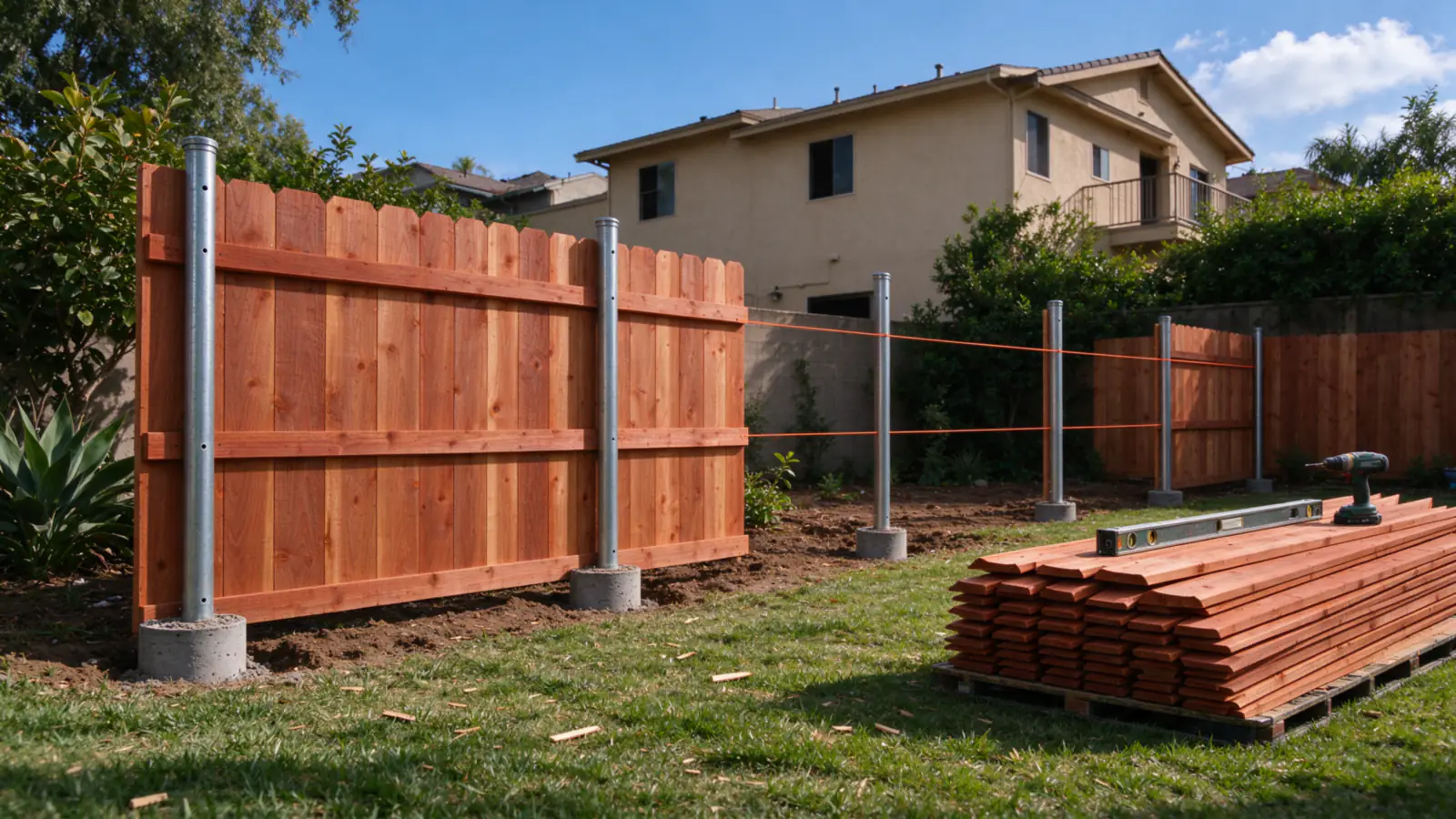
Most fences around Ontario homes land between $18 and $100 per linear foot installed, depending mostly on material. A 6-foot redwood or cedar privacy fence typically runs $30 to $70 per foot, vinyl $35 to $75 and up, ornamental steel, iron or aluminum $35 to $100, and chain link $18 to $38. Gates, tear-out and the permit are priced on top. These are typical Southern California budgeting ranges, not quotes.
Grove Ontario Fence Builders installs, replaces and repairs fences across Ontario and the west Inland Empire, with the work carried out by licensed and insured fence contractors. This guide explains what sits inside those per-foot numbers, why two yards of the same length can price differently, and which local costs, such as the City of Ontario permit, have public figures you can check yourself.
Typical installed ranges per linear foot
These are typical Southern California ranges for installed fencing, materials and labor together, at normal access and in workable soil. They are budgeting figures, not a company rate and not a quote.
| Fence type | Typical installed range per linear foot | Where a job lands in it |
|---|---|---|
| Wood privacy fence, 6 ft, redwood or cedar | $30 to $70 | Board-on-board styles, redwood and rocky or sloped runs push toward the top |
| Vinyl privacy fence, 6 ft | $35 to $75 and up | Heavier tongue-and-groove systems, reinforced posts and decorative tops can run past the top |
| Wrought iron, tubular steel or aluminum | $35 to $100 | Height, picket spacing, post style, finish and on-site welding |
| Chain link, 4 to 6 ft | $18 to $38 | 4 ft galvanized sits low; 6 ft and vinyl-coated fabric sit high |
| Old fence removal and haul-away | $3 to $8 | Posts set in large concrete footings and bulky panels cost more to remove |
The spread inside each band is real, not padding. A straight 6-foot redwood run on a flat backyard with open side access and no old fence to remove is a different job from the same length climbing a grade, dodging a mature tree’s roots and meeting the house at a gate. The second job uses more posts, more cuts and more hours, which is where the top of the band comes from. If you want a number for your own yard before calling anyone, the fence cost estimator uses these same bands.
What moves a price within the range
Every fence quote starts with footage and material, but those two rarely explain the whole difference between quotes. The table below covers the drivers that matter most in Ontario, with the local reason each one moves.
| Driver | Why it changes the price | What it looks like in Ontario |
|---|---|---|
| Linear footage | Sets the post count, the material order and most of the labor | Many Ontario tracts were built with block walls on the side and rear lines, so the fenced footage may be a return wall, a gate opening or a topper rather than a full perimeter |
| Fence height | Taller panels need longer, heavier posts and bigger footings | Side and rear fences top out at 6 ft under the city code, front-yard fences at 3 ft |
| Material and system | Sets the per-foot base in the table above | Wood, vinyl, iron and block are the city’s standard residential palette |
| Post spacing and depth | Closer spacing and deeper footings add posts, concrete and digging time | Depth is set by height, wind and soil, so a solid 6-ft privacy fence usually needs more than an open iron fence |
| Soil | Loose sand sloughs into post holes, so footings rely on depth and diameter rather than soil grip | Much of central Ontario is mapped as Tujunga loamy sand and Ontario Ranch as Delhi fine sand (USDA Web Soil Survey) |
| Slope | Racking or stepping panels means more cuts, longer posts and more layout time | Mostly flat valley floor in Ontario; grade changes between lots are more common on the north side of the region |
| Gates | Each gate needs heavier posts, hardware and adjustment | Side-yard walk gates, double drive gates and RV gates are priced separately (see below) |
| Tear-out and disposal | Old posts, concrete and panels have to come out and be hauled away | $3 to $8 per foot, more for posts in big concrete footings |
| Access | Long carries through a side yard or over a wall slow every step | Where a lot has one narrow side yard and no rear access, posts, concrete and panels are carried in by hand |
| Property line or survey | A disputed or unclear line can need a surveyor before layout | No public fee figure; see the property line guide |
| HOA and permit requirements | Approval steps, required materials and plan sheets add time and cost | Ontario permits most fences over 3 ft; Ontario Ranch specific plans add their own rules |
| Pool-barrier requirements | Height, gap limits and self-closing gates narrow the product choice | Ontario requires a 5-ft nonclimbable enclosure around pools and spas |
| Decorative caps and trim | Cap rails, post caps and trim boards add material and labor per foot | Street-facing block walls in Ontario need a decorative cap, not a grout cap |
| Staining or painting | A finish adds a separate labor step and material | Long hot, dry summers break finishes down faster, so many owners budget for it |
| Welding and fabrication | Custom iron, on-site welding and powder coating take shop and field time | Most common on iron fences, gates and toppers over existing block |
| Tree and root conflicts | Posts may need to shift or be hand-dug around roots | Matters wherever a mature tree sits near the fence line |
Two drivers that matter elsewhere barely apply here. Frost depth is not a design factor on the valley floor: NOAA’s climate normals for Ontario International Airport show about 1.7 nights a year at or below freezing, so posts are sized for wind, height and soil rather than a frost line. And the coastal salt corrosion that shortens hardware life near the ocean is not a local issue this far inland.
What’s inside an Ontario fence price
A contractor’s price bundles labor, materials, permits and overhead. Several of those parts have public figures you can look up, and the rest are scope items to confirm in writing.
| Part of the price | What sets it | Local figure |
|---|---|---|
| Installer labor | Local wages, hours on site, crew size | Fence erectors in the Riverside-San Bernardino-Ontario metro earn a mean $26.95 an hour, versus $24.29 nationally, about 11% higher; the median is $26.47 versus $23.07 (BLS OEWS) |
| Code-required materials and heights | Ontario Development Code Division 6.02 | Side and rear fences up to 6 ft, front yard up to 3 ft; street-facing walls in decorative masonry with a decorative cap; metal fences limited to ornamental iron or tube steel, chain link or heavy wire mesh (Development Code) |
| Structural design | City design criteria for wind and soil | Information Bulletin 103 sets wind Exposure C and a 110 mph design wind speed for residential work, which drives post and footing size (IB 103) |
| Building permit and plan check | Project valuation assigned by the city | Valuation-based fee, $47.50 minimum, plus plan check at 80% of the permit fee when plans are reviewed and a small state earthquake fee (City of Ontario fees) |
| Utility locate | Government Code 4216.2 | A free DigAlert ticket, requested at least two working days before digging (DigAlert) |
| HOA or specific plan approval | Tract CC&Rs and the specific plan for the subdivision | Ontario Ranch plans can require particular materials; any review fee is set by the association, not the city |
| Survey | Whether the line is clear and agreed | No public figure; scope to check when the line is in doubt |
| Sprinkler, landscape and hardscape repair | What the fence line crosses | No public figure; confirm who reroutes irrigation and restores planting or concrete |
| Debris and old footings | How the old fence was set | Covered by the removal range above; ask whether old concrete footings come out or are cut below grade |
A wage is not a billing rate. The rate a contractor bills also carries insurance, licensing, vehicles, disposal and overhead, so the BLS figure explains direction, not a per-hour charge. It does explain part of why local prices sit above national averages: the mean fence-erector wage in this metro runs about 11% higher than the national mean.
Permit fees in Ontario and nearby
The permit and height rules guide explains when each city requires a permit. For budgeting, here is what each authority charges for a typical residential fence.
| Where the property is | When a permit is needed | Fee |
|---|---|---|
| City of Ontario | Wood, chain link and wrought iron fences and block walls over 3 ft | Set by valuation under the city’s Table A, minimum $47.50, plus plan check at 80% and a small state fee. Example: a project valued at $6,000 carries a $125.25 permit fee, about $226 with plan check. Confirm the actual fee with the Building Department at (909) 395-2023 |
| Unincorporated San Bernardino County | Residential chain link, wood or wrought iron fencing | $117 flat permit fee plus a $57 intake fee, $174 in all, one inspection included (County Land Use Services); block walls are charged by wall area |
| Rancho Cucamonga | Fences over 6 ft; masonry walls and pilasters over 3 ft | No building permit for a typical fence up to 6 ft (city handout) |
| Chino Hills | Fences over 6 ft or heavier than 3 lb per sq ft; most property-line block walls | No building permit for a light fence up to 6 ft (city exemptions list) |
The Ontario example is arithmetic on the city’s published table, not a quote. The city assigns the valuation, so the same 6-foot fence can carry a different fee depending on its length and material. Because Ontario’s threshold is 3 feet, nearly every backyard privacy fence in the city needs a permit, which is a real difference from Rancho Cucamonga and Chino Hills.
Gates and work priced by scope, not by the foot
Some work does not have a dependable per-foot range, because it varies too much from one property to the next. These items are priced from the scope, and the drivers below are what move them.
Walk gates and drive gates
A side-yard walk gate is priced by width, frame material, hinges and latch, and the size of the posts it hangs from. Gate posts carry a cantilevered load that line posts never see, which is why an undersized post in loose sand is a classic cause of a sagging gate. Double drive gates and RV gates often span 12 to 16 feet, so post size, footing depth, a wheel or drop rod, and whether the gate swings or slides all change the number. Adding an automatic opener brings in the operator’s duty rating, a power run that may need an electrician and trenching, and UL 325 safety devices such as photo eyes.
Pool fencing
A pool fence is priced by footage and material like any other fence, but the barrier rules narrow the choices. Ontario requires a nonclimbable enclosure at least 5 feet tall, and state law limits gaps and sets latch height, so self-closing, self-latching gate hardware and tight picket spacing become required parts of the price rather than options.
Horizontal slats, privacy slats and pine or fir
A horizontal fence uses more boards per foot, tighter post spacing to keep long boards from sagging, and often a frame and a finish on both sides. Privacy slats in chain link vary by slat type, fence height and mesh size. Pine and fir pickets cost less than redwood or cedar, but board width and grade often matter more than the species name, so they are best treated as the low end of the wood range rather than a separate number.
Repairs and block walls
Fence repair depends on how many posts are involved, whether old concrete footings have to come out, whether the old material can be matched, and access. A block wall is a masonry job with a continuous footing, rebar and grout, and it costs far more per foot than any fence material; the block wall vs fence guide compares the two.
Large lots, horse properties and long runs
Large-lot fencing changes the math because quantity and terrain take over. Ontario’s AR-2 zone has a 100-foot minimum interior lot width under the Development Code, against 50 feet in LDR-5, so a perimeter on a large lot can run several times the footage of a tract backyard. Length is only the start. Every corner and end needs a heavier terminal post and bracing, every change in grade adds layout time, and every access gate for a truck, trailer or tractor needs its own wide opening and posts sized for it.
The rules shape the design too. In the AR-2 and RE-2 zones, the Development Code requires an 8-foot equestrian trail easement along the front property line, and a fence at the edge of that easement is limited to 48 inches, rising 1 inch for every 2 inches it sits back, and no more than 50% solid within 4 feet of the easement. Low rail or plank fencing is the preferred style there. Where animals are kept, they must be contained by a fence or wall at least 5 feet high when outdoors. A horse fence on a large lot is therefore priced by its run length, corner count, terrain and gates far more than by a per-foot material rate.
An illustrative budget
This example is built only from the ranges above and is labeled as illustrative. It is not a quote.
Picture 150 feet of 6-foot redwood privacy fence along the side and rear lines of a flat backyard, replacing an old wood fence. At $30 to $70 per foot, the fence itself comes to about $4,500 to $10,500. Removing and hauling away the old fence at $3 to $8 per foot adds about $450 to $1,200. The permit is added on top, using the valuation the City of Ontario assigns, and so is each gate, priced by its own scope. A sloped run, a long hand carry or posts set in large old footings would move the total toward the top of each range; a straight run with open side access would sit lower.
Rebates and incentives
No rebate, grant or incentive program for fence installation was found for Ontario homeowners. Utility and water-conservation programs in the region fund other upgrades, not fences, so plan the budget without one.
Before you compare quotes
Two quotes for the same yard can differ by thousands of dollars because they describe different work. Line them up item by item: footage and height, post material and spacing, how the posts are set, the number and width of gates and their hardware, removal and haul-away, the permit and who pulls it, and cleanup. If the fence runs along a shared line, California’s Civil Code 841 lets you ask the neighbor to share the cost after 30 days’ written notice; the good neighbor fence law guide explains the notice. In Ontario Ranch, the HOA approval guide covers the extra review step. If you are still choosing a material, the vinyl vs wood comparison weighs the long-term costs.
When you have a rough footage and a material in mind, call Grove Ontario Fence Builders at (909) 324-5352 or request an estimate to turn the range into a scope for your property. You can also see how the work runs on the fence replacement page.
Get a fence price for your Ontario property
Share the footage, height and material you have in mind, plus any gates, to start an estimate for your property.