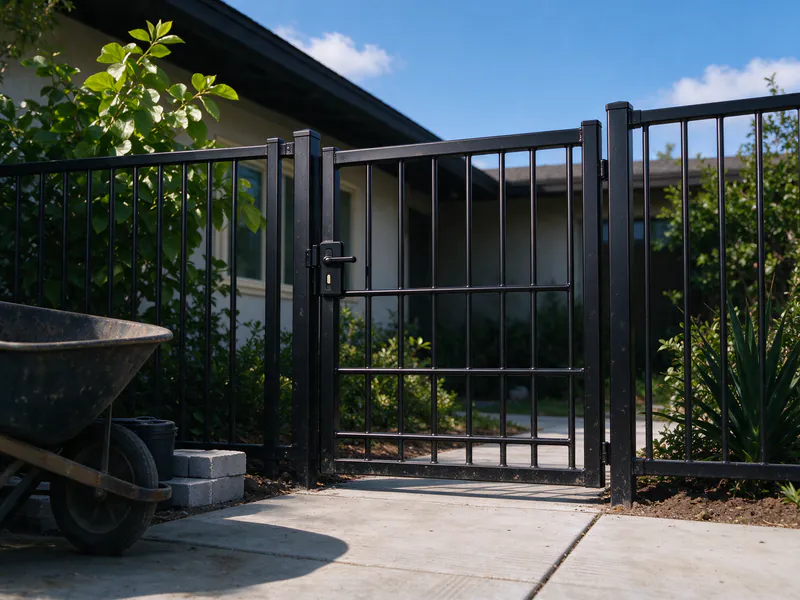
Gate installation in Ontario, CA is mostly a question of support: a gate is the only part of a fence that hangs its full weight off one post and moves every day. Grove Ontario Fence Builders builds and repairs walk gates, side-yard gates and double gates across Ontario and the west Inland Empire, in wood, steel-framed wood, tubular steel, aluminum and vinyl. Installation is carried out by licensed and insured fence contractors. This page explains why gates sag, what the posts and frame have to do, which hinges and latches suit which gate, and when an existing gate can be adjusted instead of replaced.
A good gate closes square, latches without being lifted and stays that way through years of wind, sprinkler spray and daily use. A poor one starts dragging within a season. The difference is almost never visible on the day it is hung.
What happens on the first visit
The visit starts at the opening. Its width is measured between the posts or walls that will hold the gate, and the ground under the swing path is checked, because a gate that swings uphill hits the grade before it opens fully. The direction of swing gets settled next: into the yard, away from a pool, clear of a hose bib, a downspout or an air conditioner pad. Where a gate replaces an old one, the existing hinge post is checked for lean, rot at the ground line and how it was set.
Purpose shapes everything else. A gate used by people alone, a gate that passes trash bins every week and a gate that has to admit a vehicle are three different builds, and the last belongs with RV and driveway gates. If the gate is part of a pool barrier, the hardware rules apply from the start. And if the gate is part of new fence work, the permit and a DigAlert ticket come into the schedule, since Government Code 4216.2 requires the call at least two working days before post holes are dug; the fence installation process guide shows where that fits.
Why gate posts need more than line posts
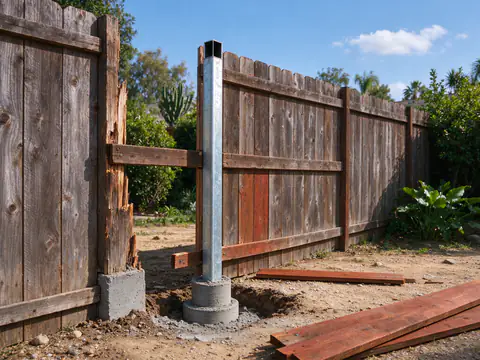
A line post holds up its share of the fence. A hinge post holds the whole gate out to one side like a lever, so the top of the post is pulled toward the latch while the bottom is pushed the other way, and that twisting load never stops. Add wind on a solid face and every gust tries to rotate the post in its footing. That is why the hinge post on a well-built gate is usually larger or stronger than the line posts beside it, and why it sits in a bigger footing.
Soil decides how hard the footing has to work. USDA soil survey data puts much of central Ontario on Tujunga loamy sand, about 80 percent sand, and Ontario Ranch on Delhi fine sand at roughly 96 percent sand. Both drain well and hardly swell, but loose sand gives a post less grip than firmer ground, so a post that would hold in Rancho Cucamonga’s Hanford coarse sandy loam can slowly lean here. Footing depth and width follow from the gate’s width and weight, the post material and the soil; there is no single correct number. A steel hinge post, or a treated wood post rated for ground contact, set in a crowned concrete footing is the usual answer, and the steel vs wood posts guide compares the two.
The latch post matters too. If it moves, the gap at the latch opens and closes with the seasons, and the latch stops catching. On a double gate, where two leaves meet in the middle, both posts carry a full leaf.
Gate frames, hinges and latches
The frame
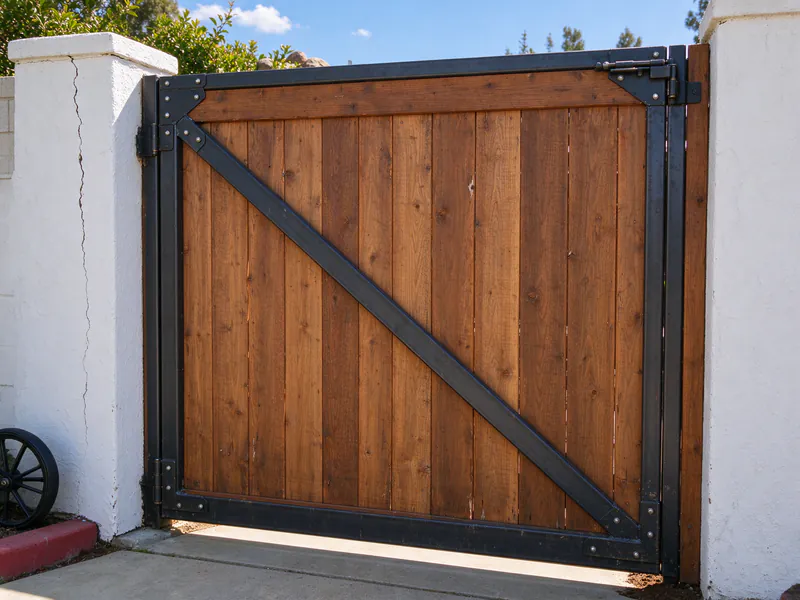
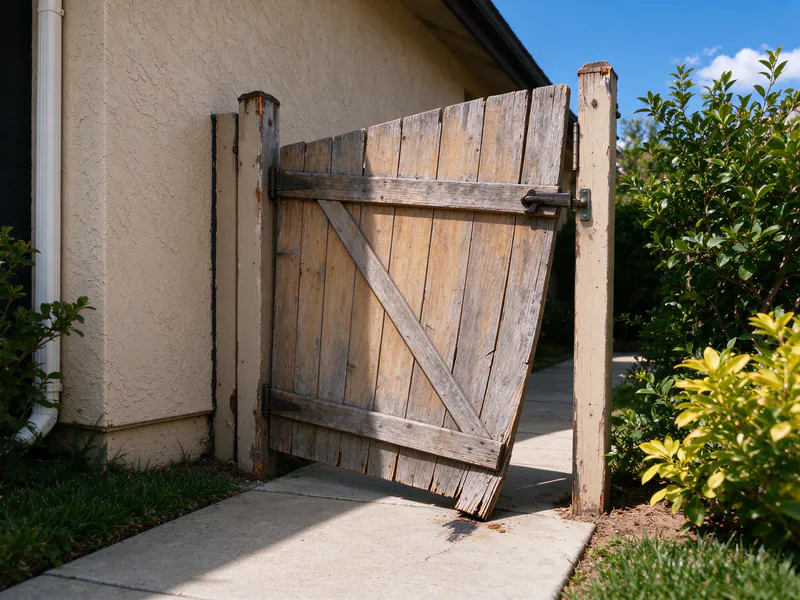
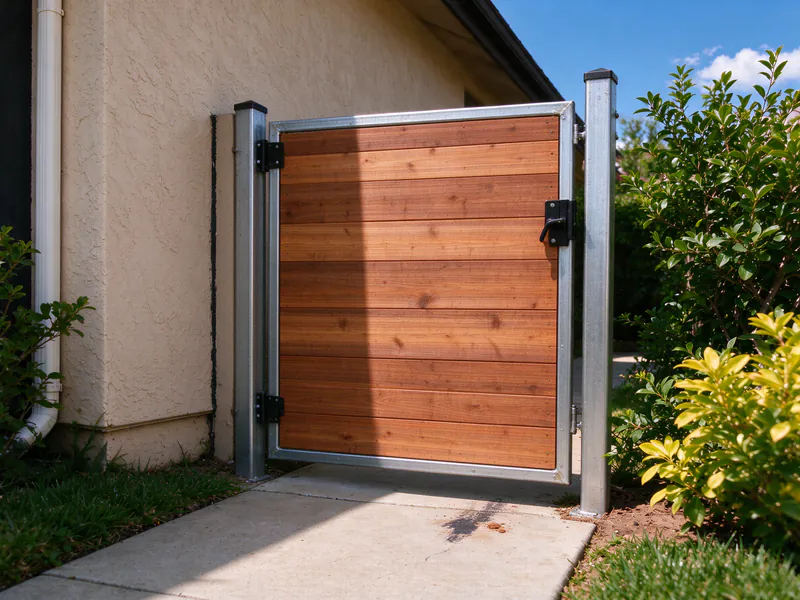
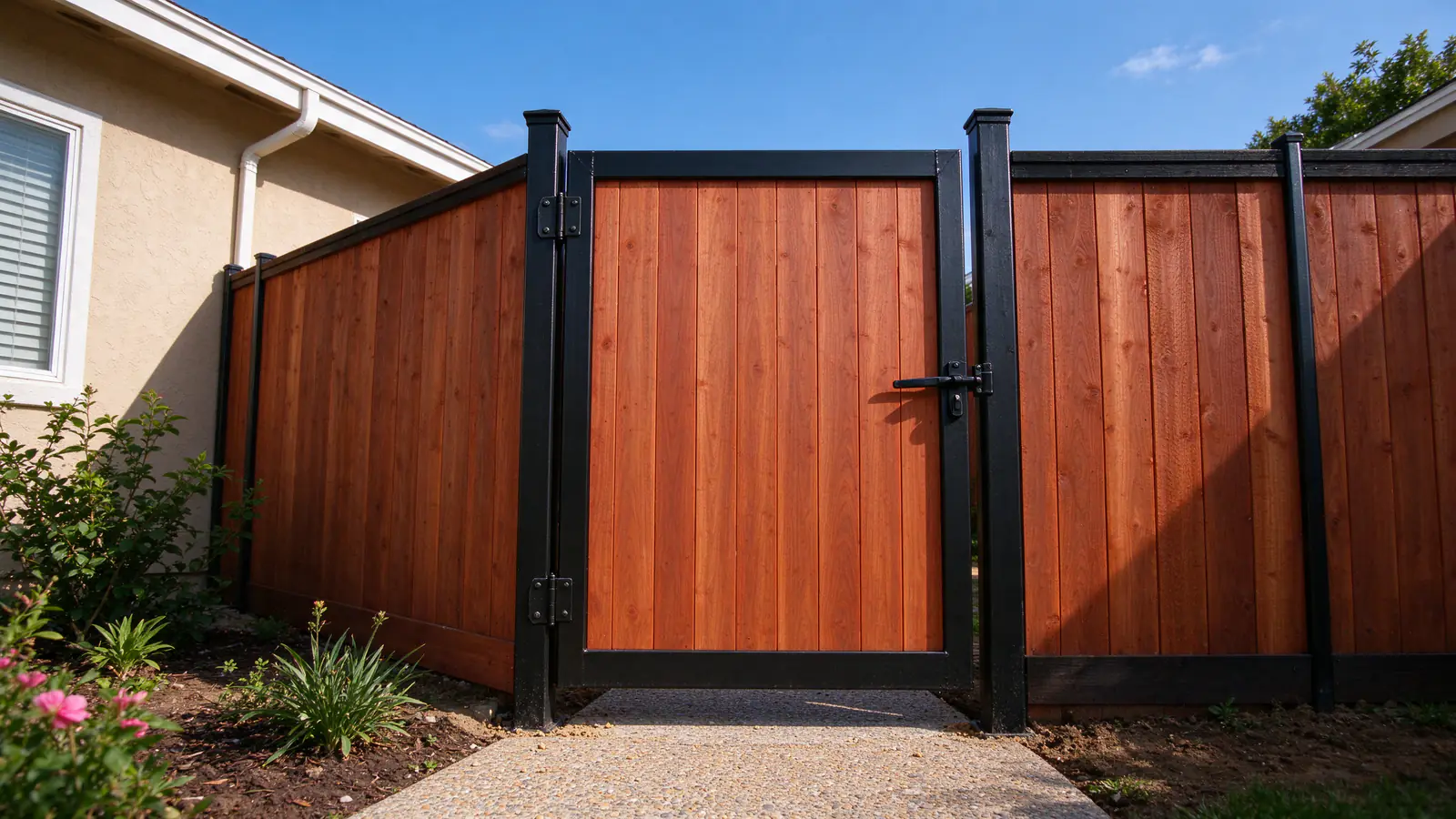
A wood gate frame is a rectangle that wants to become a parallelogram. The cure is a diagonal brace running from the bottom corner on the hinge side up to the top corner on the latch side, so the brace is in compression and pushes the latch corner up. Installed the other way it does almost nothing. Wood also shrinks as it dries in Ontario’s long summers, and the joints loosen with it. A welded steel frame with wood boards attached avoids both problems, which is why wide wood gates and gates that get heavy use are often built that way. Rancho Cucamonga goes further and lists solid wood with steel frames among the allowed materials for screening fences and gates in residential districts. Tubular steel and aluminum gates are framed in metal from the start, and a vinyl gate depends on the metal insert inside its frame.
Hinges
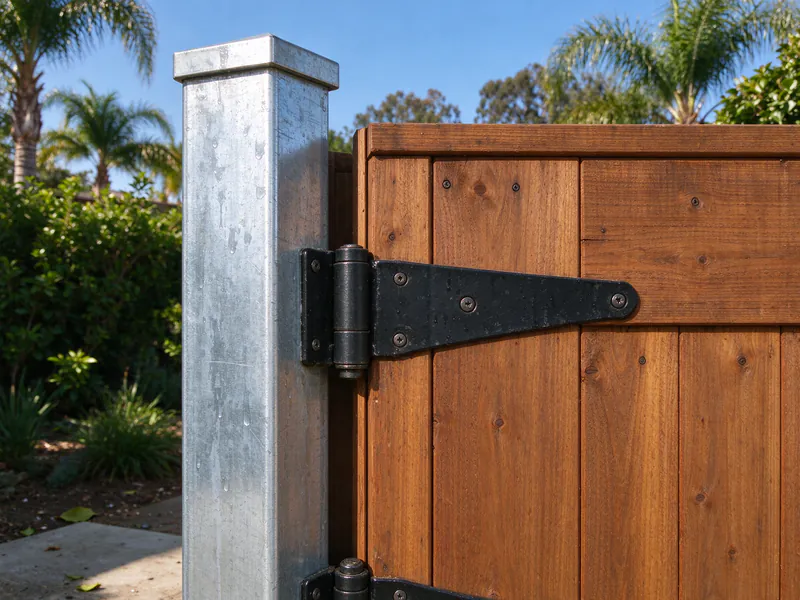
Hinges have to match the gate’s weight and width. Heavy strap or adjustable hinges, three of them on a tall gate, spread the load better than two light ones, and adjustable hinges let a small drop be taken out later without rehanging the leaf. Self-closing spring hinges pull a gate shut on their own; for a pool gate they are part of the barrier, not an extra.
Latches, stops and drop rods
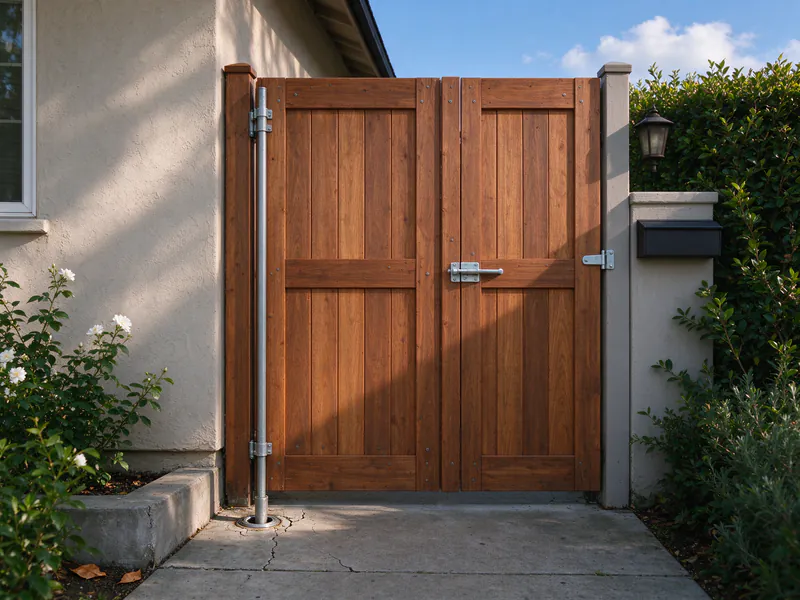
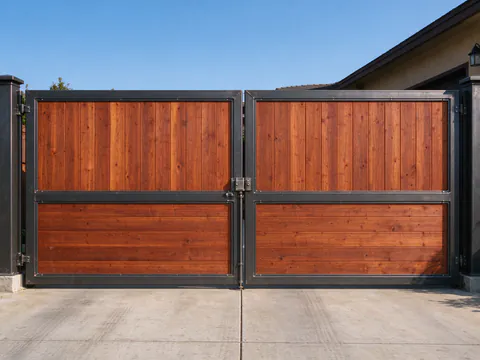
A gravity latch catches on its own when the gate swings closed. Lockable and two-sided latches let the gate be opened from the street side with a key or pull cord. A gate stop keeps the leaf from swinging past the latch post, which protects the hinges from being wrenched by wind or a hard push. On double gates, one leaf is held by a drop rod that drops into a sleeve set in the ground or into concrete, and the other leaf latches to it. A cane bolt holding a gate open on a windy day saves both the hinges and the stucco behind it.
Start with the opening
Send the width between the posts, a photo of both posts and which way the gate should swing.
Pool gates and the self-closing rule
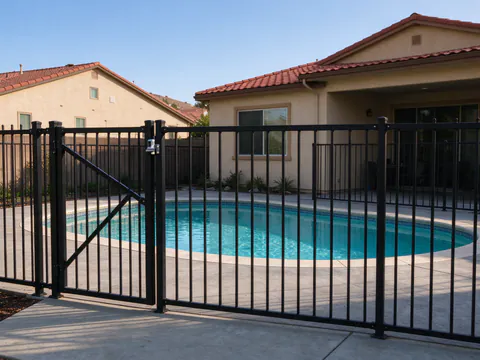
If a gate opens into a pool area, it is part of the pool barrier and the rules are specific. California Health and Safety Code 115923 and the City of Ontario’s Information Bulletin 114 describe enclosure gates that open away from the pool, close and latch on their own, and carry the release at least 60 inches above the ground. Ontario’s Development Code also requires any pool, spa or decorative water more than 1.5 feet deep to be enclosed by a decorative nonclimbable fence or wall at least 5 feet tall with decorative gates. The pool fence page covers the whole enclosure, and the California pool fence requirements guide sets out the state rule. Barrier rules are checked against the specific pool and permit, and no gate is described as compliant until it is inspected.
Gate repair: adjust, rebuild or replace
Many gates can be saved. The question is which part failed, and the symptoms point the way.
- The latch no longer lines up, but the gate is still square. Usually the hinge post has leaned or a hinge has worn or loosened. Tightening or replacing the hinges helps only if the post is solid and plumb.
- The gate has racked into a parallelogram. The frame has loosened or was never braced correctly. Re-squaring and adding a brace, or fitting an anti-sag cable with a turnbuckle, can bring it back.
- The hinge post moves when the gate is pushed. The footing has lost its grip or the post has rotted at the ground. The post is reset or replaced before any hardware work.
- Rails are split, rotted or full of termite damage. The leaf is rebuilt, often on a steel frame, and hung on the existing post if that post is sound.
When the post, the frame and the boards have all failed together, a new gate is usually the better spend. The sagging gate guide walks through the checks in more detail. A gate repair that turns up broader trouble, such as several leaning posts along the same run, becomes a fence repair question, and a fence worn out from end to end belongs with fence replacement.
Ontario rules that touch a gate
The City of Ontario’s Building Permit FAQ requires a permit for wood, chain link and wrought iron fences and gates over 3 feet, and Development Code 6.02.005 puts the design and location of every gate under Planning review, permit or not. Gates in a front yard are held to the same 3-foot limit as the fence around them. Many newer Ontario tracts were built with decorative masonry return walls between the side-yard wall and the house, with access gates in them, so a replacement gate there often hangs from masonry, and the hinge anchors need grouted block or a steel post. Ontario Ranch HOAs may also set gate materials and colors; the Ontario Ranch page covers those tracts, and the Ontario fence permit guide covers the city rules.
Wind is the other local load. Solid gates catch the same Santa Ana gusts as the fence around them, but they hang on hinges rather than being fixed on both ends, so a latch that does not hold lets a gate slam until something breaks. The Santa Ana wind guide explains what a gust does to a fence line.
What sets the price of a gate
Gates are priced as their own items, not by the foot, and no single figure covers them. Width comes first, since it sets the leaf’s weight and the post and footing size. Frame material, a solid or open face, the hinge, latch and self-closing hardware, whether the gate hangs from a new steel post or existing masonry, and any welding or custom fabrication all move the number. Repairs are priced by what failed: a hinge swap is a small job, while a post reset involves breaking out an old footing. The fence cost estimator adds gates to a fence range, and the Ontario fence cost guide explains how gates sit on a quote alongside the fence.