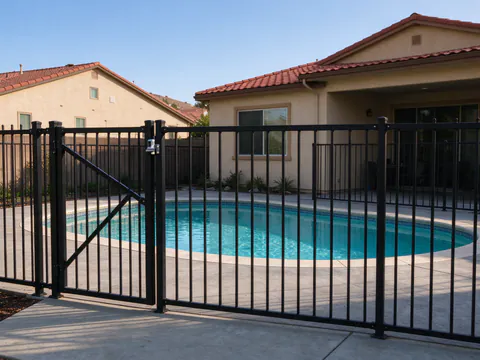
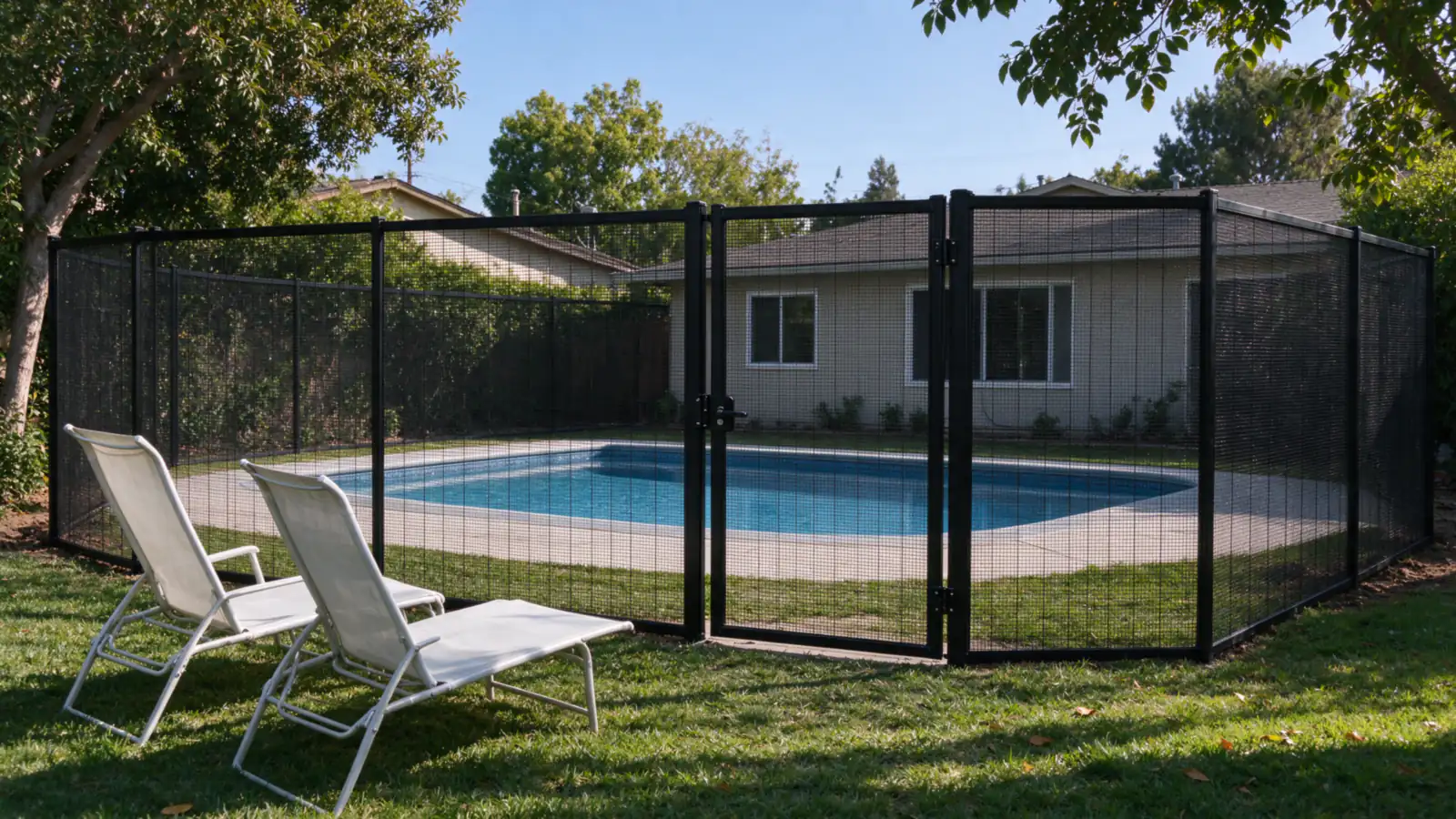
California requires a new or remodeled pool or spa at a single-family home to have at least two of seven drowning-prevention features, and an enclosure that counts must be at least 60 inches tall with self-closing, self-latching gates. The City of Ontario goes further: any pool, spa or pond over 18 inches deep must be fully enclosed by a decorative nonclimbable fence or wall at least 5 feet tall.
Grove Ontario Fence Builders designs and installs pool fences and gates across Ontario and the west Inland Empire, with the work carried out by licensed and insured fence contractors. Pool barrier rules are code-sensitive, and no fence product meets every city’s rules just by being labeled a pool fence. This guide sets out the state law, Ontario’s own rule, the city’s inspection timing and the federal guidelines behind the numbers, so a barrier can be planned before the pool schedule is fixed.
The state rule: two of seven features
The Swimming Pool Safety Act applies when a building permit is issued for a new pool or spa, or for remodeling one, at a private single-family home. Health and Safety Code 115922, in its current form since January 1, 2025, requires at least two of these features:
| Feature | What it is |
|---|---|
| Enclosure | A fence, wall or barrier meeting section 115923 that isolates the pool from the home |
| Removable mesh fence | Meets ASTM F2286, with a self-closing, self-latching gate that accepts a key lock |
| Safety cover | Labeled to ASTM F1346 |
| Exit alarms | On the doors and windows that give direct access to the pool |
| Self-closing, self-latching door devices | With the release at least 54 inches above the floor |
| Pool alarm | Meeting ASTM F2208, sounding when someone enters the water |
| Equivalent feature | Another means verified by an independent lab as equal to or better than the above |
Not every pair counts. The statute says an exit alarm and a self-closing device on the same door do not make two features, and neither does a safety cover paired with a pool alarm. A fence contractor’s work usually delivers the enclosure or the mesh fence, and the second feature is often a cover or the door hardware.
What an enclosure has to measure
Section 115923 sets the enclosure dimensions, and each one exists to stop a small child in a specific way.
| Requirement | Number | Why it is there |
|---|---|---|
| Height | At least 60 inches | Too tall for a toddler to reach the top |
| Gap at the bottom | No more than 2 inches to grade | Stops a child crawling under |
| Openings | None that pass a 4-inch sphere | Roughly a young child’s head width |
| Outside face | No handholds or footholds | Stops climbing |
| Gates | Open away from the pool, self-close and self-latch | A child pushing on a loose gate closes it |
| Latch height | At least 60 inches above the ground | Out of reach from outside |
Health and Safety Code 115921 defines the enclosure as a barrier that isolates the pool from the home. That is why a design that uses the back wall of the house as one side usually leans on door alarms or self-closing door devices as its features instead.
Ontario’s rule is stricter
The city’s zoning code does not leave the fence as one option among seven. Section 6.02.020.A.3 of the Ontario Development Code requires any swimming pool, hot tub, spa, pond or decorative body of water more than 1.5 feet deep, above or below ground, to be fully enclosed by a decorative nonclimbable fence or wall at least 5 feet tall, with decorative gates, built to the building code.
Three things follow. A koi pond or deep water feature counts, not just a pool. An above-ground spa counts. And “decorative” rules out bare chain link as the finished barrier in most backyards. Where a pool sits near a property line, the barrier may be the side or rear fence itself, so the property line guide matters, and so does height: Ontario caps side and rear fences at 6 feet, as the Ontario permit guide explains.
When the fence has to be finished
Ontario’s Information Bulletin 114 restates the two-of-seven list for new and remodeled pools and spas and adds the timing: the enclosure and drowning-safety measures must be installed at the pre-plaster inspection. On a new pool, the fence is therefore a step inside the pool contractor’s schedule, not something to arrange after the water goes in. Gate posts need their footings cured before gates are hung and adjusted, so the fence work starts well before the plaster date.
Federal CPSC guidelines as background
The U.S. Consumer Product Safety Commission publishes Safety Barrier Guidelines for Home Pools. They are guidance, not California law, and where the state or Ontario sets a higher number, such as 60 inches instead of the 48-inch minimum the guidelines recommend, the local rule controls. The guidelines are most useful for the details the statute leaves general:
- Where horizontal members of a fence are less than 45 inches apart, they belong on the pool side, and vertical spacing should not exceed 1¾ inches, about a child’s foot width.
- Where horizontals are 45 inches or more apart, vertical spacing can go up to 4 inches.
- Chain link mesh should not exceed 1¼ inches square unless slats reduce the openings to 1¾ inches.
- Lattice openings should not exceed 1¾ inches.
- A gate release lower than 54 inches should sit on the pool side, at least 3 inches below the top, with no opening over ½ inch within 18 inches of it.
Those spacing rules explain why a horizontal slat fence or a wood fence with its rails facing out is a poor pool barrier, and why ordinary chain link mesh is too easy to climb.
Choosing a material that meets the numbers
Tubular steel and aluminum picket fences are the usual answer because their picket spacing is set at the factory and the rails can be kept on the pool side. The wrought iron vs tubular steel vs aluminum guide compares those metals, including how each handles chlorine splash. Solid vinyl or wood privacy panels can serve as a barrier if the outside face is smooth, but a 6-foot solid panel next to a pool also catches Santa Ana wind; the Santa Ana winds guide explains what that does to posts. A decorative block wall meets the climbability rule as long as its face has no ledges or protrusions.
Gates are where most barriers fail in use. Self-closing hinges lose tension, latches drift out of line as a post settles, and a gate that no longer swings shut on its own is no longer compliant. In the sandy soils much of Ontario sits on, gate posts need footings sized for that cantilevered load. The gate installation page covers hardware and posts, and the pool fence installation page covers the full barrier.
Outside the City of Ontario
The state statute applies everywhere in California, including unincorporated San Bernardino County, but each city and the county can add local rules through their own codes. Those local pool-barrier rules were not reviewed for this guide, so they are confirmed per address with the jurisdiction that issues the pool permit. The Rancho Cucamonga area page and the Chino Hills area page cover those cities’ general fence rules.
Cost and next steps
Pool fencing has no dependable per-foot range, because the rules narrow the product and add hardware that a plain fence does not need. Footage, material, the number of gates, self-closing and latching hardware, and the picket spacing all move the price, as the fence cost guide explains. To plan a barrier around your pool’s permit and inspection dates, call Grove Ontario Fence Builders at (909) 324-5352 or request an estimate.
Planning a pool barrier?
Send the pool layout, the gate locations and the inspection date if you have one. The barrier is planned around that schedule.