
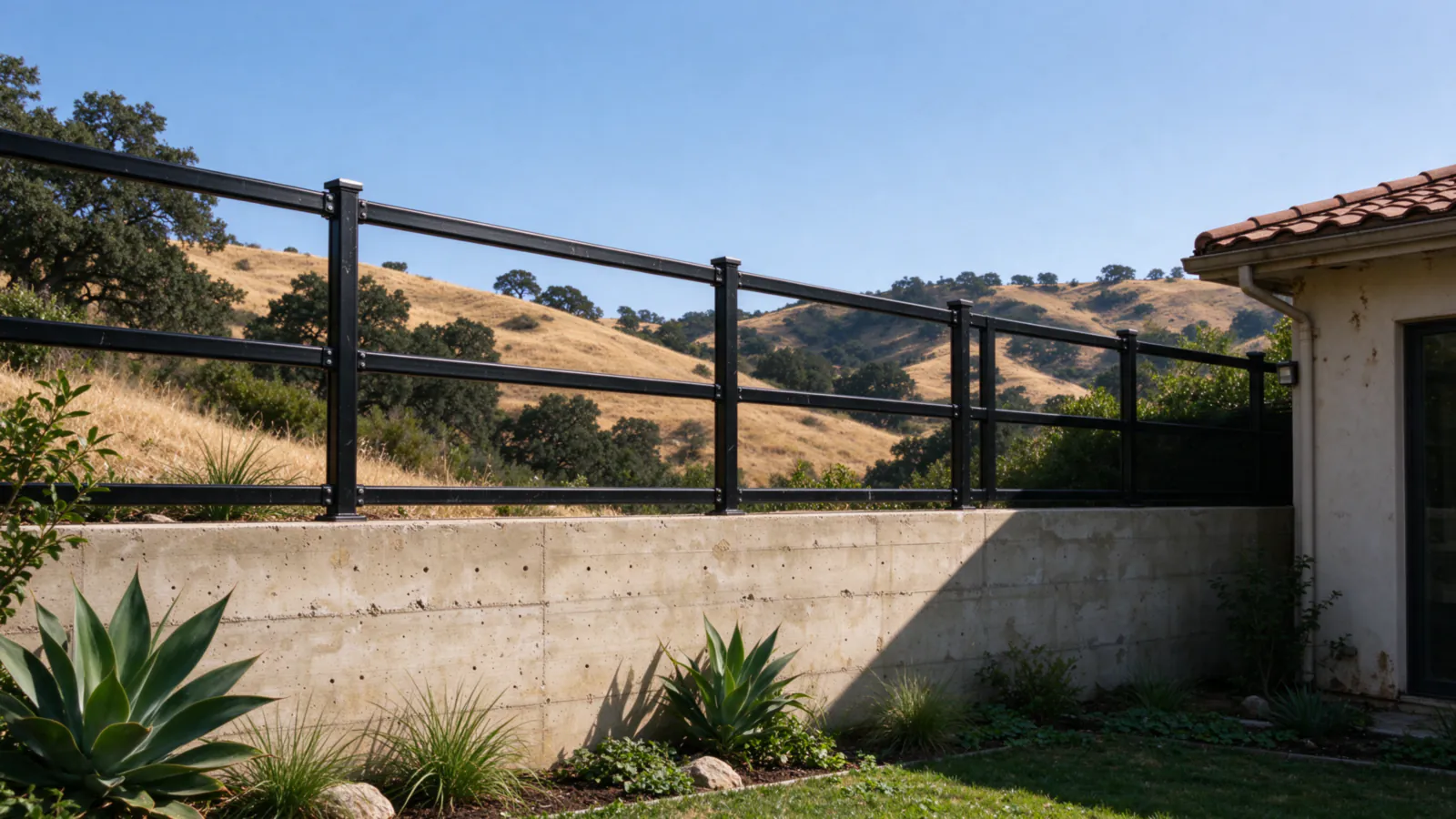
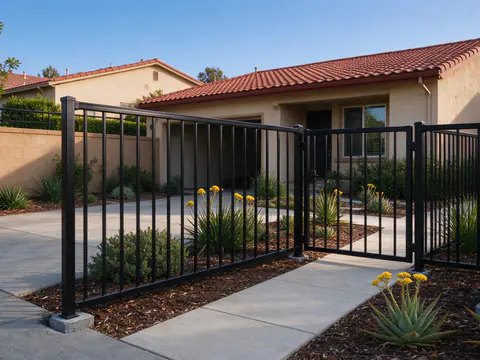
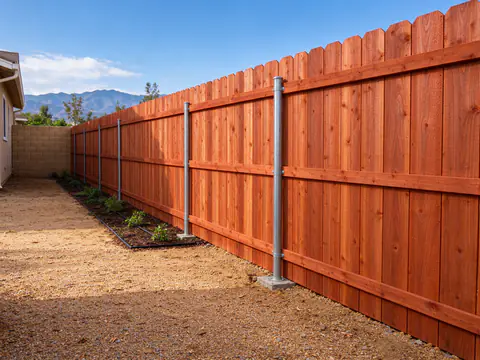
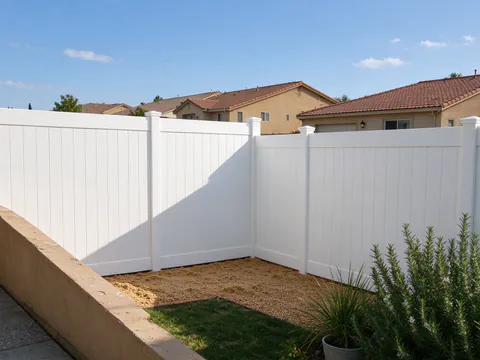
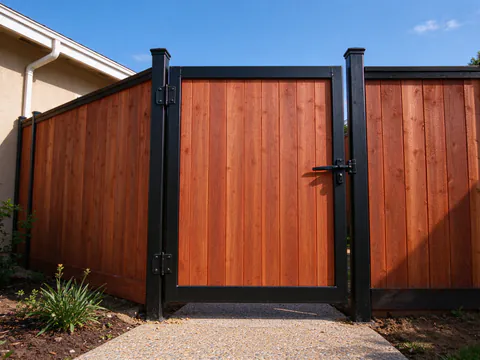
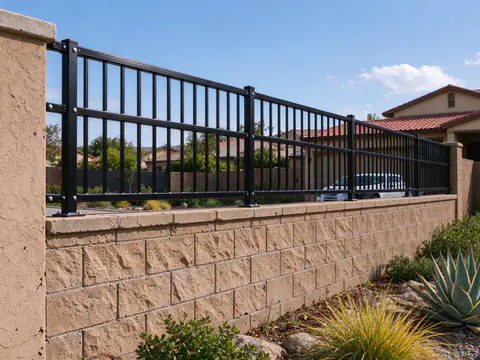
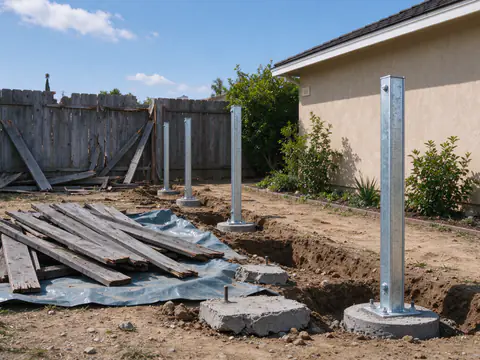
Chino Hills fences are hillside fences. USDA soil survey data maps sample points in the city as Fontana clay loam on 15 to 50 percent slopes, with soft bedrock about 28 inches down, and CAL FIRE’s hazard map puts roughly 73 percent of the land inside city limits in the Very High fire hazard zone. Grove Ontario Fence Builders plans fencing in Chino Hills around those conditions: tubular steel, iron, wood and vinyl fences, gates, and fence work on block and retaining walls, from Los Serranos and Butterfield Ranch to Carbon Canyon, Vellano and Rolling Ridge. Licensed and insured fence contractors carry out the installation. The city’s building handouts set the permit side of the job, and they draw sharp lines between a light fence, a block wall and a retaining wall.
What the slope and the bedrock change
Fontana clay loam behaves nothing like the sand of the valley floor around Ontario. It is about 31 percent clay with a moderate shrink-swell rating, so it swells as it wets and shrinks as it dries, though it drains well. Under it, the survey places paralithic, or soft, bedrock at a typical depth of about 71 centimeters, roughly 28 inches. Those numbers describe mapped soil units rather than any one lot, but they explain what a hillside post hole can run into.
Where rock sits within 2 or 3 feet, a standard auger may stop short, and the hole is finished with a rock auger or core drill. The footing may end up shallower than it would on the valley floor but socketed into the rock, which changes how it resists a push. Clay that moves with the seasons can work a shallow post loose over time, so footing size follows the soil as much as the fence. The grade decides how panels go in: on a steep side yard, a fence either steps down in level sections or racks to follow the ground, and the triangle of open space under a stepped panel has to be closed if a dog depends on it. Gates are the hardest part. A gate swinging downhill needs clearance across its arc, and its post carries a cantilevered load in soil that moves, which is why the gate installation page treats post and hinge sizing as part of the gate. The installation process guide explains stepping and racking in more detail.
Building inside a Very High fire hazard zone
CAL FIRE’s hazard zone map classifies about 73.3 percent of sampled land inside Chino Hills as Very High and another 9.7 percent as High, so most homes here sit inside the zone rather than at its edge. Government Code 51182 requires owners of homes in a Very High zone to keep 100 feet of defensible space, including an ember-resistant zone within 5 feet of the structure under rules from the State Board of Forestry and Fire Protection. The Board’s draft regulations for that 5-foot zone would prohibit new combustible fences there and require a noncombustible section, such as a metal gate, where a fence attaches to the house. Those rules are not final, so the current requirement is confirmed per address. The city’s own exemption list also notes that accessory structures must still comply with the California Fire Code and the California Wildland-Urban Interface Code.
The practical answer is a change of material at the house. A wood or vinyl privacy run can stop at a steel post a few feet out, with a tubular steel or iron gate or section closing the gap to the wall. Built that way now, the fence will not need rework if the draft rules take effect. The wildfire zone fence guide compares how each material behaves, and dry brush packed against any fence line works against defensible space whatever the fence is made of.
Light fences, block walls and retaining walls
Chino Hills’ Work Exempt From Permits list, based on California Building Code section 105.2 as the city adopts it, exempts fences not over 6 feet high built of materials weighing less than 3 pounds per square foot. That covers a typical wood, vinyl or tubular steel fence. Masonry is another matter. A masonry or concrete wall up to 4 feet, or a retaining wall holding less than 3 feet of soil, is exempt only when the retained soil slopes less than 4 to 1, nothing surcharges it, and every part of the wall stands more than 5 feet from every property line. A block wall on or near a property line needs a permit almost every time.
The Building Department’s retaining wall handout adds the hillside cases. A permit is required for a retaining wall over 3 feet exposed, for one with sloping backfill or a surcharge, wherever any part of a slope is cut into, and for any combination of fence and wall over 6 feet. A 4-foot fence on a 3-foot retaining wall, 7 feet combined, is a permitted job even though neither part would need a permit alone. The block wall extension page explains what a wall must have before it carries a fence.
Height and setback limits come from the city’s zoning, which sets them by zone and lot. Those limits are confirmed per address with Community Development at (909) 364-2740 before a design is drawn, and the fence permit and height guide sets Chino Hills’ permit thresholds beside Ontario’s and Rancho Cucamonga’s.
Property-line walls need a signature or a survey
For a wall on a shared line, Chino Hills wants proof of where the line is. Its Common Property Line Wall/Fence Agreement lets the adjoining owners sign, in place of a formal survey, that the footing location matches the commonly recognized boundary, and indemnify the city. If any neighbor will not sign, the permit must state that the wall or fence is wholly on the applicant’s property, and a survey stamped by a registered surveyor goes to the inspector at the footing inspection. The city’s standard CMU wall detail for private property carries the same condition, along with footing and rebar, grout-lift and bond-beam, drain-and-seal and final inspections.
So a neighbor conversation becomes a schedule item. An unresponsive neighbor means a surveyor, and the surveyor’s lead time, before the footing can pass. The property line and survey guide explains when a survey is worth ordering anyway, and the post on how to talk to your neighbor about a new fence covers opening that conversation. Sharing the cost of a dividing fence falls under Civil Code 841, set out in the good neighbor fence law guide.
The order of a hillside fence job
The address comes first. It confirms the city, the zoning limits, the fire hazard zone and whether a homeowners association reviews the design. The site walk measures the grade along the line, looks for existing retaining walls and slope cuts, and marks where the fence will meet the house. When a block or retaining wall is part of the job, its permit and the signed agreement or survey are arranged before anything is dug.
A DigAlert ticket goes in at least two working days before the first hole, as Government Code 4216.2 requires of any contractor, permit or not. Posts are drilled, set and cured, stepped or racked panels follow, and gates are hung last and adjusted for the slope. Where an old fence has failed, the choice between a fence repair and a full replacement is made separately from new work, after the posts and footings are checked.
How Chino Hills differs from the valley floor
Chino Hills shares a National Weather Service wind zone with Ontario and Rancho Cucamonga, and little else about a fence job. Ontario requires a building permit for most fences over 3 feet, sits on loose sand, and has no mapped fire hazard zone inside city limits. Chino Hills exempts a light fence up to 6 feet, builds on clay over rock, and is mostly Very High fire hazard. A plan that suits one does not transfer to the other. For homes in the valley, see the Ontario Ranch page and the Rancho Cucamonga page.