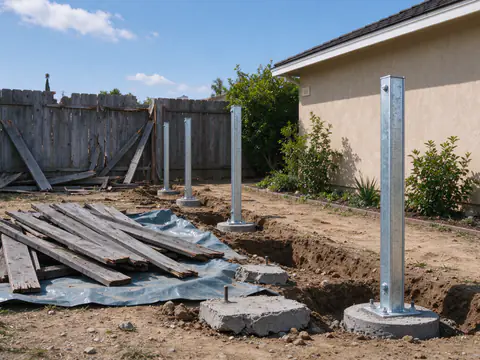
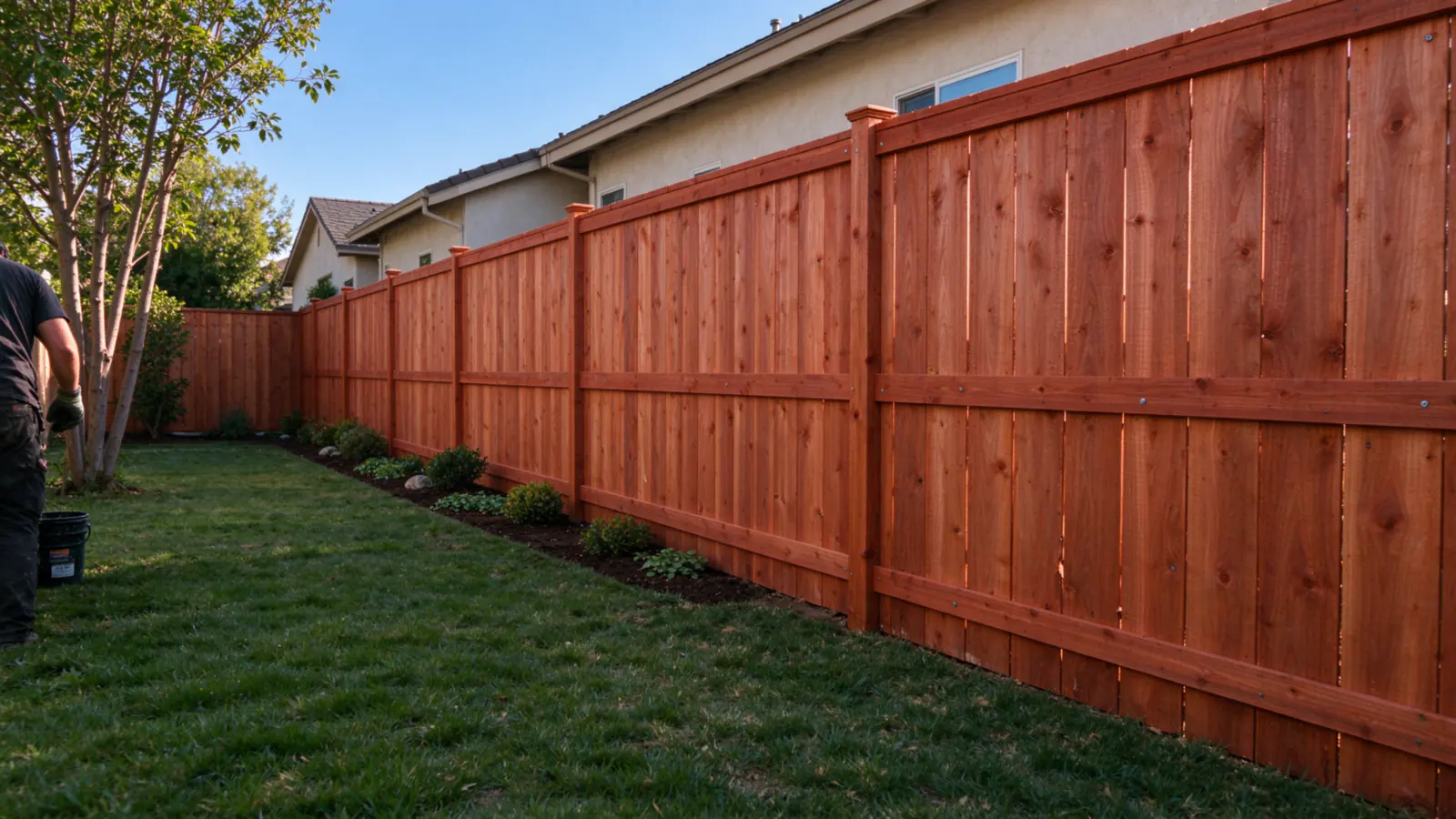
California’s good neighbor fence law, Civil Code 841, presumes that two adjoining owners benefit equally from the fence between them and share the reasonable cost of building, maintaining or replacing it, unless they agree otherwise in writing. Before spending money on a shared fence, an owner who wants the neighbor to contribute must give 30 days’ written notice with specific details.
Grove Ontario Fence Builders replaces and repairs shared side and rear fences across Ontario and the west Inland Empire, with the work carried out by licensed and insured fence contractors. Most of those fences sit on a line two households share, so the cost question comes up early. This page describes what the statute says and how it plays out on a typical tract fence. It is general information about the law, not legal advice for a particular dispute.
What Civil Code 841 actually says
The statute has three working parts. Subsection (a) says adjoining landowners share equally in maintaining the boundaries and monuments between them. Subsection (b)(1) adds the fence rule: owners are presumed to share an equal benefit from any fence dividing their properties and, unless a written agreement says otherwise, are presumed equally responsible for the reasonable costs of construction, maintenance or necessary replacement. Subsection (c) defines who counts. A landowner is a private person or entity holding a possessory interest in the property, and public bodies such as cities, counties and districts are excluded.
The current text replaced an older version of section 841 and took effect on January 1, 2014. Two words carry most of the weight. “Reasonable” limits the presumption to sensible costs, not whatever one owner chooses to spend. “Necessary” limits replacement to a fence that actually needs it, which is why the condition of the old fence matters as much as the price of the new one. The full text is on the California Legislative Information site.
The equal-benefit presumption on a tract lot
On most Ontario tract lots, the fence or wall on the interior side and rear lines divides two backyards that use it the same way: privacy, a place for dogs to stay put, a screen for a pool. That is the situation the presumption was written for. A plain 6-foot redwood or cedar privacy fence replacing a failed one is close to the textbook case.
The presumption gets weaker as one owner’s preferences take over. If one side wants board-on-board with a cap rail where a dog-ear fence would do, or a decorative iron section where wood would serve, the extra cost is the kind a neighbor can argue is aesthetic rather than shared. The fence cost guide explains why those choices move a price toward the top of the range, which is useful context when two owners are deciding what “reasonable” means for their own line.
Many shared lines in Ontario are block walls built with the subdivision rather than wood fences. Whether a particular wall project falls under section 841 is a legal question for the owners, and work on an existing wall is covered on the block wall extension page.
What the 30-day notice must include
Section 841(b)(2) lists the contents of the notice, and leaving one out weakens it. The notice goes to each affected adjoining owner, in writing, at least 30 days before the owner incurs the cost.
| Required element | What it looks like in practice |
|---|---|
| The presumption of equal responsibility | A sentence stating that California law presumes both owners share reasonable fence costs equally |
| The nature of the problem | For example: posts rotted at grade, a section down after a wind event, boards missing |
| The proposed solution | Repair of specific posts and panels, or full replacement, with height and material |
| Estimated costs | A written estimate from a contractor for the work described |
| The proposed cost-sharing approach | An even split, or a different split the sender proposes |
| The proposed timeline | When the work would start and roughly how long it would take |
A contractor’s written estimate is the natural source for the cost line, and a scope that separates the fence itself from extras such as a new gate on one owner’s side makes the split easier to defend. Photos of the old fence help show that replacement is necessary rather than cosmetic. Keep a copy and a record of how and when the notice was delivered. The blog post on talking to a neighbor about a new fence covers the conversation that usually comes before the letter.
How a neighbor can rebut the presumption
The presumption is a starting point, not a final answer. Under section 841(b)(3), it can be overcome by a preponderance of the evidence showing that equal responsibility would be unjust. The statute directs a court to weigh these factors:
- Whether one owner’s financial burden is substantially out of proportion to the benefit that owner receives.
- Whether the cost of the fence would exceed the increase in the property’s value from installing it.
- Whether the burden would cause undue financial hardship, shown by reasonable proof.
- Whether the project is reasonable, including whether costs look unnecessary or excessive and whether they come from one owner’s aesthetic, architectural or other preferences.
- Any other equitable factor that fits the circumstances.
If the presumption is rebutted, the court can order a contribution smaller than half, or none at all. In practice, the factors explain why neighbors who compare two or three like-for-like estimates and agree on a standard fence rarely end up arguing. The disputes that reach a judge tend to involve one owner who replaced a sound fence, chose a premium style, or never sent notice.
Repair or replacement: what “necessary” means
A shared fence with two leaning posts and a few loose boards is a repair, not a replacement, and the cost of fixing it is far less than a new run. A fence with rot at most posts, termite damage in the rails and sections already down is a different case. The fence repair page and the fence replacement page describe how that line is drawn, and the repair or replace assessment walks through the same questions for your own fence.
The difference matters under section 841 because only necessary replacement is presumed to be shared. If one owner wants a full replacement and the other wants a repair, an assessment that documents post condition along the whole line gives both of them something more solid than opinion. After a windstorm, check homeowners coverage before assuming the neighbors split everything; the wind-damaged fence insurance guide explains how that usually works.
If you cannot agree: small claims in general terms
When notice has gone out and the neighbor still declines, the next step for most homeowners is a conversation about a written agreement, and failing that, court. Disputes over a share of a fence bill are often modest enough for small claims court, where people usually represent themselves and the dollar limit is set by state law. The California Courts self-help pages explain the current limits and filing steps. A copy of the notice, the estimate, photos and the paid invoice are the documents that matter there.
Two practical points sit outside the statute. The fence has to sit on the line or on one owner’s side, and an old fence does not prove where the line is; the property line and survey guide explains when a surveyor is needed. And in Ontario a fence over 3 feet needs a building permit whoever pays for it, as the Ontario permit guide explains, while tracts with an association add an HOA approval step.
The spite fence statute: Civil Code 841.4
A separate section deals with the opposite problem: a fence built to annoy rather than to divide. Civil Code 841.4 says that a fence or other structure in the nature of a fence that unnecessarily exceeds 10 feet in height, and is maliciously erected or maintained to annoy the owner or occupant of the adjoining property, is a private nuisance. A neighbor injured in their comfort or enjoyment of their property can pursue the nuisance remedies the Civil Code provides.
Each element has to be present. The fence must be taller than 10 feet, the extra height must be unnecessary, and the purpose must be malicious. A 6-foot privacy fence within Ontario’s residential limit does not come close, and city height limits would stop most residential fences well short of 10 feet anyway. The statute has been on the books since 1953 and mostly matters in unusual disputes, but it is the answer to the common question of whether California has a spite fence law.
Putting it in order
For a shared fence that has reached the end of its life, the sequence that keeps both households on the same page is short: agree on where the line is, get a written estimate for a standard fence, send the 30-day notice with every required element, then pull the permit and schedule the work. If you want an estimate written so it can go straight into that notice, call Grove Ontario Fence Builders at (909) 324-5352 or request an estimate. Splitting a wood or vinyl fence? The vinyl vs wood comparison can help two owners settle on a material first.
Need an estimate for a shared fence?
Send the address, the length of the shared line and what has failed. The written scope can go straight into your 30-day notice.