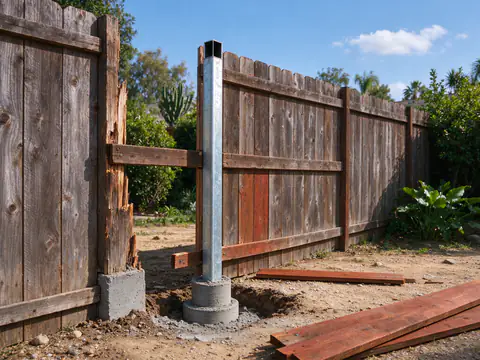
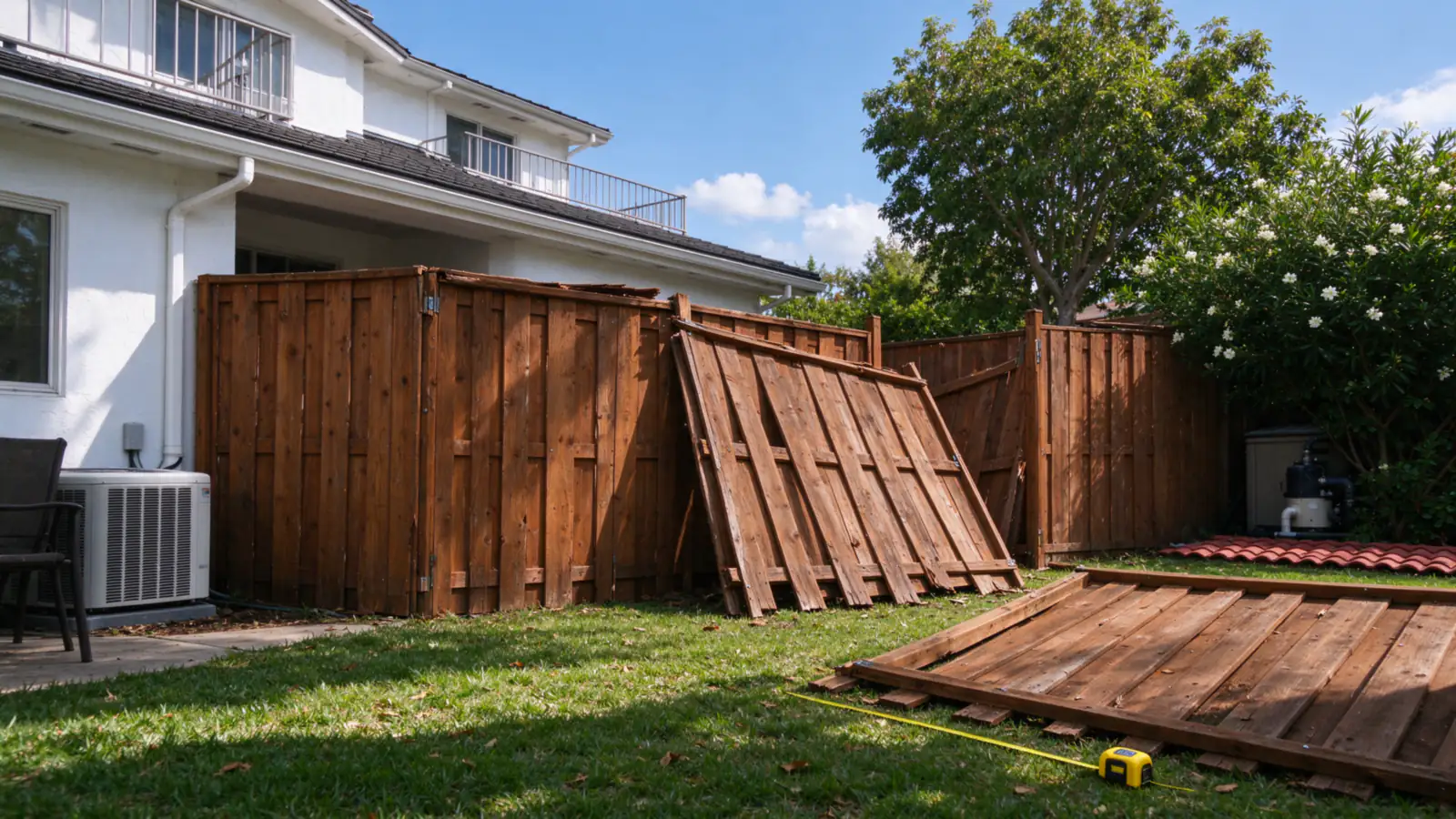
Often, but not automatically. Most homeowners policies list windstorm as a covered peril and cover a detached fence under Coverage B, other structures, which the California Department of Insurance says is normally limited to 10% of the dwelling limit. Whether a claim pays depends on your policy wording, your deductible and whether the adjuster sees wind damage or long-term wear.
Grove Ontario Fence Builders repairs and rebuilds wind-damaged fences across Ontario and the west Inland Empire, from a single snapped post to a full run lying in the yard, with the work carried out by licensed and insured fence contractors. Emergency fence repair covers securing and rebuilding a fence knocked down by wind or impact. This guide explains how coverage usually works and what helps a claim; it is general information, not insurance or legal advice, and your own policy decides.
How a homeowners policy usually treats a fence
The California Department of Insurance’s residential insurance guide breaks a standard homeowners policy into coverages A through F. Coverage A is the house and attached structures. Coverage B, other structures, protects structures on the property that are not attached to the dwelling, such as detached garages and sheds, and a freestanding fence normally falls here. The department notes that Coverage B is normally limited to 10% of the Coverage A limit, and that more can be bought for an added premium.
That limit is shared. On a home insured for $500,000 under Coverage A, a 10% Coverage B limit would be about $50,000 for every detached structure combined, including a detached garage, a shed and any block walls. A wind event that takes down a fence and damages a shed draws on the same pool. This is arithmetic on the department’s description, not a statement about any particular insurer’s policy, and some policies are written differently. Your declarations page, usually the first page of the policy, lists the actual limits and deductibles.
The same guide lists the perils typically covered and typically excluded:
| Typically covered | Typically not covered |
|---|---|
| Windstorm or hail | Wear and tear or maintenance |
| Falling objects | Neglect |
| Vehicles | Termites, insects, rats or mice |
| Vandalism and malicious mischief | Earth movement and earthquake |
| Fire or lightning | Flood |
For a fence, the two columns meet in one event more often than people expect.
Wind or wear: what an adjuster looks at
A fence rarely fails at random. The wind that pushes it over finds the weakest posts first, and those are often the ones that were already rotted at the grade line, hollowed by termites or leaning in an undersized footing. An adjuster deciding whether the loss was caused by windstorm or by wear will look at what broke and how.
| What you see | What it can suggest | What to photograph |
|---|---|---|
| Posts snapped cleanly above the concrete, sound wood at the break | Wind load exceeded a healthy post | The break, the grain and the footing still in the ground |
| Posts broken off at or just below grade, soft or crumbly wood | Rot that weakened the post before the storm | The stub, the collar, a probe into the wood |
| Galleries, mud tubes or six-sided pellets in the wood | Termite damage, which policies generally exclude | Close-ups of the damage beside a coin or tape for scale |
| Posts pulled out with the concrete attached | Footings too small or too shallow for the wind load | The footing, the hole and the soil |
| Panels torn from posts that still stand | Failed fasteners or brackets under gust load | Fastener holes, brackets and any bent hardware |
The termites and fence posts guide explains how to tell termite damage from rot. Neither visual sign proves a single cause on its own, which is why clear photographs taken before cleanup matter.
The weather record helps too. The National Weather Service office in San Diego issued 44 High Wind Warnings for the Inland Empire valley zone that includes Ontario between January 2016 and October 2026, with none from May through August and most from October through February. Noting the date of the storm and any warning in effect gives the claim a documented wind event. The Santa Ana winds guide explains why solid fences take the brunt of those gusts.
The deductible and depreciation math
The deductible is the part of a loss you pay before the insurer pays anything. For fences it decides more claims than the coverage question does.
Here is an illustrative example using typical Southern California installed ranges, not a quote. Rebuilding 40 feet of 6-foot redwood or cedar privacy fence at $30 to $70 per linear foot comes to about $1,200 to $2,800, plus $3 to $8 per foot, about $120 to $320, to haul away the broken sections. A short rebuild often prices toward the top of the range because setup and the permit do not shrink with the footage. Against a $1,000 deductible, that claim may pay something. Against a $2,500 deductible, it may pay little or nothing, and some owners decide to pay directly instead. The fence cost guide covers what moves a price within those ranges.
Depreciation is the second variable. The department explains that a replacement cost policy pays to replace a damaged item with one of similar kind and quality, while an actual cash value policy deducts for age and wear. A 15-year-old wood fence on an actual cash value policy can pay out well below the cost of a new one. Your policy states which method applies to other structures.
Shared fences, block walls and fallen trees
Many Ontario fences are shared. Under California’s Good Neighbor Fence Act, Civil Code 841, adjoining owners are presumed to benefit equally from a dividing fence and to share the reasonable cost of replacing it, unless they agree otherwise in writing, and an owner who wants to share the cost gives 30 days’ written notice. The statute governs how neighbors split a cost. It does not decide what either owner’s insurer pays, and the two questions run side by side. The good neighbor fence law guide explains the notice, and the neighbor conversation post has practical tips.
Block walls add another layer. Most Ontario tract lots were built with masonry walls on side and rear lines, and on those lots the wind damage can be a wood or vinyl topper torn off the top of the wall rather than the wall itself. Whether the topper was mounted in a way the wall could carry becomes part of the conversation; the block wall extension page explains how a wall is checked before anything is attached. Where a homeowners association maintains a wall, as Edenglen’s master association does for its community theme wall in Ontario Ranch, damage to that wall goes to the association first.
A tree is a falling object, which the department lists among perils typically covered, so a tree that falls on your fence in a windstorm is often handled under your own policy. If the tree was visibly dead or neglected beforehand, liability questions can bring the tree owner’s insurer in. Ask your insurer how it handles that situation instead of assuming either answer.
What to do in the first days after a windstorm
The department’s Residential Property Claims guide sets out the general order. For a fence, it looks like this:
- Stay clear of hazards. Keep away from leaning panels and any downed electrical line, and call the utility for lines rather than moving anything near them.
- Photograph before touching. Take wide shots of the whole line from both ends, then close-ups of every broken post, footing, bracket and gate. Include the neighbor’s side if they agree.
- Restore the barrier where safety requires it. A fence that encloses a pool is a required barrier in Ontario, which calls for a 5-foot nonclimbable enclosure around pools and spas, so a gap there needs a temporary closure and close supervision until it is rebuilt. Pets need the same attention.
- Make reasonable temporary repairs and keep receipts. The department notes that insurers reimburse reasonable costs to protect property from further damage and warns against contractors who push expensive temporary work.
- Report the claim. Ask what your deductible is, whether the policy uses replacement cost or actual cash value for other structures, and whether the insurer wants repair estimates.
- Get written, line-by-line estimates. The department advises bids from licensed contractors that list materials and prices line by line. For a fence that means footage, height, post type and footing, removal and haul-away, gates and hardware, and the permit.
- Keep a log. Note every call, name and date, and keep copies of all correspondence.
Do not throw out broken posts or panels until the adjuster says you can. The stubs in the ground are often the best evidence of why the fence fell.
Rebuilding after the claim: permits and code
A rebuilt fence is held to today’s rules, not the ones in force when the old fence went up. The City of Ontario requires a building permit for wood, chain link and wrought iron fences over 3 feet, and its structural design criteria, Information Bulletin 103, assume wind Exposure C with a 110 mph design wind speed for residential work. A fence rebuilt to that standard may need heavier posts, deeper footings or closer spacing than the one that blew down. The department’s guide notes that “ordinance or law” coverage, sold as an endorsement, can pay for added costs of meeting current codes, so it is worth checking whether your policy has it. The permit and height rules guide covers when Ontario requires a permit.
The rebuild is also the moment to fix what failed. If posts rotted at the grade line, galvanized steel posts or ground-contact treated wood in crowned footings address the cause; the steel vs wood posts guide compares them. If only a few posts failed and the rest of the line is sound, a targeted fence repair may be the right scope, while a line that is failing everywhere points toward fence replacement. The repair or replace assessment walks through that decision.
When a claim is denied or stalls
Ask the insurer to put the reason in writing and to identify the policy language it relied on. If you disagree, the California Department of Insurance takes questions and complaints through its consumer hotline at 1-800-927-4357 and its consumer pages. Its claims guide also notes that most claims can be reopened if more damage is found later, as long as you notify the insurer promptly.
When you have photos and a claim number, call Grove Ontario Fence Builders at (909) 324-5352 or request an estimate for a written, line-by-line scope you can share with your adjuster. The Santa Ana wind season checklist covers what to check before the next storm.
Fence down after a windstorm?
Send photos of the line and the broken posts. A written scope for the rebuild is the next step, whether or not a claim is involved.