
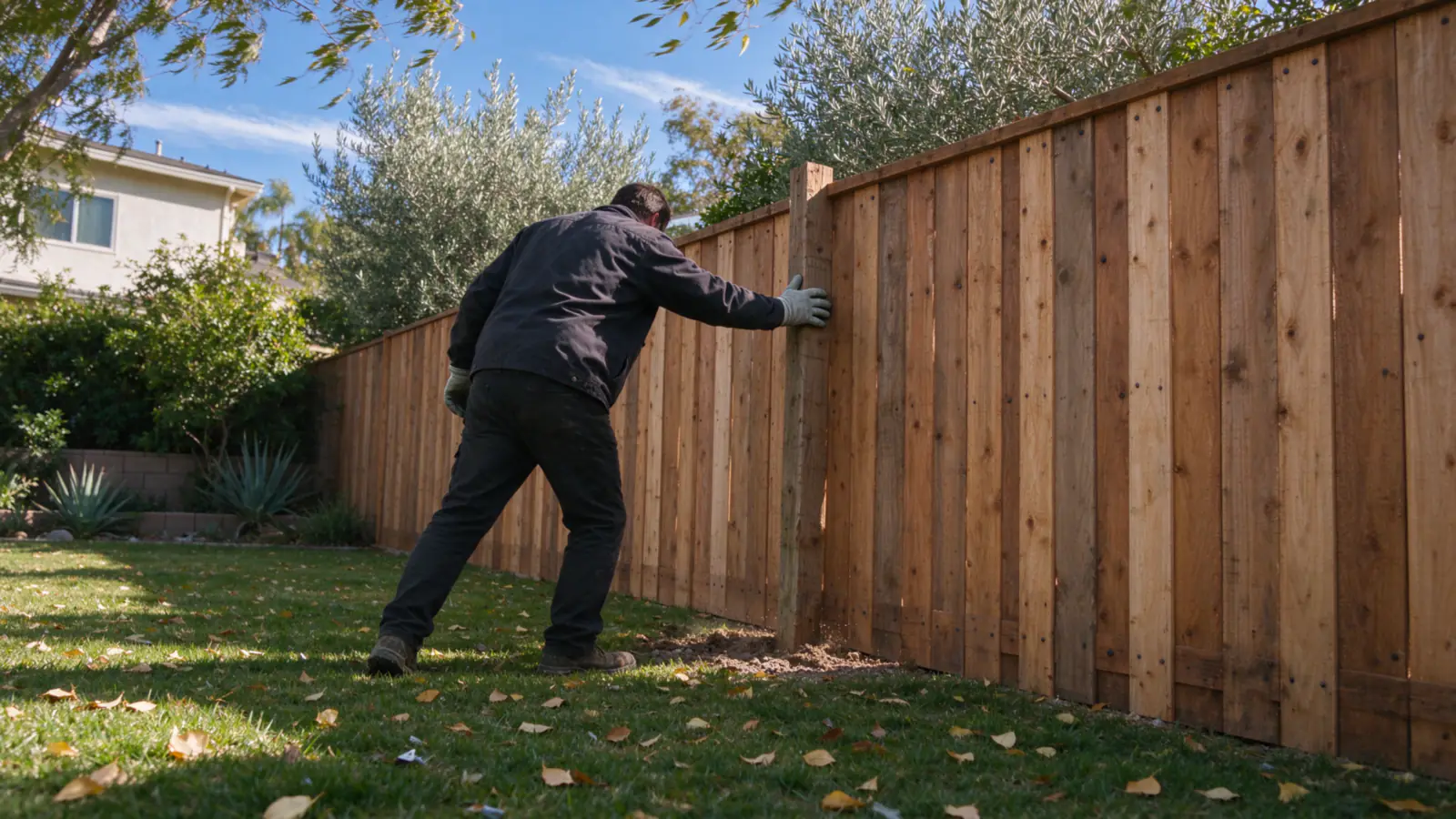
Most fences that blow down in a Santa Ana wind were already weak before it arrived: a post soft at the soil line, a gate hinge pulled loose, a panel that had been rattling for a year. Fence wind damage prevention is mostly finding those spots while the air is still calm, and the time to look is late summer and early fall, before the first offshore wind of the season.
Grove Ontario Fence Builders installs and repairs fences across Ontario and the west Inland Empire, with the work carried out by licensed and insured fence contractors. This checklist covers what to look at, what to clear away, and what to do the morning after a wind night.
When the wind season comes
The National Weather Service office in San Diego issues warnings for the Inland Empire valley zone that covers Ontario, Rancho Cucamonga, Fontana, Chino Hills and Eastvale. From 2016 through October 2026 it issued 44 High Wind Warnings for that zone, every one of them between September and April. January led with 15, followed by October, November and February with 7 each and December with 4. None fell between May and August. Wind Advisories, for lesser gusts, came 141 times over the same period.
So the pattern is steady even though no two years match: the season opens in fall, peaks through midwinter and tapers off in spring. Warning texts often place the strongest gusts below the Cajon Pass, where 55 to 75 mph is typical of a warning, so homes nearest I-15 and the pass tend to see the hardest wind. The Santa Ana wind guide explains how that wind loads a fence.
Walk the line before the first warning
Start at one end and look at every post, not just the ones that look wrong.
- Push each post at shoulder height. A sound post barely moves. One that rocks at the base has lost its grip in the footing or rotted at grade, and that is the post that fails first.
- Check wood posts at the soil line. Probe with a screwdriver just below grade. Soft, punky wood there means rot or termites. UC IPM notes that untreated wood in soil contact invites termite damage, and the termite guide covers what to look for.
- Look along the top rail. A line that dips or leans shows which posts are moving. A lean of a few inches over 6 feet is a structural sign, not a cosmetic one.
- Check rails and fasteners. Rails that have pulled away from posts, popped nails and loose rail brackets let panels flex, and flexing panels work the rest loose.
- On vinyl, look at where rails enter posts. Rails that have slipped from their pockets, or a post that has cracked near the base, need attention before a gust lifts the panel out.
- On iron and tubular steel, check the post bases. Rust where a post enters concrete or soil thins the metal right where it bends.
A fence that passes this walk can still be blown down by a severe wind, but one that fails it is likely to go in an ordinary one.
Gates take the hardest load
A gate is a panel hung from one side, so the wind pushes it like a lever against the hinge post. Before the season, open and close each gate. If it drags, sags or needs lifting to latch, the hinges, the frame or the post is moving, and the sagging gate guide explains how to tell which. Tighten loose hinge screws, check that the latch catches without help, and make sure cane bolts on double gates drop fully into their sleeves. A gate that will not stay latched is better tied shut for the season than left to swing.
Clear what adds load
Fences are designed for their own panels, not for what leans on them. Before the season:
- Cut back dense vines and climbing shrubs that turn a privacy fence into a bigger sail.
- Move trash bins, ladders, lumber and furniture away from the line so they cannot be thrown into it.
- Tie down or move trampolines, shade sails and patio umbrellas, which travel in a strong gust.
- Trim dead limbs that hang over the fence.
Do not cut slats out of a fence to let wind through on the theory that it will help. Random gaps weaken boards and rails without changing the post loads enough to matter.
After a wind night
Start with safety. Stay clear of leaning sections, which can fall without warning, and of any downed power or service lines, which are the utility’s job. Photograph everything before moving it, from several angles and close up at the post bases, because the wind-damaged fence insurance guide explains how claims often turn on the cause of failure. If the fence is shared, the neighbor will want to know too, and Civil Code 841 shapes how the cost is split, as the good neighbor fence law guide explains.
If a dog or a pool depends on the fence, close the gap the same day with a temporary panel, a tied section or a barrier. Emergency fence repair covers securing and then rebuilding a fence knocked down by wind or impact, so the property is closed in first and the permanent fix follows.
Repair or replace
The broken section is not always the whole story. If one or two posts snapped and the rest of the line is plumb and solid, fence repair replaces those posts and resets the panels. If the walk shows rot at the base of most posts, or a whole run leaning the same way, the wind only found a system-wide problem, and patching one bay leaves the next to fail in the next warning. That is a fence replacement decision, often with steel posts or deeper footings, which the steel vs wood fence post guide compares. The repair or replace assessment walks through the questions that separate the two.