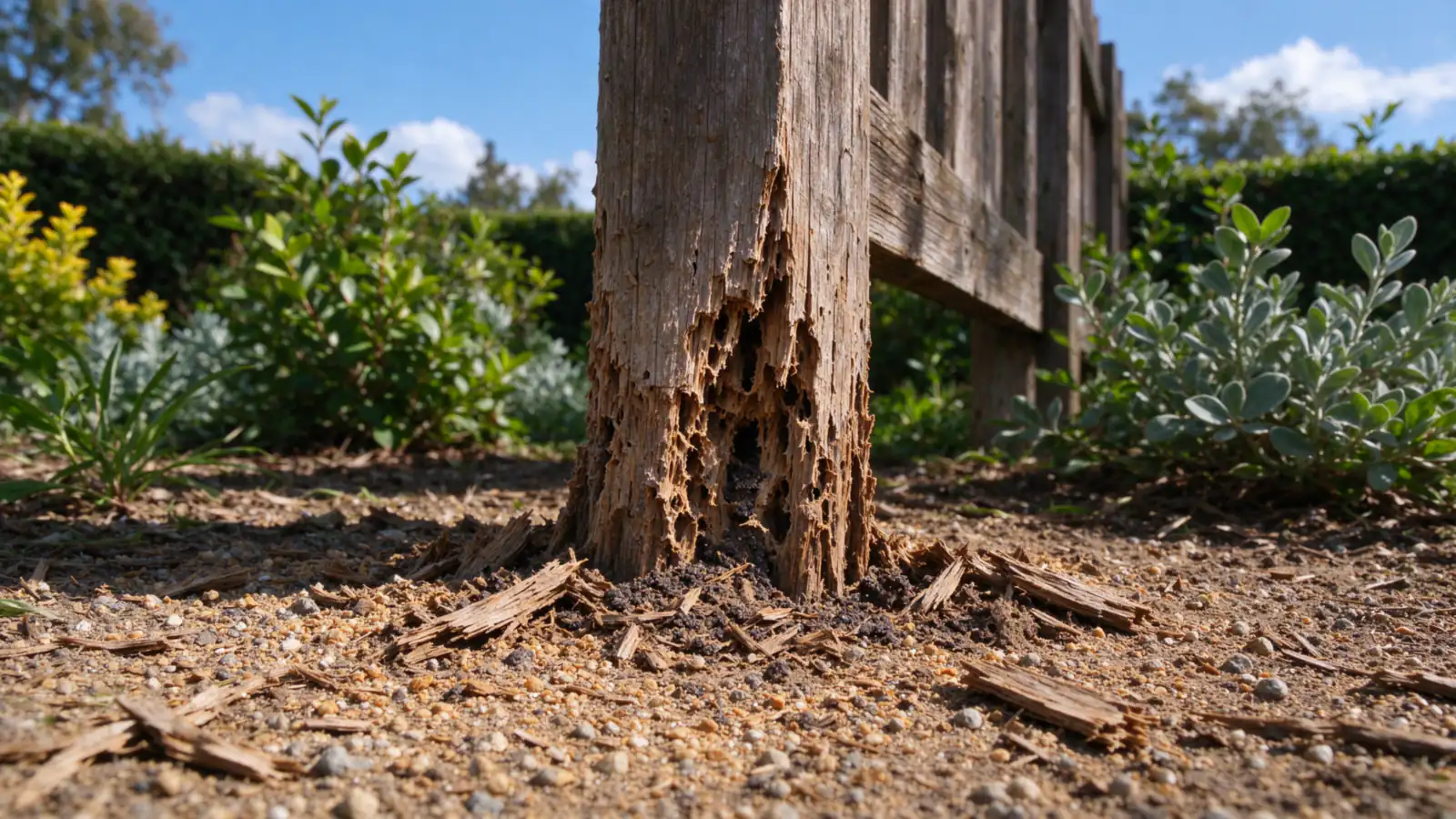
Termites can hollow out wood fence posts, and two Southern California kinds do it differently. Subterranean termites come up from the soil and leave mud tubes and grain-following galleries at the base of a post. Drywood termites live inside rails and pickets and push out tiny six-sided pellets. A post hollowed at grade usually needs replacing.
Grove Ontario Fence Builders repairs and replaces wood fences across Ontario and the west Inland Empire, including posts lost to termites and rot, with the work carried out by licensed and insured fence contractors. This guide draws on the University of California’s Integrated Pest Management program (UC IPM) to explain what to look for, what to do and how to rebuild so a fence gives termites less to eat. It does not give treatment instructions; termite control in California is mostly professional work, as UC IPM explains.
Which termites damage fences here
UC IPM’s pest notes describe three groups in California. Subterranean termites are very abundant across most of the state. They nest in soil and infest wood that touches the soil or that they can reach through earthen shelter tubes, which makes the buried end of a fence post an easy target. Drywood termites nest above ground in relatively dry wood such as lumber, utility poles, fences and dead limbs, and never need soil contact. UC IPM’s drywood termite pest note says the western drywood termite is common along the coast, into the Central Valley and across the deserts of Southern California; its colonies are small, usually fewer than 1,000 insects, and take years to mature. Dampwood termites need very moist wood and are found mostly in cool, humid coastal areas, so in the inland valleys they are less likely, and finding them usually signals a moisture or decay problem.
For a fence, that splits the risk by height. The post, from just above grade to the bottom of the footing, is where subterranean termites work. Rails, pickets, caps and trim, especially on a fence near the house or near infested wood, are where drywood termites turn up.
Reading the signs
| What to look for | Subterranean termites | Drywood termites |
|---|---|---|
| Where on the fence | Base of posts, at or just below grade, sometimes inside the concrete collar | Rails, pickets, caps and trim, above ground |
| Tubes | Earthen shelter tubes, often called mud tubes, on the post, collar or nearby concrete | None |
| Damage pattern | Galleries that follow the grain, eating the softer wood and leaving the harder rings | Chambers and tunnels that cut across the grain |
| Debris | Soil packed into galleries | Small, hard pellets with six flattened sides, piling below tiny kickout holes |
| Swarmers | Winged reproductives in spring, summer or fall | Winged swarmers that fly in daylight |
UC IPM’s subterranean termite pest note calls shelter tubes the most commonly seen evidence of a subterranean infestation. For drywood termites, the six-sided pellets are described as diagnostic, though the pellets alone cannot show whether the colony is still active. UC IPM suggests clearing pellets from around a kickout hole and checking a few days later to see whether new ones appear.
Termites, rot or something else?
A crumbling fence post is not always a termite problem. Decay fungi also break posts down at the grade line, where sprinkler water keeps the wood damp. Rotted wood turns soft, stringy or cracked into small cubes and has no galleries or tubes. Carpenter ants and wood-boring beetles can also be mistaken for termites, and UC IPM notes that winged termites are easily confused with winged ants. Rot and termites can also act on the same post at once. A licensed pest inspector, not a fence contractor, is the right person to confirm what is in the wood.
Safe checks you can make
None of these needs tools beyond a flashlight, a screwdriver and a phone camera:
- Push each post at shoulder height. Movement at the ground line means the post or its footing has lost its grip.
- Probe at the grade line with a screwdriver. Sound wood resists; a tip that sinks in easily marks rot or hollow galleries. Scrape away only an inch or two of soil, and do not dig around the footing.
- Look for tubes on the post, the concrete collar and any nearby slab or block wall.
- Check horizontal surfaces such as rail tops and post caps for small piles of pellets.
- Photograph what you find next to a coin or tape measure for scale.
If any post near the house shows tubes or pellets, that is the point to call a pest professional before anything else.
What to do when you find termites
Start with the house, not the fence. UC IPM states that an inspection by a licensed pest management professional is required before any treatment can be performed, and that the proven termite control methods in California are mostly for professional use; for drywood termites it says home-use products are not effective. It also recommends regular inspections every 3 to 5 years to catch infestations early. In California, termite inspection and control companies are licensed by the Structural Pest Control Board, where you can check a license.
Homeowners can do some things themselves, according to UC IPM: replace damaged wood, destroy shelter tubes between the soil and wood, and remove untreated fence posts, wood piles and buried scrap wood near the structure. For a fence, that means getting infested posts and boards out and hauled away rather than stacked against the garage or left in a pile by the side yard.
Repair or replace the posts
The extent of the damage sets the scope, and the two outcomes are different jobs:
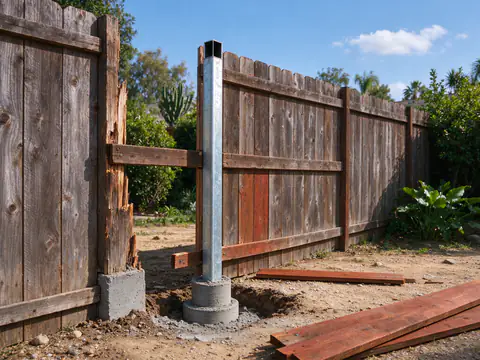
- A few posts damaged, the rest sound. Those posts can come out with their old footings and be replaced, often with galvanized steel or ground-contact treated wood, while the rails and boards stay. That is a fence repair.
- Damage along the whole line, or rails and pickets riddled by drywood termites. Replacing members one by one rarely makes sense once the infestation is widespread or the fence is near the end of its life anyway. That points to fence replacement.
The repair or replace assessment walks through the signs that separate the two, and the how long fences last guide explains where an older fence sits in its life.
Do not wait for wind season to decide. A post hollowed at grade still stands in calm weather, but the National Weather Service office in San Diego issued 44 High Wind Warnings for the Inland Empire valley zone between January 2016 and October 2026, most from October through February, and those gusts find the weakest posts first, as the Santa Ana winds guide explains. The California Department of Insurance lists termites among the perils homeowners policies generally exclude, so a fence that falls because of termite damage may not be a covered wind claim; the wind damage and insurance guide explains why.
Rebuilding with less to eat
UC IPM’s prevention advice for fences is direct: choose termite-resistant wood or use concrete footers for fences that must contact soil, and treat or use naturally resistant wood wherever wood touches the ground. On a rebuild that translates into a handful of choices:
- Steel or treated posts. Galvanized steel posts give termites nothing to eat. Treated posts rated for ground contact are the wood option; the steel vs wood posts guide compares them.
- Heartwood boards. Redwood and cedar resist termites mainly in their heartwood, and UC IPM notes that resistance varies with the share of heartwood versus sapwood. The cedar vs redwood guide covers grades.
- A gap at the bottom. Boards held a little above the soil, with no mulch or soil piled against them, stay drier and harder for subterranean termites to reach.
- No wood touching the house. Where the fence meets the house, a steel post or a small gap keeps the fence from bridging to the structure.
- Sprinklers aimed away. Dry wood rots slower and gives subterranean termites less moisture.
Galvanized steel posts carrying wood fence boards combine most of those choices in one build. Owners who would rather leave wood behind can compare a vinyl or wood fence, or choose an iron or tubular steel fence, neither of which feeds termites.
If you have found tubes, pellets or hollow posts, call Grove Ontario Fence Builders at (909) 324-5352 or request an estimate to scope the repair or rebuild once the pest question is settled.
Posts hollow at the ground line?
Send photos of the damaged posts and the length of the fence to plan a repair or a rebuild on posts termites cannot eat.