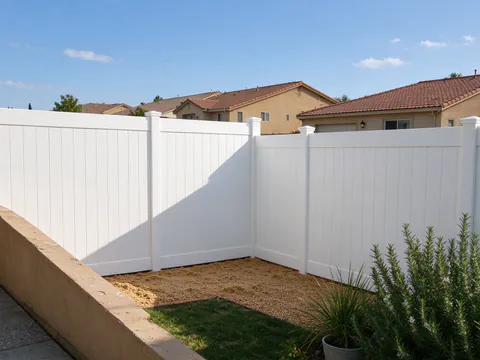
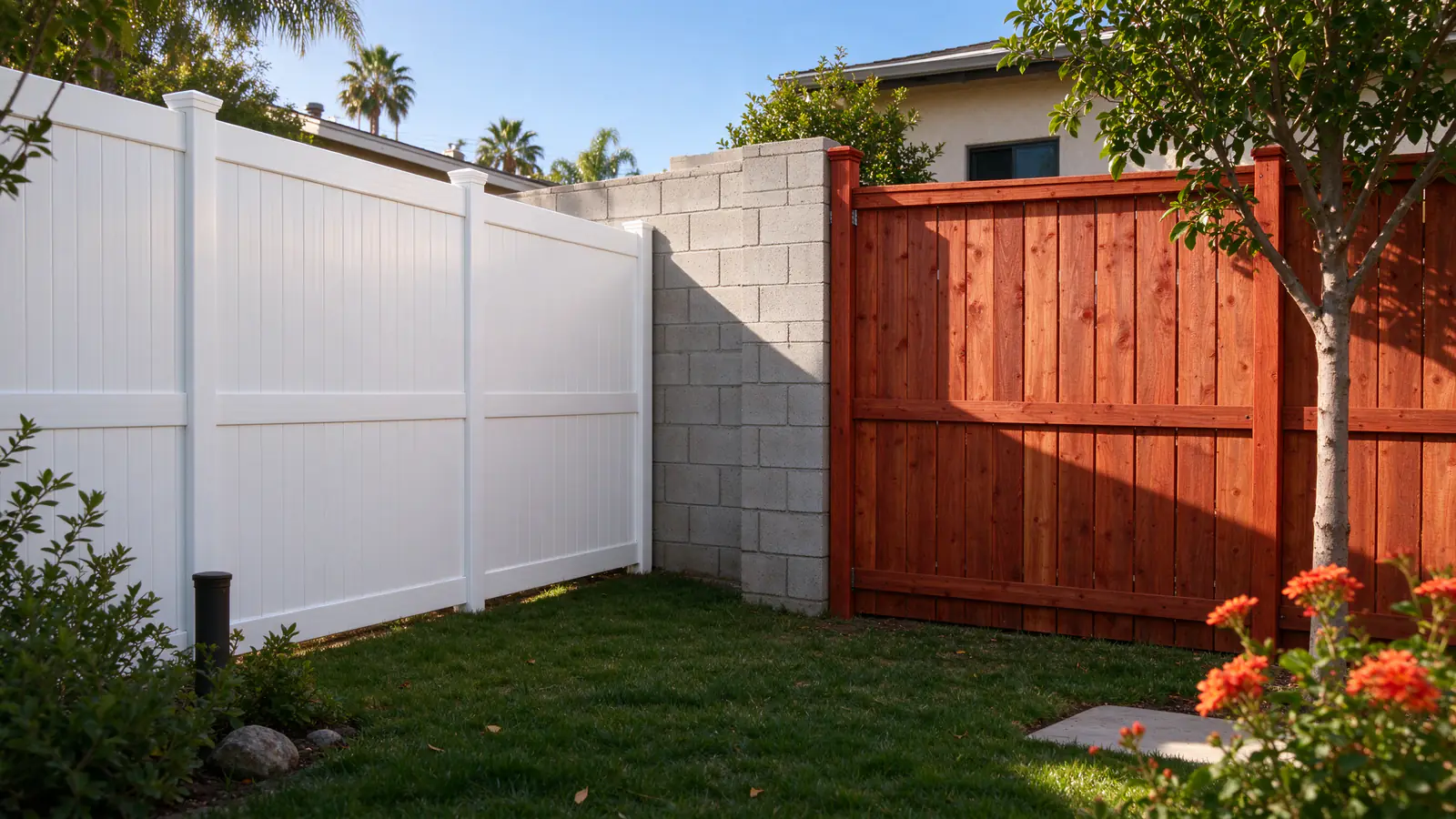
For most Ontario yards, wood costs less up front and vinyl costs less to live with. A 6-foot redwood or cedar privacy fence typically runs $30 to $70 per linear foot installed in Southern California, and a 6-foot vinyl privacy fence about $35 to $75 and up. Vinyl does not rot, feed termites or need stain; wood is easier to repair and to match later.
Grove Ontario Fence Builders installs both across Ontario and the west Inland Empire, with the work carried out by licensed and insured fence contractors. Neither material wins everywhere. The right choice depends on how long you plan to stay, how much summer upkeep you want, what your HOA allows and how exposed the line is to wind. This comparison works through each of those in local terms.
Side-by-side comparison
| Factor | Wood (redwood, cedar or fir) | Vinyl (PVC) |
|---|---|---|
| Typical installed range, 6-ft privacy | $30 to $70 per linear foot | $35 to $75 and up per linear foot |
| Sun and heat | Dries, checks and grays; stain needs renewing | Holds color better; UV inhibitors and light colors matter |
| Rot and termites | Posts are the weak point; treated or steel posts help | Does not rot and is not termite food |
| Wind | Stiff if posts are sound; steel posts stiffer still | Panels flex; reinforced posts and rails matter |
| Impact | Dents and splits, easy to patch | Can crack, especially in cold or with age |
| Repair | Board by board with stock lumber | Parts from the same system and color |
| Upkeep | Clean and restain every few years | Wash off dust and sprinkler marks |
| Looks | Natural grain, can be stained any color | Clean, uniform; wood-look textures available |
The gap at the low end is narrow. A plain dog-ear wood fence on a level line sits near the bottom of its range, and a basic vinyl privacy panel near the bottom of its own, so the first-cost difference on a typical side yard is often smaller than buyers expect. Heavier tongue-and-groove vinyl, decorative tops and premium colors can run past the top of the vinyl band, which is why it stays open at the high end. The fence cost guide explains what else moves a price.
How each handles inland sun
NOAA’s 1991-2020 climate normals for Ontario International Airport average about 93 days a year at or above 90°F and 19 days at or above 100°F, with under 12 inches of rain. That is a different climate from the coast, and both materials feel it.
Wood dries and moves. Boards shrink, small gaps open on dog-ear fences and the surface checks and turns gray within a few seasons unless a pigmented, UV-blocking stain is kept up. Low rainfall works in wood’s favor in one way: rot is concentrated where sprinklers or soil keep wood wet, not across the whole fence. The wood fence installation page covers species and grade, and the cedar vs redwood guide goes deeper on the two premium woods.
Vinyl carries its color through the material, so it does not need paint or stain. Its exposure is heat and UV. Quality profiles include UV inhibitors, and white and light colors absorb less heat than dark or wood-look colors. PVC also expands and contracts with temperature, so rails need room to move in their post pockets. A fence installed without that allowance can bow on a hot afternoon. Vinyl is not maintenance-free: it collects dust, sprinkler minerals and mildew on shaded faces, and it can crack from a hard impact.
Termites and posts
Wood’s long-term weak point is underground. UC IPM’s pest note on subterranean termites says wood in soil contact should be treated or naturally resistant, and its drywood termite note adds that the western drywood termite, common in Southern California, nests in wood without touching soil. A wood fence built on ground-contact treated or galvanized steel posts answers most of that, and the termites and fence posts guide explains the warning signs.
Vinyl has nothing for termites to eat, which is one of its clearest advantages near a house. Its posts are hollow, though, and on a tall or gated run they rely on a steel or aluminum insert and a sound concrete footing for stiffness.
Wind: which stays up in a Santa Ana
A solid 6-foot privacy fence, wood or vinyl, takes the full wind load across its face, and the posts carry it into the ground. The National Weather Service office in San Diego issued 44 High Wind Warnings for the Inland Empire valley zone that includes Ontario from January 2016 through October 2026, most between October and February.
Wood on sound posts is stiff and fails mostly at rotted or undersized posts. Vinyl panels flex, which can help them ride out a gust, but a panel can also pop out of its rails if the system is not reinforced. Steel-reinforced posts, closer post spacing and aluminum-reinforced bottom rails are the usual answers on an exposed vinyl line. In Ontario’s sandy soils, footings get their grip from depth and width, and that depth is set by fence height, panel type and wind together rather than one number. The Santa Ana winds guide covers the details.
HOA rules and appearance
In master-planned tracts, the choice may already be made. Many association guidelines call for a low-maintenance or wood-look product in a set color, and the Edenglen Specific Plan in Ontario Ranch requires perimeter thematic fencing to be wood-look material or tubular steel and bars real wood on that fencing. Check the specific plan and CC&Rs before falling for either material; the HOA approval guide explains the submittal. On a shared line, the two neighbors also see opposite faces of the fence, which is easier to settle when both agree on material first.
Fire zones: proposed Zone 0 rules
The City of Ontario has no fire hazard severity zones on CAL FIRE’s maps, so this does not affect most Ontario homes. In the foothill parts of Rancho Cucamonga, Chino Hills and nearby cities, the State Board of Forestry and Fire Protection’s draft Zone 0 regulations would bar new combustible fences within 5 feet of a house and require a noncombustible section where a fence or gate meets it. Those rules are proposed, and their final form should be checked before a foothill project is designed. Neither wood nor vinyl is a noncombustible material, so the last few feet near the house would be metal or masonry under that draft. The wildfire zone fence guide tracks the details.
Where composite fits
Composite fence boards, a blend of wood fiber and plastic, sit between the two. They look more like wood than vinyl does, do not need stain, and resist rot and termites better than untreated wood. They are also heavier, usually hang on steel or wood posts with dedicated brackets, can fade or show surface mildew, and come from a smaller set of systems, which makes later repairs depend on that product staying available. Composite has no dependable local price range; board profile, post system and finish set the cost. Compared with vinyl, composite trades vinyl’s lighter, hollow profile for a denser, more wood-like board.
Is vinyl worth it?
Vinyl is usually worth the extra first cost when you plan to stay for a long time, do not want to restain a fence every few years, live in an HOA tract that prefers it, or have a line near the house where termites are a concern. Wood is usually the better buy when budget is tight, you want a natural look or a custom stain color, you expect to repair sections yourself, or the line is long and you would rather replace boards than whole panels. The how long do fences last guide explains what shortens each material’s life here.
If you are weighing both for a particular line, call Grove Ontario Fence Builders at (909) 324-5352 or request an estimate and ask for both priced on the same layout. The vinyl fence installation page covers how vinyl systems are built and set.
Price vinyl and wood on the same line
Send the length, height and gate count. Seeing both options priced side by side makes the choice easier.