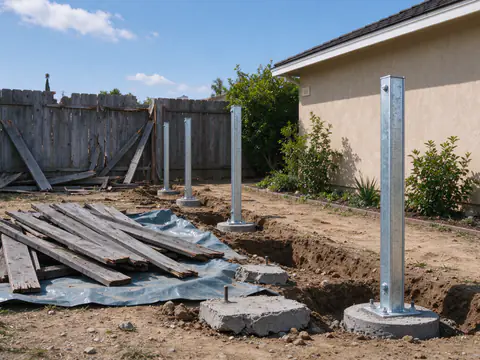
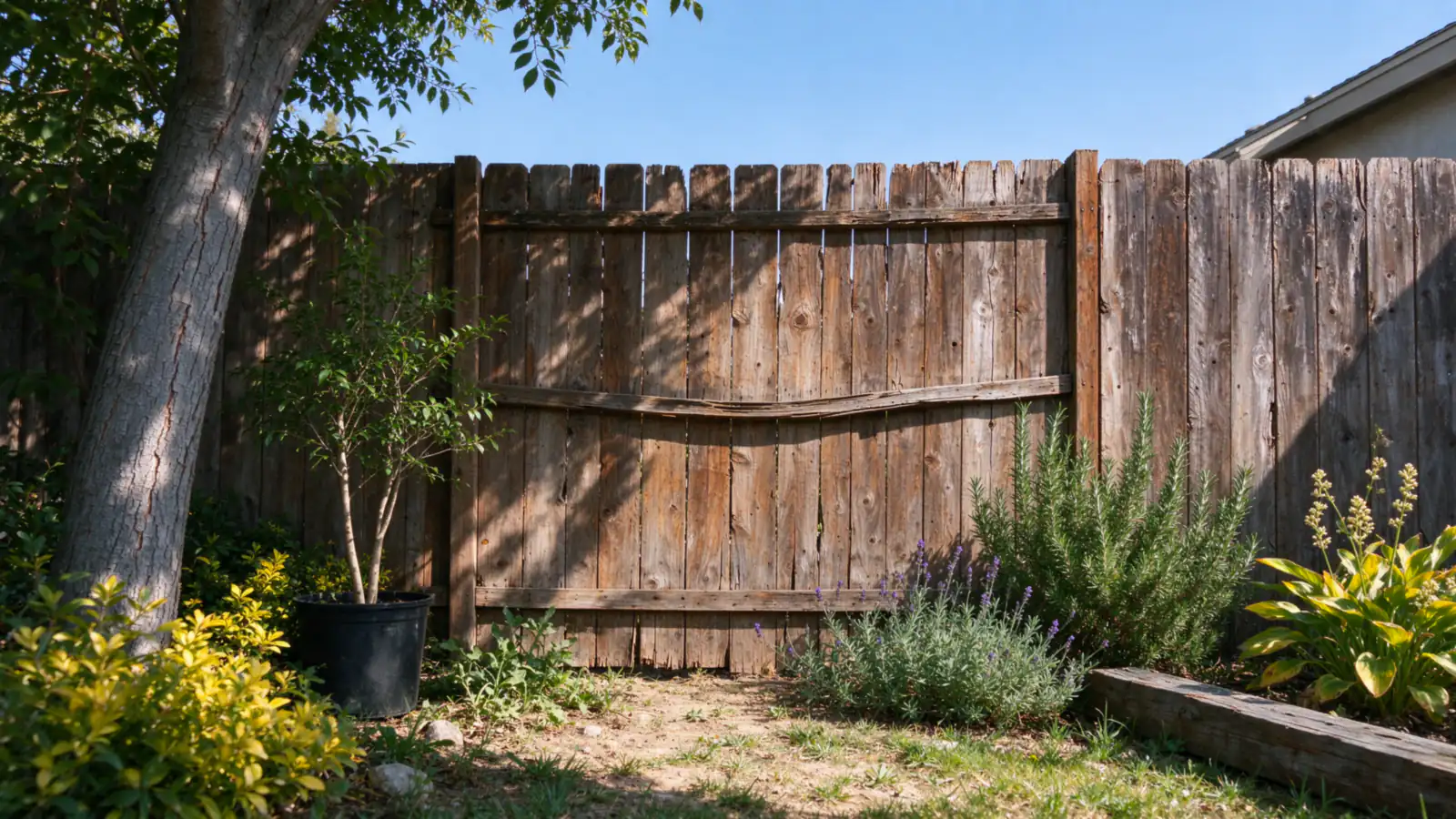
Among common residential fences, a well-built decorative block wall or a properly coated steel or aluminum fence usually stands the longest, followed by vinyl, then redwood or cedar heartwood on good posts, with fir at the shorter end. But no material carries a guaranteed lifespan. In Ontario, how long a fence lasts depends mostly on its posts, the sun, sprinkler water, termites and wind.
Grove Ontario Fence Builders replaces and repairs fences across Ontario and the west Inland Empire, with the work carried out by licensed and insured fence contractors. Fences rarely wear out evenly. They fail at specific points for specific reasons, and knowing those reasons is the best way to choose a fence that lasts and to keep the one you have standing longer.
What decides how long a fence lasts
Four things set a fence’s life, roughly in this order: how the posts meet the ground, what the visible material is made of, the local climate, and maintenance. A redwood fence on rotted posts falls over with good boards on it. A vinyl fence on shallow footings leans in the first strong wind. That is why the honest answer to “how long will it last” is a list of conditions rather than a number of years.
| Material | What usually ends its life here | What extends it |
|---|---|---|
| Fir or pine wood | Rot at the posts, sun checking, termites | Ground-contact posts, stain, keeping sprinklers off |
| Redwood or cedar heartwood | Post failure more often than board failure | Heartwood grades, steel or treated posts, regular stain |
| Vinyl | Cracked or brittle parts, wind-loosened posts | Reinforced posts, UV-stable profile, room for expansion |
| Tubular steel or aluminum | Rust where the coating is broken (steel), loose posts | Intact powder coat, touch-up, sound footings |
| Chain link | Loose fabric, rusted ties, bent rails | Galvanized or coated fabric, proper tension |
| Decorative block wall | Footing movement, cracks from roots or impact | Engineered footing, drainage, a sound cap |
Sun: the slow, steady wear
NOAA’s 1991-2020 climate normals for Ontario International Airport average 93 days a year at or above 90°F and 19 days at or above 100°F. Ultraviolet light breaks down the lignin at the surface of wood, which is why boards turn gray and fuzzy, and heat drives the drying cycles that cause checking, cupping and loose fasteners. South- and west-facing runs show it first.
UV also works on vinyl and on the powder coat of metal fences, more slowly. Vinyl profiles include UV inhibitors, and white and light colors handle heat best. Dark colors on any material run hotter. The vinyl vs wood guide compares how the two main privacy materials age in this sun.
Moisture: where rot actually happens
Ontario averages under 12 inches of rain a year, so weather alone rarely rots a fence. Water from sprinklers and soil contact does. Wood rots where it stays damp: at grade where the post enters the footing, on the bottom edge of boards that touch soil or mulch, and on any face that takes daily sprinkler spray. A footing poured with a flat or dished top holds water against the post at exactly the point where it is weakest.
The fixes are simple to build in and hard to add later. Posts rated for ground contact, footings crowned to shed water, a gap between the bottom of the boards and the soil, and sprinkler heads turned away from the fence all slow rot. A stain or sealer protects the surface but cannot reverse decay that has already started, so a post soft at grade needs replacing, not coating.
Termites in rails, pickets and posts
UC IPM’s pest note on drywood termites says the western drywood termite is common along the Pacific coastal region and into the deserts of Southern California, and that drywood termites nest in wood without needing soil contact. That means rails and pickets can be infested even when the posts sit in concrete. The subterranean termite note adds that wood in soil contact should be treated or naturally resistant, and lists untreated fence posts near a structure among things that can contribute to an infestation.
Heartwood redwood and cedar resist termites better than sapwood or fir, and steel posts remove the in-ground food entirely. The termites and fence posts guide explains how to tell the two kinds apart and what to check when an old fence comes out.
Sandy soil and how posts are set
USDA soil survey data maps much of central Ontario as Tujunga loamy sand, about 80 percent sand, and parts of Ontario Ranch as Delhi fine sand at roughly 96 percent. These soils drain fast and barely swell or shrink, which is good for posts, but loose sand holds a post less firmly than heavier ground. A footing in sand gets its grip from its depth and diameter. Undersized footings let posts rock a little in each wind event, and over seasons that movement becomes a lean.
There is no single right depth. It follows from fence height, panel type, post spacing and wind exposure, and a solid 6-foot fence generally needs more footing than a short open one. Gate posts carry a cantilevered load that line posts never see and need the largest footings on the job. The steel vs wood posts guide covers post choices and footings in sand.
Wind: repeated loading, not just one storm
The National Weather Service office in San Diego issued 44 High Wind Warnings for the Inland Empire valley zone from January 2016 through October 2026, with most from October through February. A fence that survives its first Santa Ana season can still be weakened by it. Each gust works the posts in their footings and pulls at fasteners, and a fence with marginal posts can fail in a later season rather than the first. Solid privacy panels take the most load; open iron and picket styles let wind pass. The Santa Ana winds guide explains why.
Staining and sealing a wood fence
Finish is the one factor an owner controls every year. A penetrating, pigmented stain soaks into the wood, blocks UV with its pigment and slows water absorption. Clear water-repellent sealers protect against water but let UV through, so the wood still grays. Film-forming paints look crisp at first but tend to peel on a fence that moves through dry and hot cycles, and peeling paint is harder to renew than stain.
Plan to restain every few years, and sooner on sun-facing sides. The boards should be clean and fully dry first. Air district rules in Southern California limit solvent content in coatings, so many stains sold locally are water-borne, and the product label gives the recoat interval for that formula. New wood fences are often left to dry for a while before the first coat; the stain maker’s instructions set how long.
Signs a fence is near the end
Some wear is repairable, and some means the system is finished. A single leaning post, a few broken boards or a sagging gate are repair jobs; the fence repair page covers them. Rot at grade on many posts, termite damage through the rails, sections leaning in the same direction after each wind or a vinyl fence whose parts are no longer made point toward replacement, covered on the fence replacement page. The repair or replace assessment walks through the same questions for your fence.
If you want to talk through which material will last on your line, call Grove Ontario Fence Builders at (909) 324-5352 or request an estimate. The cedar vs redwood guide and the metal fence comparison cover the longer-lasting options in more depth.
Is your fence worth repairing?
Send a few photos of the posts at ground level and the worst sections. That is usually enough to tell repair from replacement.