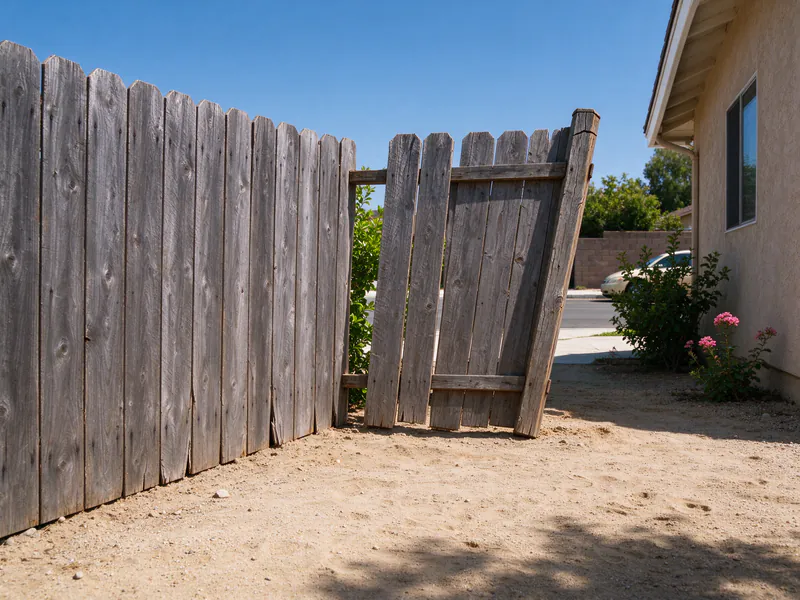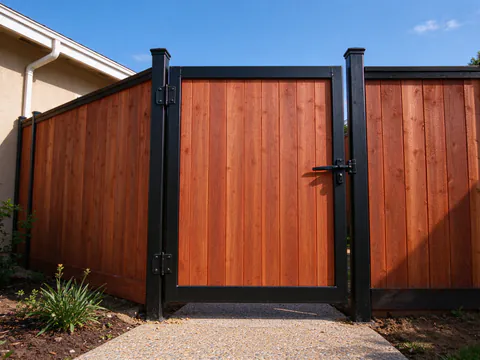
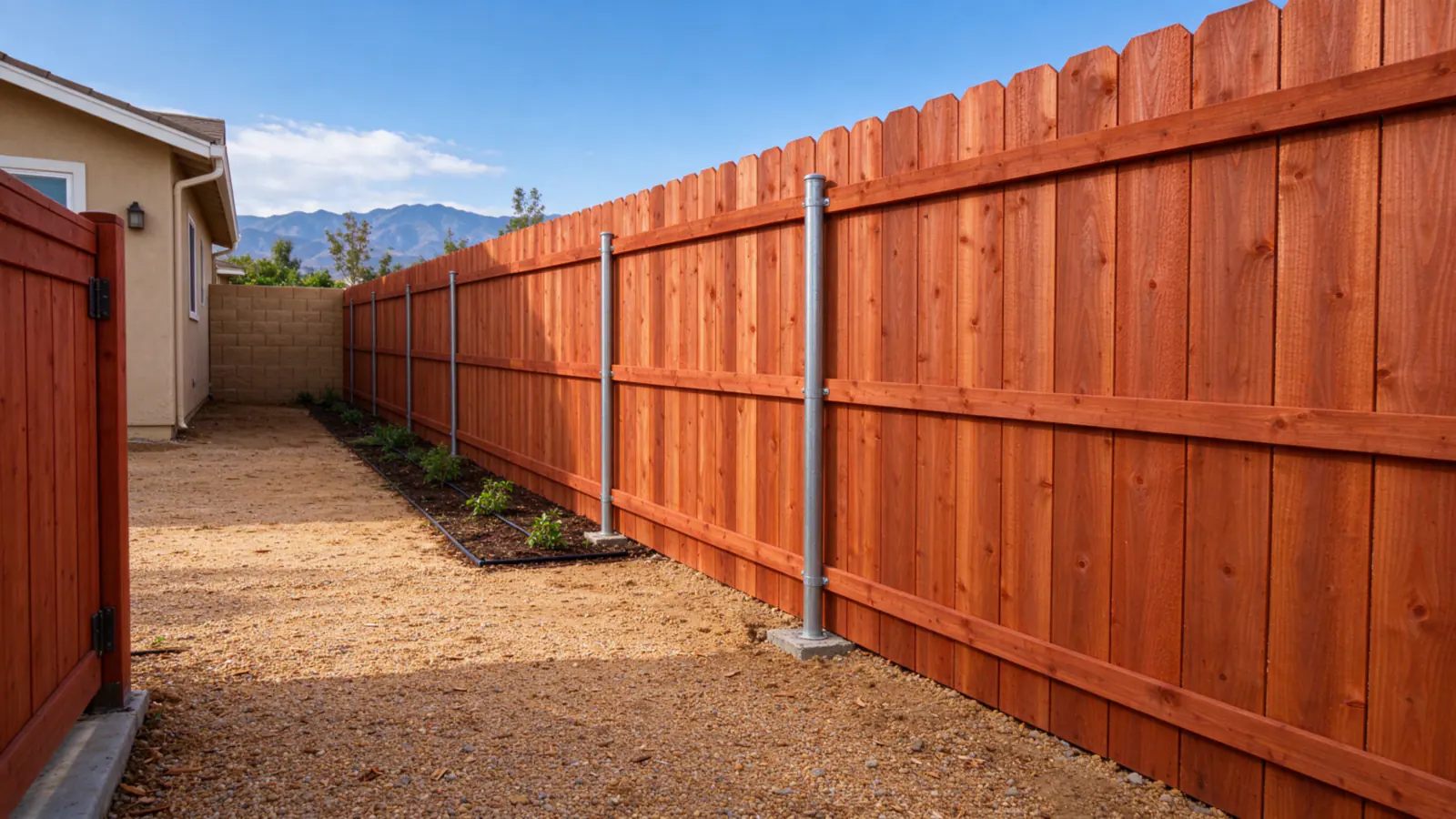
Wood fence installation in Ontario, CA starts with two facts many buyers do not expect: the city requires a building permit for any wood fence taller than 3 feet, and the sandy ground under most of Ontario gives a post less grip than firmer soil does. Grove Ontario Fence Builders plans and installs redwood, cedar and fir fences across Ontario and the west Inland Empire, from 6-foot side-yard privacy runs to 3-foot front-yard pickets. Installation is carried out by licensed and insured fence contractors. This page covers the decisions that set how long a wood fence stands here: the species and grade of the boards, what the posts are made of, how they are set, and which style suits a yard that takes Santa Ana wind.
Wood is still the lowest-cost way to put up a 6-foot privacy screen in Southern California and the easiest fence to repair one board at a time. Its weak points are local too: long, hot summers, termites, and posts that spend their whole life in the ground.
What happens on the first visit
The first visit is a walk of the line. The run is measured, corners and gate openings are marked, and grade changes are noted, because Ontario measures fence height from the lowest adjacent finished grade (Development Code 6.02.020.C). A fence on the high side of a slope loses usable height. Where the property line is uncertain, that question comes up before any price is final. An old fence does not prove where the line is, and the property line and survey guide explains when a licensed surveyor is needed.
The walk also records what shapes the post plan: whether an old fence is coming out and how its footings were set, where gates need heavier posts, how close the line runs to the house, and whether a neighbor shares the fence. A shared fence brings in California Civil Code 841, which presumes both owners benefit and share the reasonable cost after 30 days’ written notice; the good neighbor fence law guide walks through that notice. After that come the permit, any HOA approval and a DigAlert ticket, which Government Code 4216.2 requires at least two working days before the first post hole is dug. The fence installation process guide follows the job from there to the last gate.
Redwood, cedar or fir: species and grade
Species gets the attention, but grade often matters more. Redwood and western red cedar owe their decay resistance to heartwood, the darker wood from the center of the log. Sapwood, the paler outer band, has little natural resistance in any species. A redwood board graded Construction Heart is all heartwood. Construction Common allows sapwood and more knots, costs less and weathers less evenly. Cedar fence boards are mostly sold in knotty grades where the heartwood share varies from board to board.
Fir is the budget wood. Douglas fir and the red-stained fir pickets sold for fencing are strong and take stain well, but they resist decay less than redwood or cedar heartwood, so they depend on a finish and on staying off the soil. Board width and thickness move the material cost as much as species does: a wide, thick fir board can cost more than a thin cedar one. The cedar vs redwood guide compares the two premium woods in depth, and the table below this article sets all three side by side.
Sun is the other half of the choice. NOAA’s 1991-2020 climate normals for Ontario International Airport average 93 days a year at or above 90°F and 19 at or above 100°F, with under 12 inches of rain. Wood in that climate dries, checks and turns gray faster than it does near the coast. A penetrating stain with UV-blocking pigment slows the change, and it needs renewing every few years; no stain or sealer reverses rot once it has started. Frost is not a concern: the same normals show fewer than two nights a year at or below freezing.
Posts: pressure-treated wood or galvanized steel
Most wood fence failures in the Inland Empire start at the posts. A post carries the wind load of its whole panel into the ground, and it is the only part of the fence that sits in soil. UC IPM’s pest note on subterranean termites (Publication 7415) says wood in contact with soil should be chemically treated or naturally resistant, and lists untreated fence posts near a structure among the things that can contribute to an infestation. Its drywood termite note (Publication 7440) adds that the western drywood termite is common in Southern California and nests in wood without needing soil contact, so rails and pickets are exposed as well. The termites and fence posts guide explains how to tell the two kinds apart.
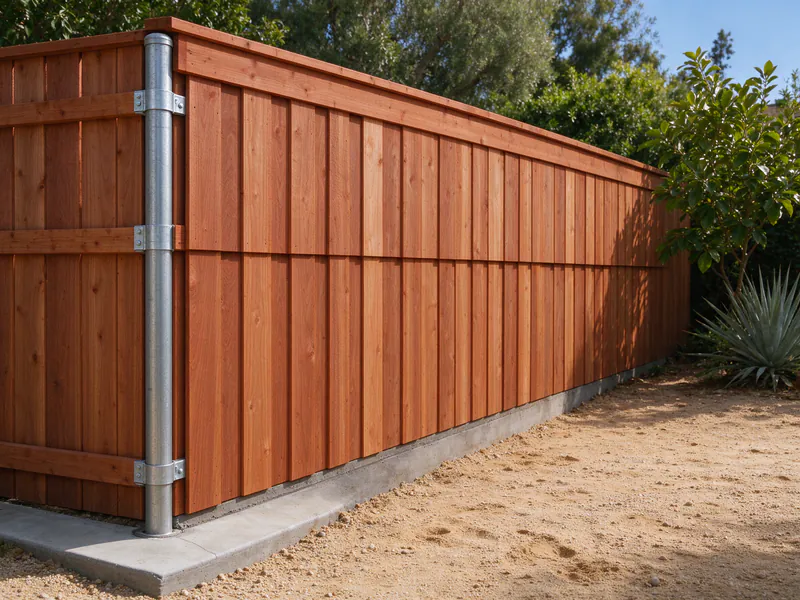
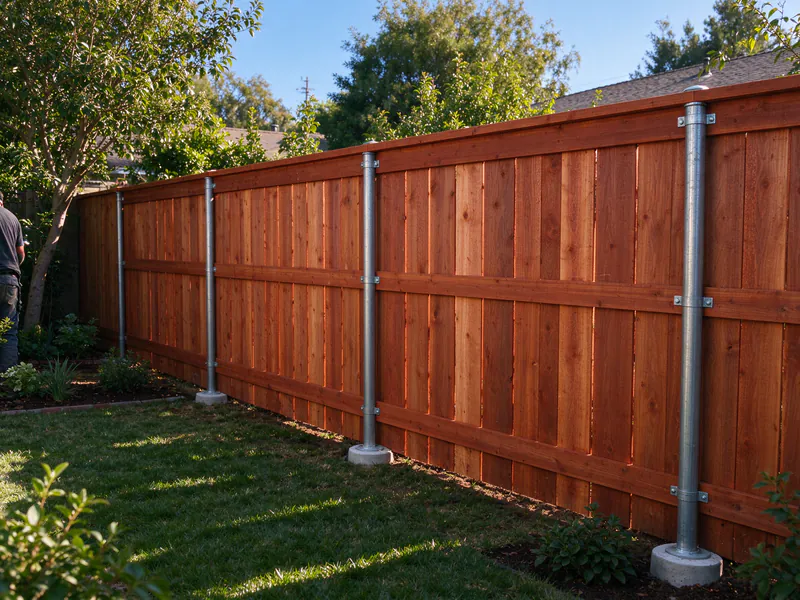
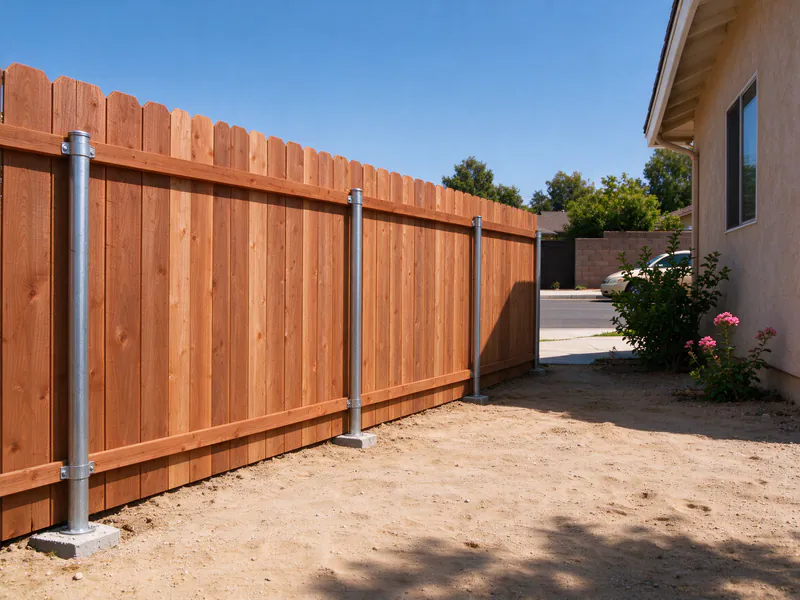
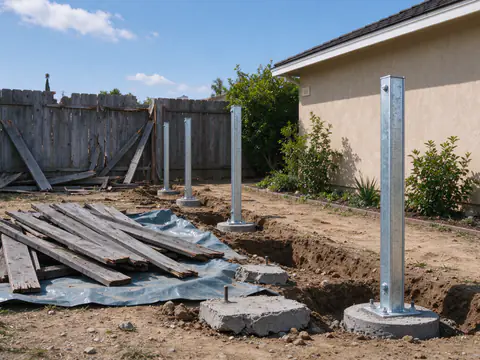
That leaves two sound choices. A pressure-treated post rated for ground contact, usually treated Douglas fir or hem-fir in the West and southern pine elsewhere, is the traditional option. It matches the fence and is easy to fasten to. A galvanized steel post, with wood rails bolted to it through brackets and the boards hiding it from the street side, cannot rot or feed termites and is stiffer in wind. It costs more in material, and the frame has to be planned before the boards are cut. With either post, the top of the concrete footing is crowned so water runs away from the post instead of pooling where wood meets concrete. The steel vs wood posts guide covers post sizes and bracket types.
Setting is where Ontario’s soil comes in. USDA soil survey data puts central Ontario on Tujunga loamy sand, about 80 percent sand, and much of Ontario Ranch on Delhi fine sand at roughly 96 percent sand. Both drain quickly and barely shrink or swell, which helps, but loose sand holds a post less firmly than heavier ground. The city’s structural design criteria (Information Bulletin 103) assume wind Exposure C, meaning open terrain, with ultimate wind speeds of 103 mph for Risk Category I structures and 110 mph under the residential code; which category a fence falls in is the plan checker’s call. No single post depth is correct everywhere. Depth follows from fence height, post spacing, soil and wind, and a 6-foot solid fence in sand generally needs deeper or wider footings than a short open one. The Santa Ana wind guide explains what a gust does to a fence line.
Plan the posts before the boards
Send the line length, the height and the style. The post type, spacing and footing come first in the plan.
Wood fence styles and what each does in the wind
Every solid style takes the full force of the wind, so choosing between them is about looks, privacy and board count more than strength.
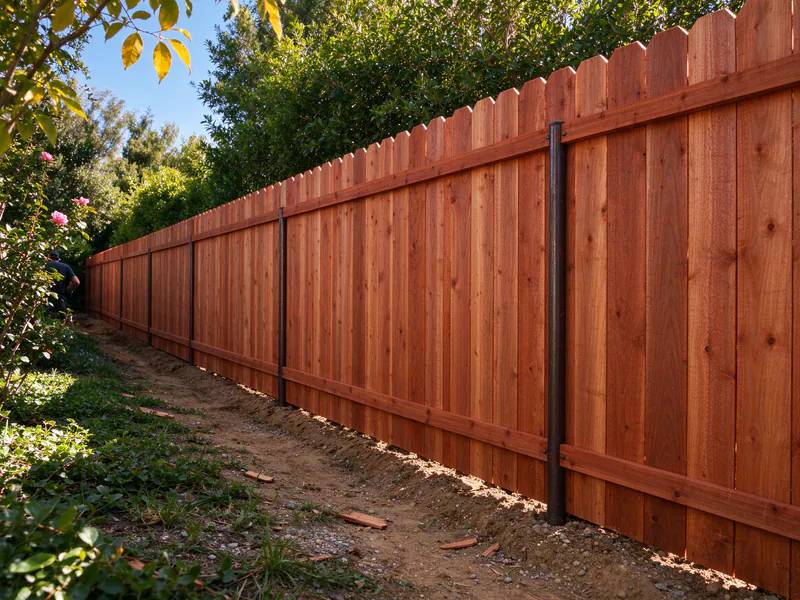
- Dog-ear. Boards with clipped top corners, butted edge to edge on two or three rails. It is the most common privacy fence on Southern California tract lots and uses the least material per foot. Small gaps open as the boards shrink in dry weather.
- Stockade and flat-top. The same solid face with pointed or square tops, often finished with a cap rail and trim board that also shield the board ends from sun and rain.
- Board-on-board. Boards overlap on alternating sides of the rails, so no gap appears when they shrink. It takes more boards per foot and is fully solid to wind, which moves it toward the top of the price range.
- Shadowbox. Boards alternate on each side of the rails with space between them, so the fence looks finished from both sides and air passes through at an angle. How much load that relieves depends on the gaps, so the posts are still planned close to a solid fence.
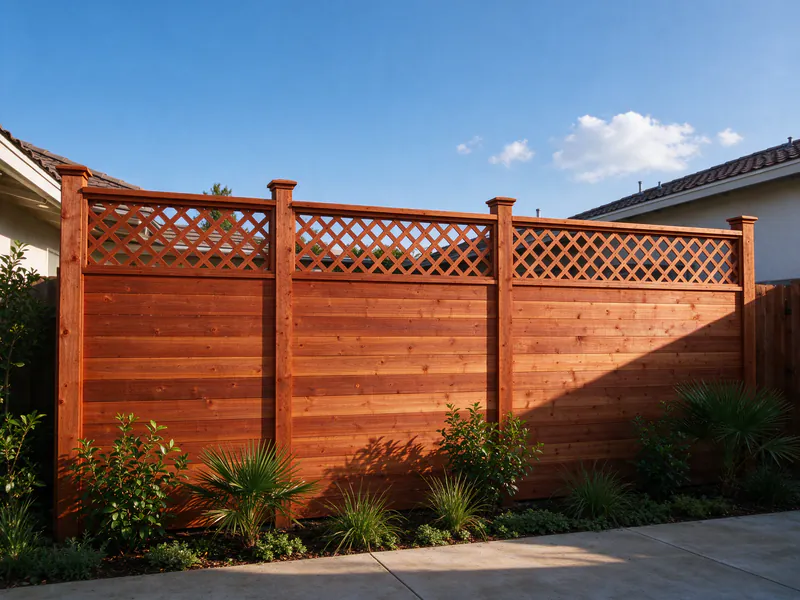
- Lattice-top. A solid lower section under an open lattice band. The lattice adds height that lets air through and softens the top line of a 6-foot fence.
- Picket. Spaced boards on a low fence, the usual front-yard choice. In Ontario a front-yard fence tops out at 3 feet, and at that height no building permit is needed.
- Split rail and ranch rail. Two to four horizontal rails, mostly open, for larger lots. In Ontario’s AR-2 and RE-2 equestrian zones the Development Code prefers wood rail or plank fencing along the trail easement and holds it to 48 inches at the easement edge.
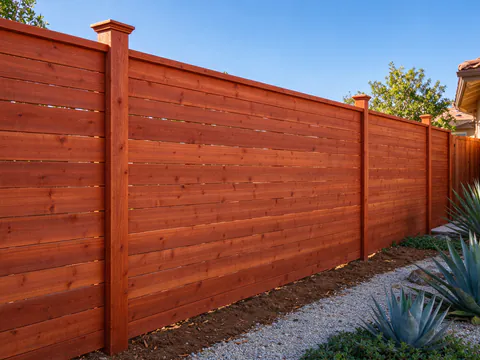
The real decision on a windy line is privacy or semi-privacy. A semi-privacy style such as shadowbox or a lattice top gives up some screening for a fence that catches less wind and looks the same from both sides, which helps when a neighbor shares the line. A horizontal slat fence is a different build, framed to keep long boards from sagging, and it has its own horizontal fence installation page. If you are still choosing a material, the vinyl vs wood fence guide and the vinyl fence page cover the main alternative.
Ontario’s permit and height rules for a wood fence
The City of Ontario’s Building Permit FAQ requires a building permit for wood fences over 3 feet, so almost every privacy fence in the city is a permitted job, held to 6 feet on side, street-side and rear lines by Development Code 6.02.020. Ontario Ranch tracts add specific plan and HOA rules that can set fence and wall materials on certain lines, and the Ontario Ranch page covers them. Rancho Cucamonga draws its permit line at 6 feet instead, as the Rancho Cucamonga page explains. CAL FIRE maps no fire hazard severity zones inside Ontario, but foothill cities have them, and the wildfire zone fence guide covers wood near a house there. The full height and permit rules are in the Ontario fence permit guide.
What a wood fence costs in Ontario
A typical Southern California range for a 6-foot redwood or cedar privacy fence, installed, is about $30 to $70 per linear foot. At those rates a 100-foot run works out to roughly $3,000 to $7,000 before gates, removal and the permit. That is a budgeting figure, not a quote. Redwood heart grades, board-on-board and cap-and-trim styles, steel posts, slopes that need stepped sections and hard digging push a job toward the top. A plain dog-ear run on an open, level line, especially in fir, sits toward the bottom. Taking out an old fence and hauling it away typically adds $3 to $8 per linear foot, more when old concrete footings have to come out; the fence replacement page covers that work, and a fence that only needs posts or boards belongs on the fence repair page. Gates are priced by size, frame and hardware, through gate installation or, for 12 to 16 foot openings, RV and driveway gates.
The permit is part of the budget in Ontario. The city sets building permit fees by project valuation, and as an example from its published fee table, a $6,000 valuation gives a $125.25 permit, or about $226 if plan check at 80 percent of the permit fee applies and the small state fee is added. Labor costs a little more here than nationally: fence erectors in the Riverside-San Bernardino-Ontario metro earn a mean $26.95 an hour, about 11 percent above the $24.29 national mean, according to the Bureau of Labor Statistics. A wage is not a billing rate, since a contractor’s price also carries materials, insurance, licensing, vehicles, disposal and overhead. The fence cost estimator turns length, height and gates into a range, and the Ontario fence cost guide breaks the numbers down further.