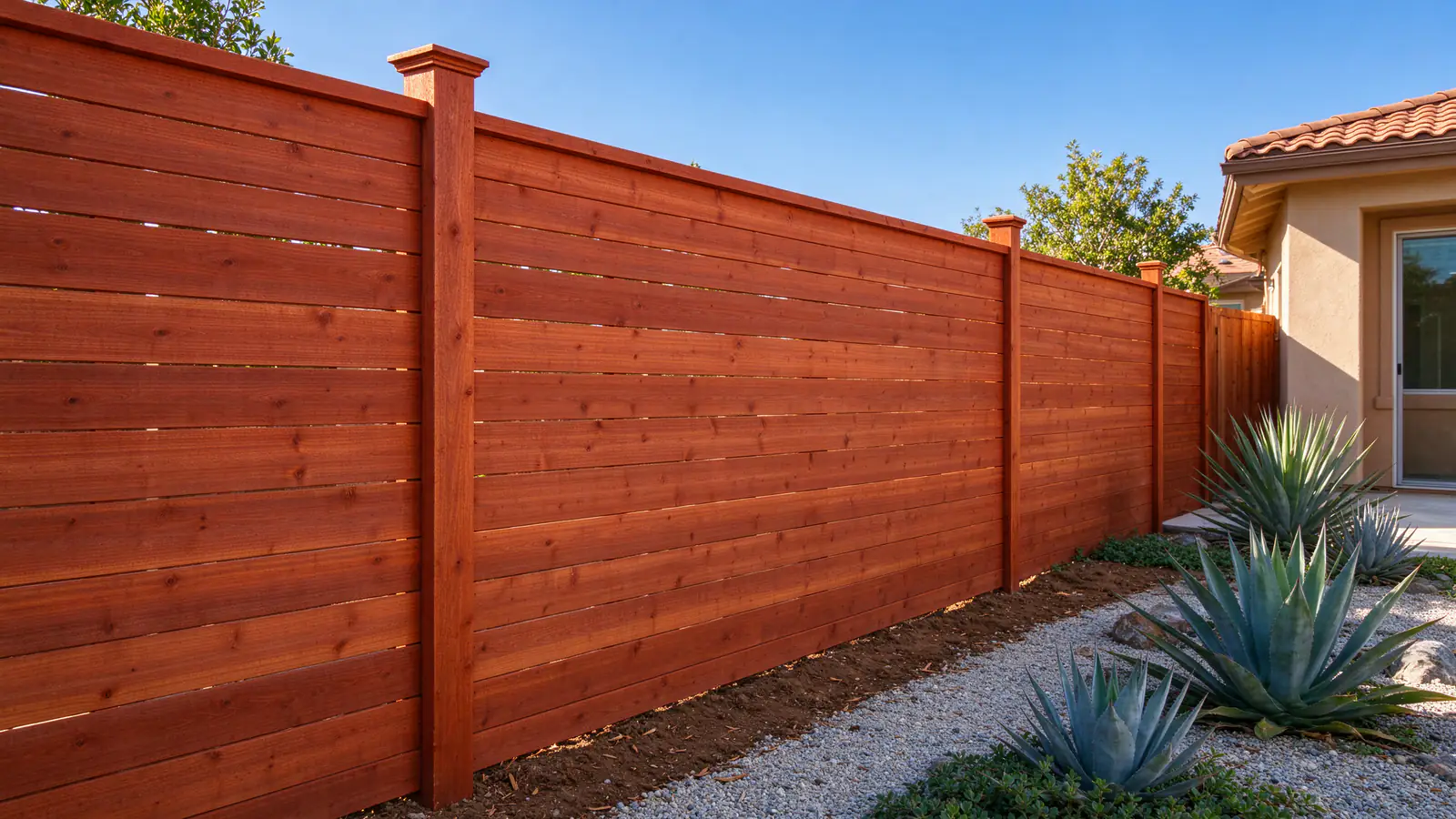
Horizontal fence installation in Ontario, CA is not a vertical fence turned on its side. In a horizontal fence each board spans from one support to the next, which makes the board itself the rail, and that changes the post spacing, the framing, the fasteners, the finish and the gates. Grove Ontario Fence Builders installs horizontal slat fences in redwood, cedar, fir and vinyl across Ontario and the west Inland Empire. Installation is carried out by licensed and insured fence contractors. This page covers what makes a horizontal fence stay straight in a hot, windy valley and what it asks of the build that a standard wood fence does not.
Horizontal slats suit the low, stucco houses common across the Inland Empire and make a narrow yard look wider. They also show every flaw: a board that sags half an inch reads from across the yard as a crooked line, where the same movement in a vertical fence goes unnoticed.
What happens on the first visit
The walk measures the line and the grade, as on any fence, and then turns to questions specific to horizontal work. The board look comes first: board width, thickness, species or vinyl profile, and the gap between boards. Those choices set the post spacing, which is laid out before anything else is priced. A slope is a bigger question than usual, because horizontal boards cannot be racked to follow the grade without looking wrong, so a sloped line is stepped section by section and each step has to be planned.
The walk also asks which side the neighbor sees. On a shared line, California Civil Code 841 presumes both owners share the reasonable cost of a dividing fence after 30 days’ written notice, and a horizontal fence with framing exposed on one side is a common source of disagreement; the good neighbor fence law guide explains the notice. Property lines, any HOA approval, the permit and a DigAlert ticket follow, as described in the fence installation process guide.
Why horizontal boards sag, and how framing stops it
A vertical fence board is held by two or three rails and carries almost no load along its length. A horizontal board is a small beam. Its own weight, the weight of the boards fastened above it in some designs and every gust of wind all push on the middle of its span. Over months, a board that is too thin for its span bows. Wood also moves as it dries, and in a climate with about 93 days a year at or above 90°F, according to NOAA’s normals for Ontario’s airport, boards lose moisture fast. As they shrink across their width they tend to cup, and long boards can twist off their supports.
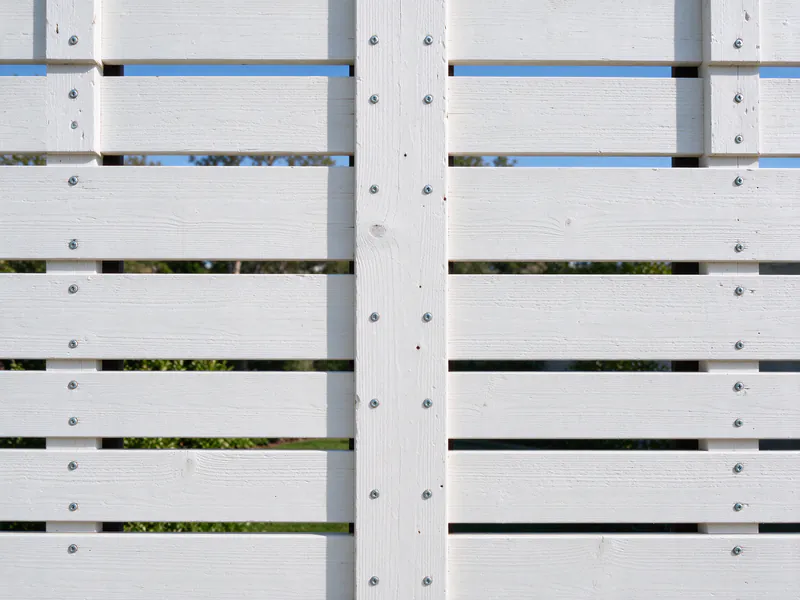
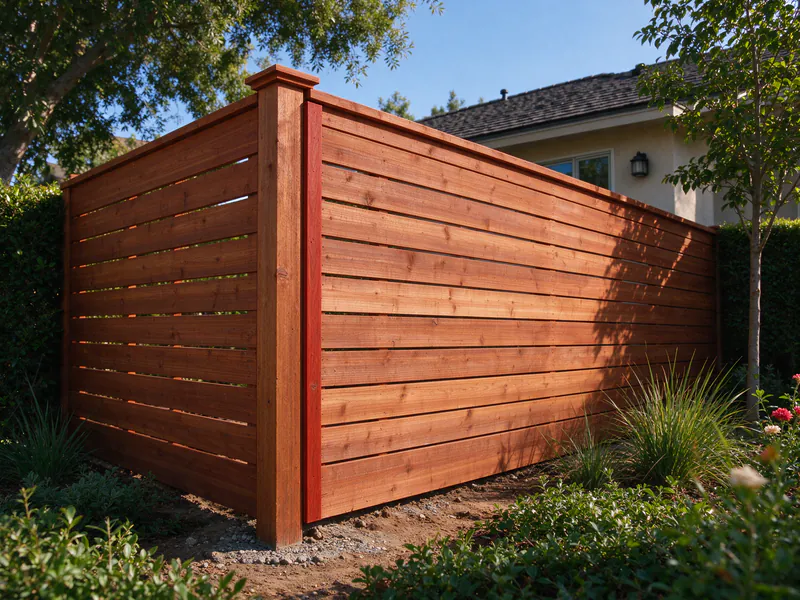
The fixes are structural, not cosmetic. Posts go closer together than the 8-foot spacing common on vertical privacy fences, and the exact spacing follows the board thickness. A vertical support at mid-span, fastened to every board, halves the unsupported length. Thicker boards resist bowing far better than thin ones; a fence of thin pickets laid horizontally on wide spacing is the version that fails first. A top cap fastened across the upper edge of every section ties the board ends together and shields the top edge from sun.
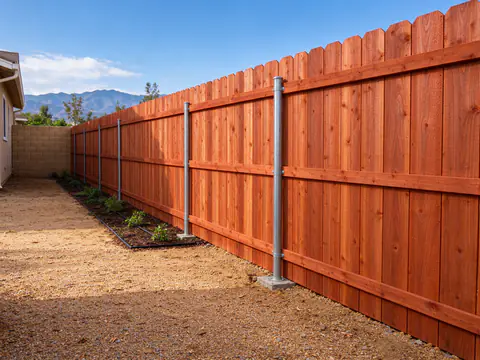
There are three common ways to frame the result, compared in the table on this page. Boards screwed to the face of the posts with a center support is the simplest. Framed panels box the boards in rails, a cap and trim. Galvanized steel posts with U-channels let the boards slide in and float as they shrink and swell, which handles movement well and removes rot and termite risk at the posts; the steel vs wood posts guide covers them. Rancho Cucamonga requires residential wood screening fences to have steel frames, which makes the steel options the standard there.
Board spacing, fasteners and the finish
Gap width is a decision, not a byproduct. Boards are usually set with spacers so the gaps stay even along the run. A board installed while still holding moisture shrinks in the dry months and the gap grows; a board installed very dry can swell slightly in winter. The gap is chosen with that movement in mind, so a fence meant to look tight in October does not open into visible stripes by August.
Fasteners carry more load in a horizontal fence, because the board hangs on them instead of resting on rails. Two screws per board at every support is the norm, and they are corrosion-resistant. Uncoated steel reacts with the tannins in redwood and cedar and leaves black streaks running down from each fastener, so stainless or coated screws are standard on those species. The cedar vs redwood guide compares the two woods.
Finish matters more on horizontal boards, too. The top edge of every board faces the sun and catches sprinkler water, which is where checking and graying start. A UV-blocking penetrating stain applied to faces, edges and ends, often before installation so hidden surfaces are covered, helps a horizontal fence weather evenly. It needs renewing every few years, and no stain reverses decay once it has started.
Choose the board, then the post spacing
Send the board width and gap you like, plus the length and height. The framing is planned around them.
Finished on both sides
A single-sided horizontal fence shows its posts, supports and screw lines to whoever is on the back side. On a street-side line or a shared fence that can be a problem. There are three ways around it. Boards can go on both faces of the posts, which looks finished from either side and adds a second set of boards. The back side can be boxed with trim so the frame reads as deliberate. Or steel channel posts can be used, which look much the same from both sides.
Two-sided fences cost more in boards and labor, and they are heavier, which the posts and footings must carry. They are also fully solid to the wind. Whether a city permit asks for the finished side to face the neighbor or the street is confirmed per address when the permit is applied for.
Wind, sandy soil and the posts
A horizontal slat fence catches the wind like any privacy fence. Narrow gaps let a little air through, but a 6-foot slat fence still behaves close to a solid face in a gust, and the National Weather Service issued 44 High Wind Warnings for the Inland Empire valley zone around Ontario from January 2016 through October 2026. In a horizontal fence that load arrives at the posts through the fasteners at each board end, so a board fastened only at its ends can work its screws loose over a few windy winters. The center support spreads that load as well as stopping sag.
The posts are set for the full load. USDA soil survey data puts central Ontario on Tujunga loamy sand and much of Ontario Ranch on Delhi fine sand, both loose, and the City of Ontario’s Information Bulletin 103 assumes wind Exposure C. Footing depth and width are sized from the height, the post spacing, the soil and the exposure, not taken from a single number. The Santa Ana winds guide explains the forces in more detail.
Horizontal vinyl and other variations
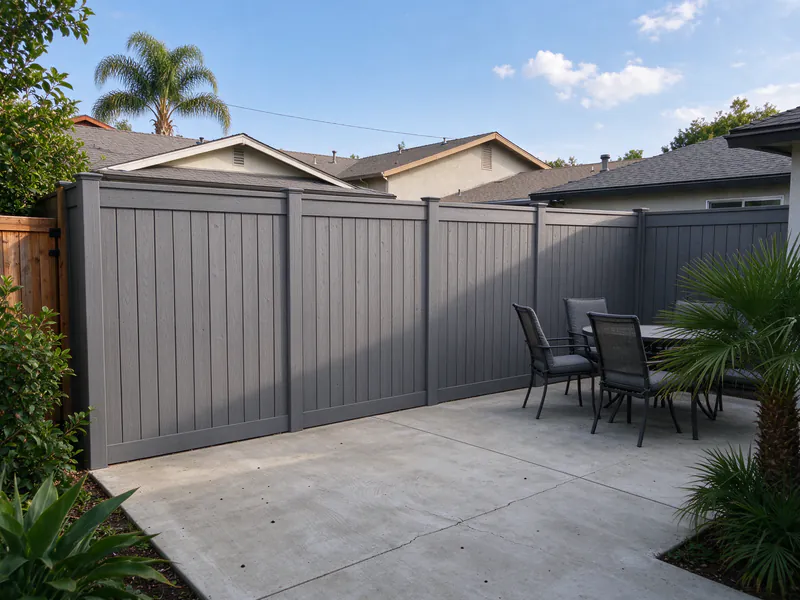
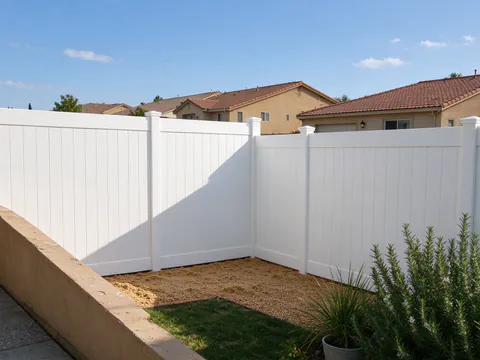
Horizontal vinyl systems use interlocking slats that slide into routed posts. They avoid staining and rot, but PVC softens in heat, so spans are shorter than in wood and an aluminum stiffener or an intermediate post keeps long slats from drooping in summer. Darker and wood-grain colors run hotter and move more. The vinyl fence page covers how vinyl systems are reinforced. In Ontario Ranch, where plans such as Edenglen bar wood on some perimeter fencing, horizontal vinyl or another wood-look material is often the way to get the look; the Ontario Ranch page explains those rules.
Some owners ask for a fence that is horizontal on their side and vertical on the neighbor’s. It can be built with boards on both faces of a frame, at roughly the cost of two fences’ worth of boards. Horizontal boards fastened to wood strips bolted onto a block wall are a different job and a frequent failure point; the block wall extension page explains how a wall is checked and how a topper is mounted.
Gates in a horizontal fence
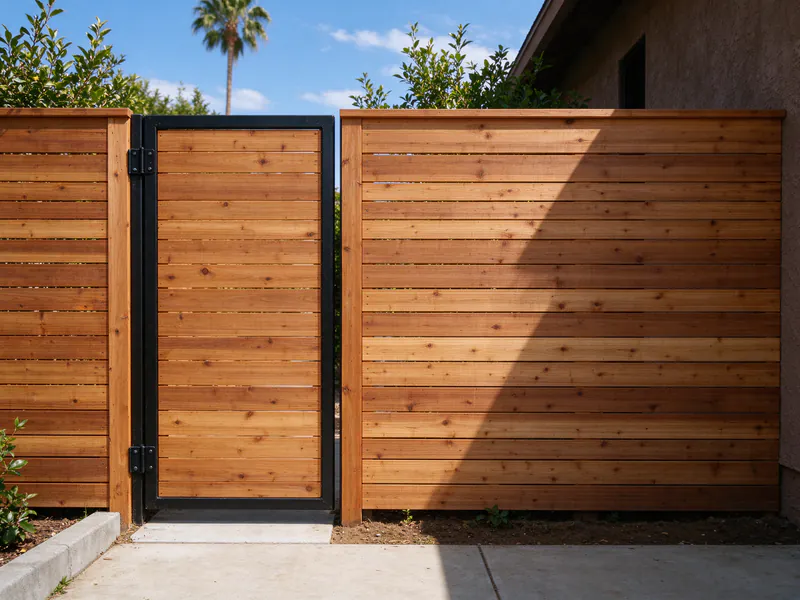
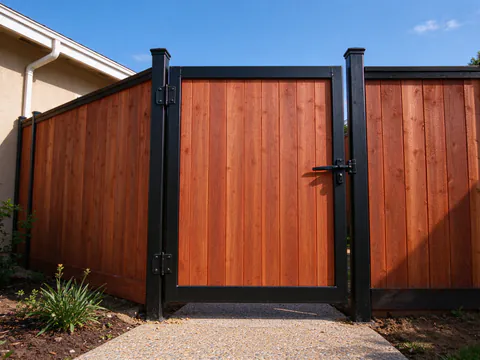
A gate is where horizontal fences most often go wrong. A vertical board gate is held square by a diagonal brace; horizontal boards give no bracing, so a gate built from boards alone racks and its latch side drops within a season. The reliable answer is a welded steel frame with the boards mounted on it, hung from a heavier gate post on hinges rated for its weight. The gate installation page and the sagging gate guide cover gate posts and hardware.
What drives the price of a horizontal fence
Horizontal fences are priced from their parts rather than from a standard per-foot band. Board count per foot is higher than on most vertical fences, especially with narrow gaps or two finished sides. Closer post spacing adds posts and footings. The framing method, steel posts and channels, the cap and trim, a stain on all surfaces and steel-framed gates all add cost, while fir boards and a single finished side reduce it. Ontario’s building permit for wood fences over 3 feet applies here too, and the fence cost guide explains how the city’s valuation-based fee is figured. Taking out an old fence and hauling it away typically adds $3 to $8 per linear foot, covered on the fence replacement page.