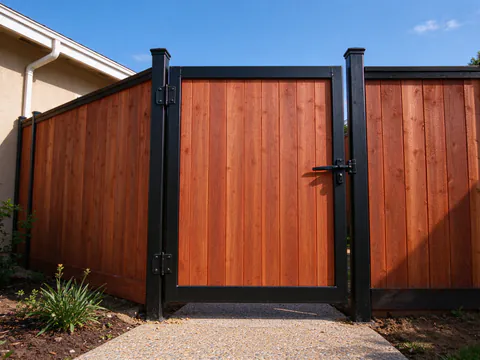
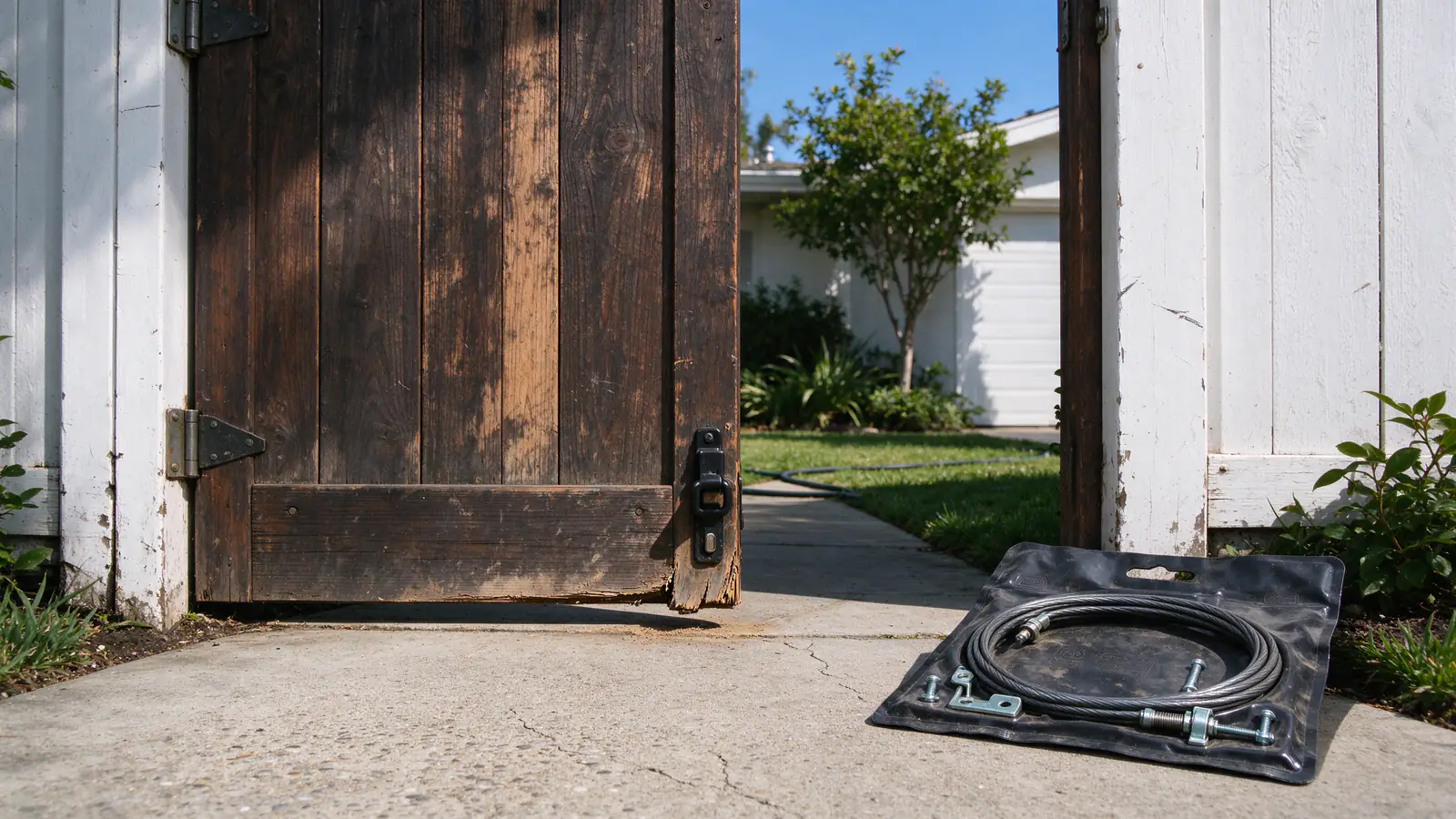
Find out what moved before adjusting anything. A sagging gate often traces back to the hinge post leaning or turning in its footing, not to the hinges. If the post is plumb, look at the hinges, the frame and the brace; a corrected brace or an anti-sag cable often fixes it. A hinge post leaning in loose sand needs resetting.
Grove Ontario Fence Builders installs, rehangs and repairs gates across Ontario and the west Inland Empire, from side-yard walk gates to double drive gates, with the work carried out by licensed and insured fence contractors. This guide covers the checks you can make safely yourself, what each finding usually means, and when a gate needs more than an adjustment.
Why gates sag
A gate is a lever. Its weight hangs off the hinge side, and the farther the latch side sits from the hinges, the harder that weight twists the hinge post. Double the width of a gate and you roughly double its weight as well as the distance it hangs out, so the turning force on the post grows about four times. That is why a 5-foot leaf sags far more readily than a 3-foot one built the same way, and why the post, not the gate, is usually the first thing to give.
Ontario’s ground makes that worse. USDA soil survey data maps central Ontario on Tujunga loamy sand, about 80 percent sand, and much of Ontario Ranch on Delhi fine sand at around 96 percent. Loose sand holds a footing mostly by its depth and width, so a hinge post set in a footing sized for a line post can rotate a little at a time until the latch no longer meets. Wood adds its own movement: with about 93 days a year at or above 90°F at Ontario’s airport, a gate frame built from damp lumber shrinks, its joints loosen and hinge screws driven into end grain pull out. Wind finishes the job. A gate left unlatched in a Santa Ana gust swings hard against its hinges, and the National Weather Service records most of the Inland Empire’s High Wind Warnings from October through February.
Safe checks before you adjust anything
These checks need a level, a tape measure and a helper, not digging or power tools:
- Close the gate and look at the latch side. Note whether the gap at the top is wider than at the bottom and whether the latch strikes low.
- Put a level on the hinge post, on the face and on the side. A post leaning toward the latch side means the footing, not the hardware, is the place to start.
- Push the top of the hinge post toward and away from the opening. Movement at the ground line means the footing or the post base has failed.
- Check the hinges. Look for loose screws, bent straps, and hinge pins worn oval.
- Measure the frame’s diagonals, corner to corner both ways. Unequal measurements mean the frame has racked out of square.
- Check the latch post too. If it has leaned away, the gate may be fine and the latch simply out of reach.
- Look at the post base for rot or termite damage at the grade line.
Do not lift a heavy wood or iron gate off its hinges alone. Support the latch side on blocks before loosening any hardware.
What you find and what it usually means
| What you find | Likely cause | Usual fix |
|---|---|---|
| Hinge post leans toward the latch side | Footing too small or shallow for the gate in loose sand, or rot at grade | Reset the post in a larger footing, or replace it with a steel or 6-by-6 post |
| Post plumb, frame diagonals unequal | Frame has racked; brace missing or installed backward | Correct the brace or add an anti-sag cable kit |
| Hinge screws loose or stripped | Short screws in end grain, or hinges too light for the gate | Through-bolt heavier strap or adjustable hinges into solid wood |
| Gate square, hinge post plumb, latch misses | Latch post has moved | Reset or brace the latch post, then reset the latch |
| Gate scrapes the ground | Sag, or the grade or paving has risen under the swing | Rehang with clearance or adjustable hinges after fixing any sag |
| Double gate leaves meet low in the middle | One or both leaves sagging, or no drop rod holding the inactive leaf | Square each leaf, add a drop rod and a center stop |
None of these symptoms proves a single cause on its own. A post can lean and a frame can rack at the same time, which is why the checks go in order from the ground up. The steel vs wood posts guide explains how hinge-post footings are sized, and the termites guide covers a post soft at the base.
Which way the brace goes
On a wood gate, the diagonal brace runs from the bottom corner on the hinge side up to the top corner on the latch side. The latch side wants to drop; with the brace in that position, its weight pushes down the brace into the bottom hinge corner, where the hinge carries it to the post. The brace works in compression, which is what a board does well.
A brace installed the other way, from the top hinge corner down to the latch side bottom, can only hold the gate by pulling on its end fasteners, which wood joints do poorly, and the gate sags anyway. Flipping the brace often fixes a racked frame on its own.
An anti-sag kit, a steel cable with a turnbuckle, runs the opposite diagonal from a wood brace: from the top hinge corner down to the bottom latch corner. It works in tension, pulling the latch corner back up as the turnbuckle tightens. It straightens a racked frame but cannot fix a leaning post, and tightening it against a moving post only pulls the gate out of shape in a new direction.
Wide gates, double gates and wind
Gates wider than a walk gate need more than hinges. A double drive gate or RV gate splits the opening into two leaves, and the inactive leaf is held by a drop rod, a steel rod that drops into a sleeve or hole in the pavement. A stop at the center keeps the leaves from swinging past each other and twisting their hinges. A wheel or caster under a long single leaf carries part of its weight on the ground, which only works where the ground under the swing is flat and hard. Homeowners report double vinyl gates swinging open in the wind when the leaves have no stop; a latch-side stop and a drop rod at the center answer that. The RV gate width guide covers wide openings, and gates with operators have their own load questions on the automatic gate installation page.
Vinyl and metal gates
A sagging vinyl gate is usually a reinforcement problem. Vinyl gate frames rely on aluminum or steel inside the rails, and vinyl hinge posts need an aluminum or steel insert, often set in concrete, to carry the gate’s turning load. A hollow vinyl hinge post flexes every time the gate closes until the latch no longer lines up. Parts are system-specific, so a manufacturer’s reinforcement kit may help where the frame is intact; a cracked frame at the hinge or an unreinforced post usually means rebuilding that side. The vinyl fence installation page covers how vinyl gates are reinforced from the start.
Iron and tubular steel gates sag when weld-on hinges wear, a weld cracks, or the steel post moves in its footing. Hinges can be replaced and welds repaired, but a moving post needs the same reset as any other. The wrought iron fence installation page covers those gates.
Pool gates are a safety repair
A gate in a pool barrier has to work every time. California’s Health and Safety Code 115923 calls for enclosure gates that open away from the pool and self-close and self-latch, with the latch at least 60 inches above the ground, and Ontario requires a full 5-foot nonclimbable enclosure around pools and spas. A sagging pool gate that drags, swings shut without latching or leaves a gap is a failed barrier, not a cosmetic problem. Keep the pool supervised and get it fixed promptly. The pool fence requirements guide and the pool fence installation page cover the rules.
When to rebuild instead of adjust
An adjustment is worth trying when the post is plumb and solid, the frame is sound and the problem is a brace, a hinge or a latch. A rebuild is the better scope when the hinge post is rotted, cracked or moving in its footing; when the frame is rotted at the joints; when the gate is wider than its post and hinges were ever sized for; or when the same gate has been adjusted more than once and keeps dropping. Splitting one wide leaf into two, or replacing a wood hinge post with steel in a larger footing, often solves a gate that adjustments never will. If the whole fence is failing along with the gate, the repair or replace assessment helps decide between a fence repair and a wider rebuild.
For a gate that will not stay square, call Grove Ontario Fence Builders at (909) 324-5352 or request an estimate and include a photo of the hinge side with a level on the post.
Gate dragging or missing its latch?
Send a photo of the hinge post and the gap at the latch, and the fix can be scoped from the ground up.