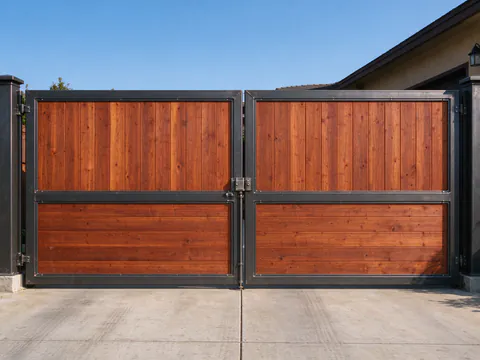
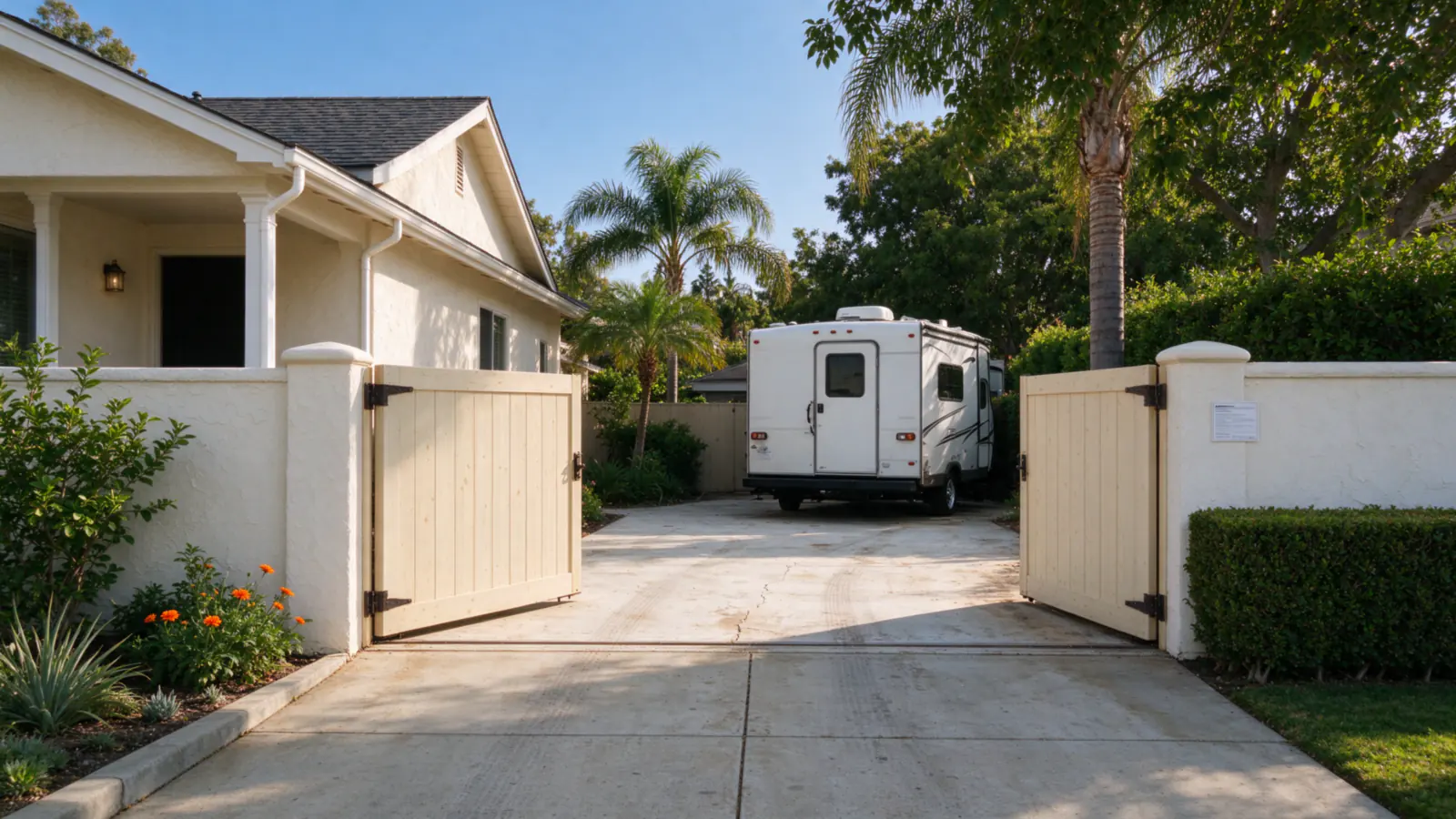
There is no single standard, but most residential RV gates are built with a clear opening of about 12 to 16 feet. Most RV bodies are about 8 to 8.5 feet wide, mirrors and awnings add more, and the extra width gives room to swing the rig in from the street at an angle instead of threading it straight through.
Grove Ontario Fence Builders designs and installs RV gates and double drive gates across Ontario and the west Inland Empire, with the work carried out by licensed and insured fence contractors. This guide explains how wide an RV gate needs to be for your rig and your lot, why the size on a quote and the space you can drive through are different numbers, and which Ontario rules shape where the gate goes.
How wide RVs actually are
Highway width limits keep most motorhome, fifth-wheel and travel trailer bodies at or under 102 inches, which is 8.5 feet. That body width is only the start. Side mirrors on a motorhome or the tow mirrors on a pickup stick out beyond the body on both sides, and awning arms, steps and grab handles add inches. Slide-outs are retracted for travel and do not count, but a rig with mirrors can measure close to 10 feet from tip to tip.
The quickest way to plan is to measure your own: mirror tip to mirror tip on the widest vehicle that will use the gate, plus the trailer body if you tow. If you are planning for a future rig, use the widest you might own. A boat on a trailer, a work truck with a utility bed or a car hauler each have their own widest point.
| Clear opening | What it usually fits | Approach |
|---|---|---|
| 10 ft | Small trailers, boats and utility trailers | Nearly straight in, with a spotter |
| 12 ft | An 8.5-ft rig with mirrors, little margin | Straight or a shallow angle |
| 14 ft | Most RVs with room for an angled approach | A moderate turn from the street |
| 16 ft | Long rigs, narrow streets and sharper turns | Turning in from the street or around a wall |
These are planning guides, not rules. A long fifth-wheel turning off a narrow street can need more than a short travel trailer on a wide street with a straight driveway.
Clear opening versus gate size
The clear opening is the space you can drive through with the gate fully open: the distance between the inside faces of the posts, minus anything that sticks into it. The size on a quote may be the gate leaf, the post centers or the rough opening, and those can differ from the clear width by several inches or more.
Width gets used up in a few places. The posts themselves take space, and posts for a heavy RV gate are larger than line posts. Hinges and latch hardware stick out from the post face. A swing gate that cannot open past 90 degrees, because a wall, a planter or the slope gets in the way, leaves its own thickness and hardware in the opening. A rolling gate’s guide rollers and catch post sit at the edges. When you compare quotes, ask each one to state the clear opening with the gate fully open.
Turning in from the street
A straight approach needs the least width. An angled approach needs more, because a long vehicle cuts the corner: the rear wheels of a motorhome, and especially the wheels of a trailer, track inside the path of the front wheels. The narrower the street, the more the rig has to turn in the last few feet, and the wider the opening has to be to catch the corner.
Ontario’s tract lots add two constraints. Many were built with masonry walls along the side and rear lines and decorative return walls between the side-yard wall and the house, so an RV gate often hangs in a return wall with block on both sides; the block wall vs fence guide explains why those walls are there. And because a 6-foot gate cannot sit in the front yard, the gate is set back from the street, which gives the rig room to straighten out before it reaches the opening but means the driveway has to carry the turn.
The best test costs nothing. Set cones where the posts would go, have a spotter watch the mirrors and the rear wheels, and make the approach you would make on a normal day. If you have to pull forward and back to line up, add width. The same test shows whether an existing double drive gate is worth widening or replacing. The driveway apron at the curb matters too: if it is narrower than the turn, widening it is construction in the street right-of-way, which in Ontario needs an encroachment permit from the City Engineer.
Swing gate or rolling gate
| Swing gate | Rolling or sliding gate | |
|---|---|---|
| Space it needs | A clear arc inside the yard for each leaf; a 14-ft double gate sweeps two 7-ft arcs | Level concrete across the opening for a track gate, or a clear run beside the opening for a cantilever gate |
| Slopes | Leaves can hit an uphill driveway unless they swing out or the hinges are set for it | Track gates need a level opening; cantilever gates roll above the ground |
| Wind | Open leaves catch wind and need stops and drop rods | Less exposed when open; closed gate still takes wind load |
| Hardware | Hinges, drop rods, center stop, sometimes wheels | Track and wheels, or rollers and a counterbalance section |
| Automation | Swing operators | Slide operators |
A cantilever gate has no track across the opening, which helps where the driveway dips or pavers would wear, but it needs a counterbalance section behind the opening, often around half the opening’s width again, and a straight run of fence or wall for it to roll along. A double swing gate splits the weight into two leaves, held at the center by a drop rod into a sleeve in the pavement. The sagging gate guide explains why wide leaves need that support.
Posts and footings for a wide gate
An RV gate is the heaviest load on any fence. A long leaf hanging off its hinges twists the post, and a solid gate also catches wind across its whole face. USDA soil survey data maps much of central Ontario on Tujunga loamy sand and Ontario Ranch on Delhi fine sand, and in loose sand a footing holds mostly by its depth and diameter. RV gate posts are usually steel, the same tube steel used for wrought iron and tubular steel fences, set in footings sized for the gate’s weight, width and wind exposure; the steel vs wood posts guide explains the footing logic. A partly open design, such as spaced pickets or a perforated panel, lowers the wind load during the Santa Ana season, when the National Weather Service records most of the Inland Empire’s High Wind Warnings.
Ontario rules that touch an RV gate
The City of Ontario’s rules decide where the gate goes and what it can be made of:
- Height and location. The Development Code limits front-yard fences and gates to 3 feet and side, street-side and rear fences to 6 feet, so a full-height RV gate sits at or behind the front setback.
- Corner lots and driveways. Nothing over 3 feet may stand in the corner clearance area at intersecting streets, and the city can require a corner cutoff where a driveway meets a street, set by a 45-degree line through a point 20 feet from the intersection. Walls, fences and hedges judged to affect safe entry and exit are limited to 3 feet within a required front or street-side setback.
- Permits. The city’s Building Permit FAQ requires a permit for wrought iron fences and gates over 3 feet, and for wood and chain link over 3 feet.
- Materials. Metal fences are limited to ornamental iron or tube steel, chain link or heavy wire mesh, so solid sheet-metal panels are a question to confirm with the city before ordering.
The permit and height rules guide covers these rules in full. Rancho Cucamonga works differently: it keeps anything over 3 feet out of a triangle with 10-foot sides where a driveway meets the street, and requires iron or steel screening gates to be backed with metal sheeting painted to match, as the Rancho Cucamonga page explains. Whether an RV may be parked in a side yard is a separate zoning and HOA question, confirmed for each address; in master-planned tracts the HOA fence approval guide covers the review step.
Adding an opener
An opener brings its own requirements: the gate has to move freely and stay square, the operator has to be rated for the gate’s weight and length, power has to reach it, and UL 325 safety devices such as photo eyes protect anyone in the gate’s path. The automatic gate installation page covers that work, and the gate installation page covers the walk gate that usually sits beside an RV gate.
To size an RV gate for your rig and your lot, call Grove Ontario Fence Builders at (909) 324-5352 or request an estimate with your rig’s widest measurement and a photo of the driveway from the street.
Size your RV gate to the rig, not the catalog
Send the widest measurement of your rig and a photo from the street, and the clear opening can be planned from there.