Automatic gate installation turns a driveway gate into a machine that moves on its own, often while the person who started it is sitting in a car and looking elsewhere. That changes what the gate needs. Grove Ontario Fence Builders installs gate operators, safety sensors and access controls on swing and sliding driveway gates across Ontario and the west Inland Empire, either on a new gate or on an existing one that is sound enough to automate. Installation is carried out by licensed and insured fence contractors, with a licensed electrician bringing in the power where a new circuit is needed. This page explains how operators are chosen, what UL 325 entrapment protection requires, why the power run is its own piece of work, and which access controls fit which household.
What happens on the first visit
The first visit looks at the gate before the opener. A swing gate is swung by hand through its whole arc to feel for binding, sag and loose hinges; a slide gate is pushed along its track or rollers. The posts are checked for plumb and movement, since an operator pushing a leaf hundreds of times a month will find any weakness. Then come the layout questions: which way the gate travels, where an operator can mount without blocking the drive, where the photo eyes and edges have to sit, how far it is to a power source, what the trench would cross, and where a keypad or intercom can stand. If the gate itself is not ready for a motor, that is said plainly, and the gate installation or RV and driveway gate work comes first.
Choosing a gate operator
Swing operators
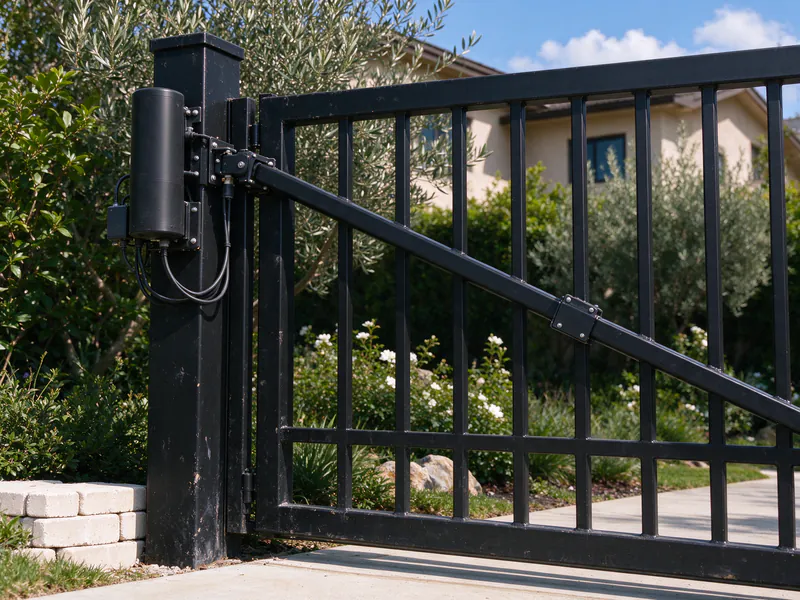
Swing gate operators come in two broad types, and both depend on a leaf that already hangs true, which the sagging gate guide helps check. An articulated arm bends like an elbow and mounts on the face of the post, which suits thick posts and pilasters with little room behind them. A linear actuator, a ram that extends and retracts, mounts between the post and the leaf and needs clearance behind the hinge. Double gates take two operators, one per leaf, timed so the leaves do not collide. Solid leaves are the hard case here: a 7-foot solid leaf in a Santa Ana gust pushes back on the operator arm, and National Weather Service warnings for the Inland Empire commonly forecast gusts of 55 to 75 mph.
Slide operators
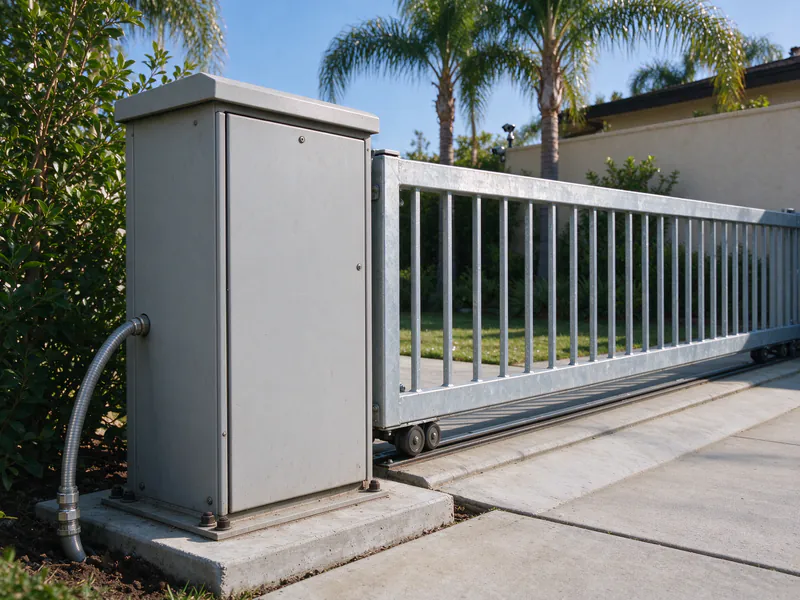
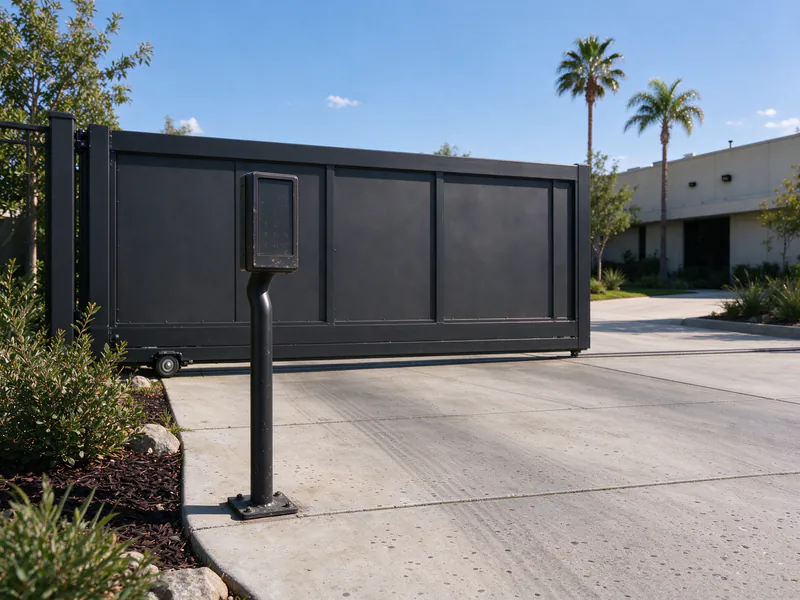
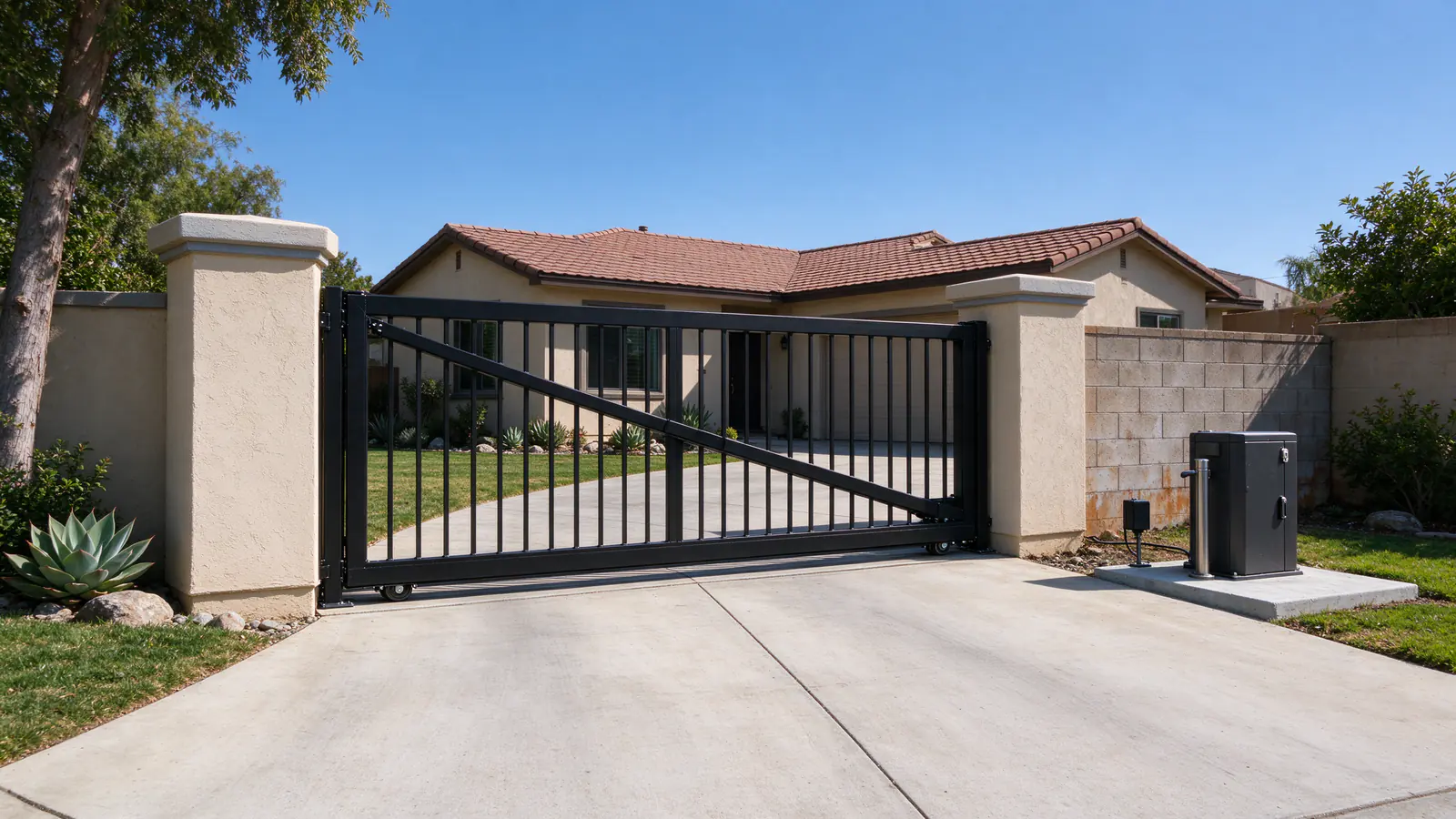
A slide operator sits on a concrete pad inside the yard and drives a toothed rack bolted along the gate frame. It works with rolling gates on a track and with cantilever gates on roller trucks, and it is generally less troubled by wind than a swing operator because the gate moves edgewise. A cantilever gate keeps the drive clear of a track, which also keeps sand and debris out of the mechanism.
Duty rating and usage class
Operators are rated for gate weight, gate length and how often they run. A residential operator listed for UL 325 Class I is meant for a home or a small group of single-family homes, not for a busy shared entry. A heavy gate opened dozens of times a day needs a heavier-duty operator than a light gate opened a few times. Choosing an operator at the edge of its rating shortens its life and makes it more likely to stall on a windy day. Gates for businesses and shared entries are scoped through commercial fencing.
Entrapment protection and UL 325
The biggest difference between a manual gate and an automatic one is who is responsible when something is in the gate’s path. UL 325, the safety standard that gate operators are tested and listed to, requires protection against entrapment: the places where a person, especially a child, could be caught between the moving gate and a post, wall or the ground. A compliant operator carries its own built-in protection that senses an obstruction, and it relies on external devices as well. Since the 2016 revision of UL 325, those external devices must be monitored by the operator, so a disconnected or failed sensor stops normal operation rather than leaving the gate running blind.
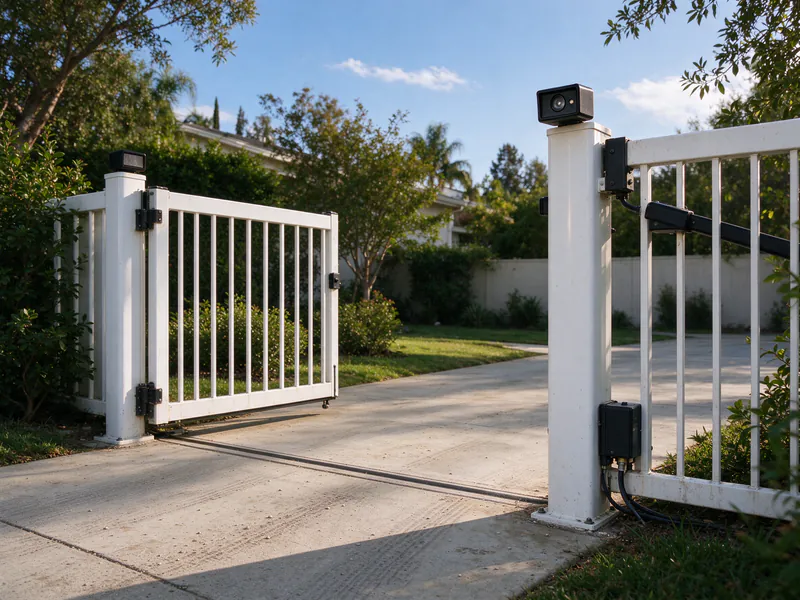
The two common external devices do different jobs. Photo eyes send an invisible beam across the opening and, on a slide gate, across the path where the gate parks; when the beam is broken, the gate stops or reverses. Contact edges are pressure-sensitive strips on the gate’s leading edge or on posts and walls; when touched, they signal the operator to stop or reverse. Which zones need which device depends on how the gate moves, and that layout is drawn before any hardware is ordered.
The gate has its own standard. ASTM F2200 covers how automated vehicular gates are built, including limits on openings in the lower part of the gate that a hand or arm could pass through and guarding of rollers on sliding gates. An old ornamental gate with wide pickets near the ground or exposed rollers may need modifying before it is automated.
Two layout rules follow from all of this. Controls such as a keypad or push button go where the person using them cannot reach the moving gate, and people on foot use a separate walk gate rather than the driveway gate. Every safety device is tested at handover, and testing it again every month or so is part of owning the gate.
Get the safety layout drawn first
Send a photo of the gate open and closed. The entrapment zones and sensor positions come from how it moves.
Power, trenching and the electrician’s part
Operators run on house power, low voltage through a transformer, or a solar panel and battery. A new line-voltage circuit from the panel to the gate is electrical work, done by a licensed electrician under the California Electrical Code and, in most cases, an electrical permit; that portion is coordinated alongside the gate job. The run usually means a trench across a yard or under a drive. Government Code 4216 counts digging as excavation, and section 4216.2 requires a DigAlert ticket at least two working days before the trench is opened, since gas, water and communication lines often share the same strip of ground beside a driveway.
Solar avoids the trench and suits a gate far from the house, such as an RV gate at the back of a long side yard. Ontario’s climate helps: NOAA’s 1991-2020 normals for Ontario International Airport show under 12 inches of rain a year. The limit is daily use. A heavy gate opened many times a day, or a panel shaded for part of the afternoon, can run the battery down. Battery backup on a wired operator, by contrast, keeps the gate working through a short outage. Every operator also has a manual release, and the handover covers where it is.
Access controls
How the gate opens day to day is a separate choice from what moves it. Most households start with remote transmitters in the cars and add a keypad at the drive for visitors and deliveries. An intercom, wired or wireless, lets someone in the house open the gate for a guest. Phone-based controls work through the home network. On the way out, a vehicle sensor buried in the drive or a free-exit wand opens the gate automatically as a car approaches. Each control is positioned for the driver’s window, clear of the gate’s travel and of the street. Where a fire authority or HOA requires emergency access hardware, that requirement is confirmed per address.
Ontario rules that shape an automatic gate
A gate’s design and location fall under Planning review in Ontario’s Development Code 6.02.005, and 6.02.015 keeps fences and construction out of the street right-of-way without an encroachment permit, so automatic gates swing inward or slide along the property side. The city’s Building Permit FAQ requires a permit for wrought iron fences and gates over 3 feet, and the electrical work brings its own permit. Ontario Ranch HOAs often review gates that face the street, as the HOA fence approval guide explains. The Ontario fence permit guide collects the fence rules, and the Santa Ana wind guide covers the wind load a solid gate takes.
What sets the cost of automation
There is no single figure for automating a gate; the price follows the parts. The operator type and duty rating come first, then the number of operators on a double gate. Safety devices scale with the number of entrapment zones. The power run depends on distance, what the trench crosses and whether a new circuit and electrical permit are needed, or whether solar is the better route. Access controls range from a remote or two to a keypad, intercom and exit sensor. Any repair or stiffening of the gate itself, and any concrete pad, are scoped on top. The Ontario fence cost guide shows how gate items sit on a quote, and the standard RV gate width guide helps size a new gate that will be automated from the start.