Commercial fence installation in Ontario, CA answers to a different set of rules from a backyard fence. Ontario’s Development Code sets nonresidential fences back from the street, keeps chain link out of public view and limits barbed wire to industrial districts, so the fence type for each line of a commercial site is decided as much by zoning as by security. Grove Ontario Fence Builders installs perimeter, security and ornamental fencing and gates for business, industrial and other nonresidential property across Ontario and the west Inland Empire. Installation is carried out by licensed and insured fence contractors. This page explains how a commercial fence is scoped, the rules that shape it in Ontario, what makes a fence secure, and what drives its price.
Commercial work also runs differently. The site is usually open for business while the fence goes in, more people have a say in the scope, and gates carry trucks and visitors all day rather than a homeowner a few times a week.
What happens on the first visit
The walk starts with the site plan, if one exists, or a marked aerial photo if it does not. It records each line the fence will follow, what faces the street and what is out of public view, where vehicles and people enter, and where gates must open and close without blocking traffic. The property’s zoning matters from the start, since Ontario’s rules for nonresidential and industrial districts differ, and the property line, not the edge of the pavement or landscaping, decides where posts can go. The property line and survey guide explains when a surveyor sets that line.
Utilities get more attention than on a home. California Government Code 4216.2 requires a DigAlert ticket at least two working days before augering post holes. DigAlert’s member utilities mark their own lines, but privately owned lines on a commercial site, such as parking lot lighting, irrigation, private water or data runs between buildings, are generally the owner’s to locate, so they are flagged for a separate private locate before digging. Access hours, staging space, traffic control for work near a driveway and how the site stays secure overnight while a fence is half-built are agreed before the schedule is set.
Ontario’s rules for nonresidential fences
Several sections of Ontario’s Development Code apply to commercial and industrial fencing, and the Ontario fence permit guide covers the citywide rules in full.
Setbacks. Security fences in nonresidential districts must sit at least 5 feet behind the front and street-side property lines and at least 10 feet behind the rear line of a through-lot, under section 6.02.025.D. A fence cannot simply run along the back of the sidewalk.
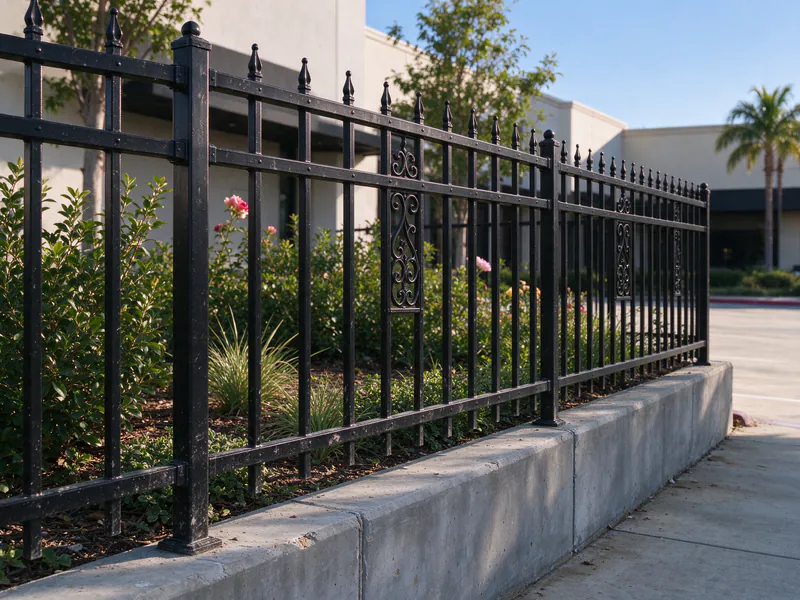
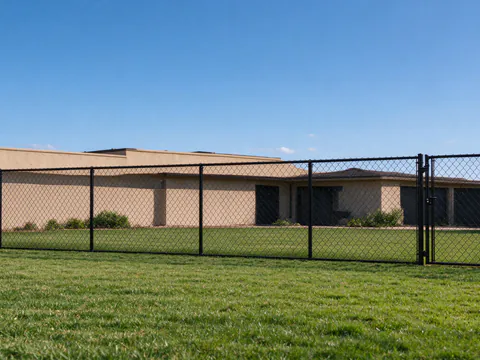
Visibility. Section 6.02.020.B bars chain link in areas visible to the public on nonresidential property and does not allow precision block where it can be seen. Street frontages use tubular steel, ornamental steel or decorative masonry; chain link stays on rear and side lines and in yards screened from view.
Wire. Razor wire is banned everywhere in Ontario. Barbed wire is banned in commercial and mixed-use districts and allowed in industrial districts only if it does not project above the fence where it is visible from public areas, under section 6.02.025.B.6. Ontario’s code also limits metal fences to ornamental iron or tube steel, chain link and wire mesh of at least 4 by 4 inches in 12.5 gauge.
Right-of-way and corners. Nothing may be built in a street right-of-way without an encroachment permit from the City Engineer, and unpermitted work there must come out within 7 days of notice. At intersections and driveways, corner clearance rules keep fences and walls under 3 feet within the sight area.
Planning reviews the design and location of every fence and gate, and building permits apply to chain link and iron fences over 3 feet. Ontario’s Information Bulletin 103 sets the wind design criteria: Exposure C, with basic wind speeds of 103 mph for Risk Category I structures and 110 mph for Risk Category II. Which category a fence falls under, and whether drawings need an engineer’s stamp, is the plan checker’s call.
Match each fence line to its zoning
Send the site plan and the lines that face the street. Material and setback come from the code before price.
What makes a fence secure
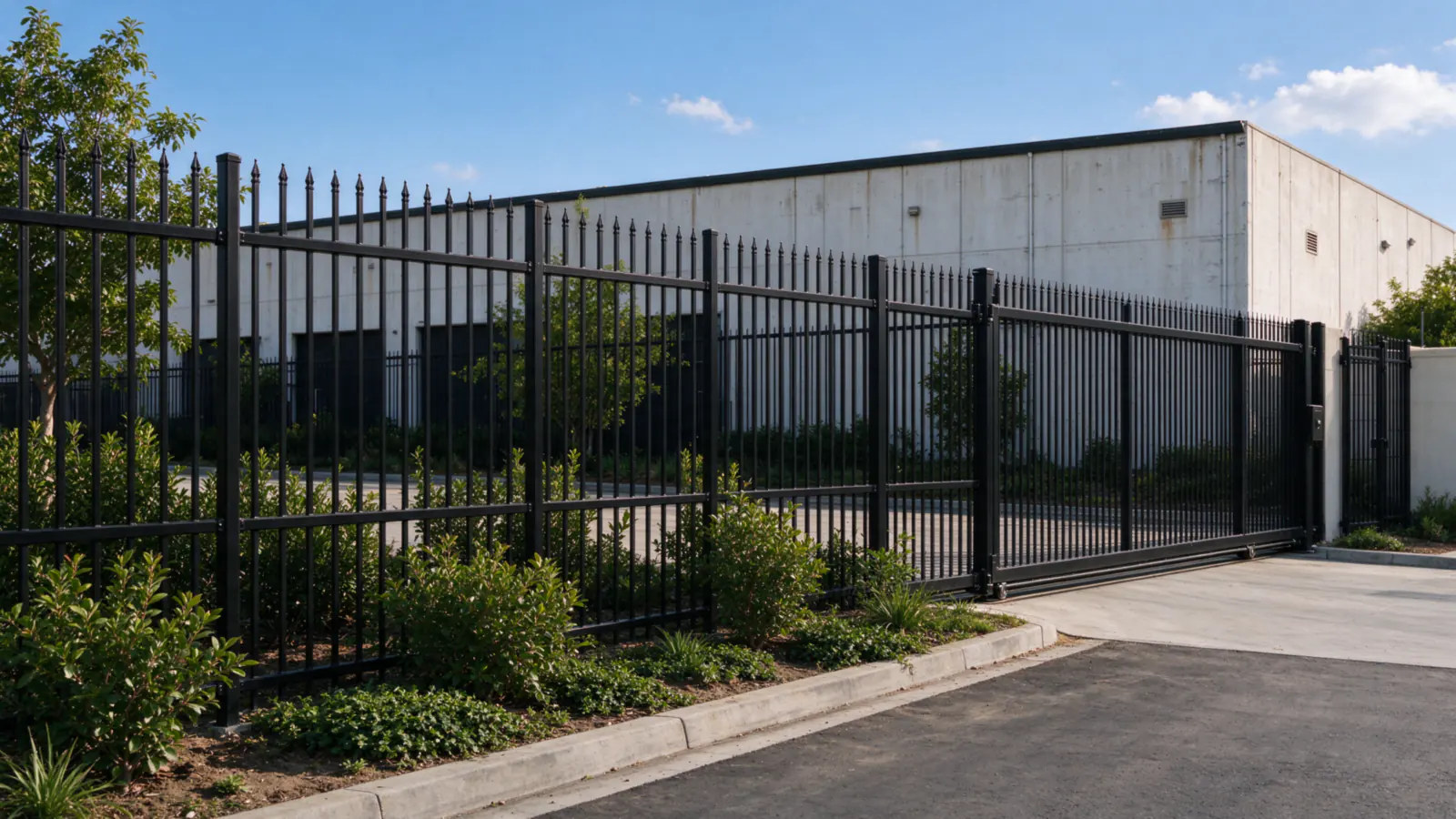
A security fence does three jobs: it is hard to climb, hard to cut and hard to get under, and its gates are not the weak link. Height is the first defense, within what the zoning allows. Climb resistance comes from the fence face: small-mesh chain link gives fingers and toes less purchase than standard mesh, and a tubular steel security fence with closely spaced vertical pickets and its rails kept to the inside offers no ladder. Cut resistance comes from heavier wire gauge and steel pickets. A bottom rail or tension wire held close to the pavement keeps anyone from lifting the fabric and crawling under, and on bare ground the bottom edge is kept tight to grade.
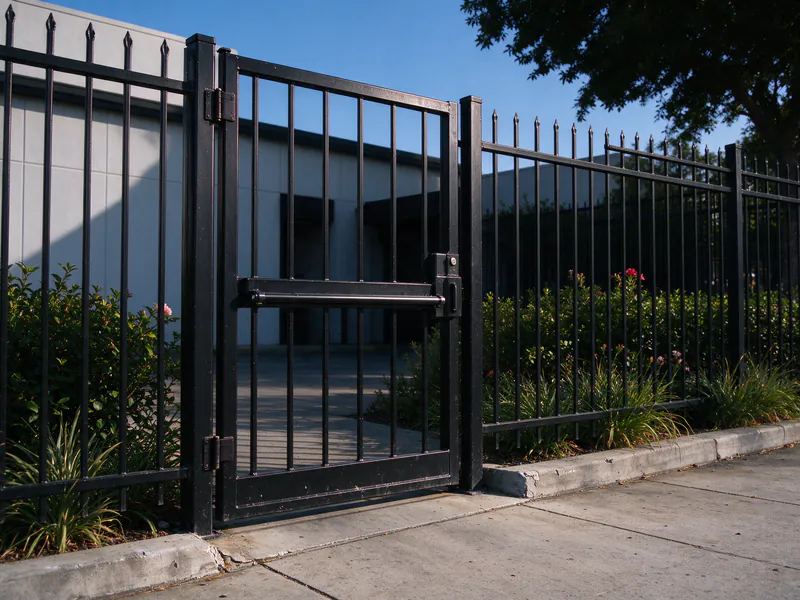
Gates are where security is usually lost. A gate with a gap at the hinge side, a latch reachable through the pickets or a frame that sags and no longer closes square defeats the fence around it. Gate posts on commercial gates are sized for the gate’s weight and the daily cycles it will see. Because Ontario limits barbed wire, security on most commercial lines comes from height, fence type and gates rather than wire on top.
Commercial chain link
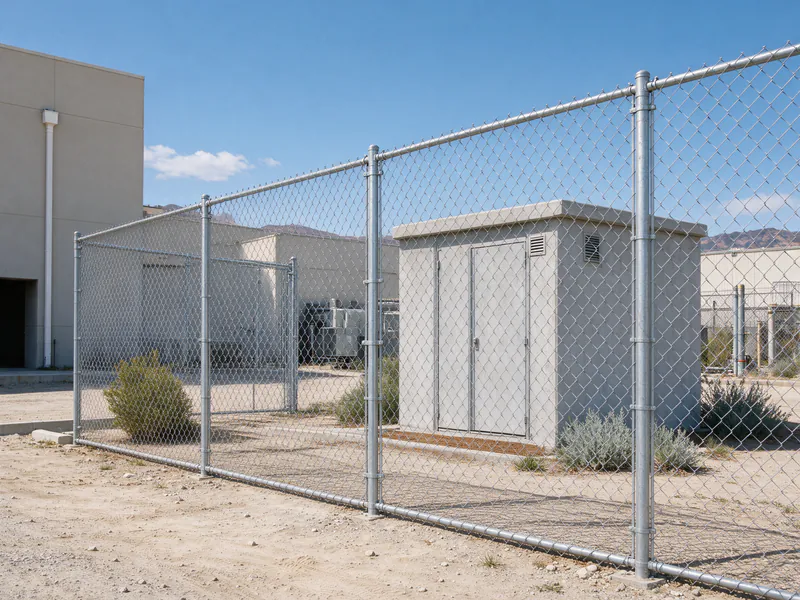
Chain link is the workhorse for rear lines, storage yards and equipment areas. Commercial chain link differs from a residential fence in its parts. The fabric is a heavier gauge, terminal and line posts are larger in diameter and wall thickness, and terminal posts at corners and gates are braced with rails and truss rods. A top rail and a bottom rail or tension wire hold the fabric in line, and taller fences may carry a mid rail. Where barbed wire is allowed in an industrial district, arms at the top carry the strands within the code’s limits.
Footings are sized for height, post spacing and the ground. USDA soil survey data puts much of Ontario on loose Tujunga loamy sand and Delhi fine sand, and the National Weather Service issued 44 High Wind Warnings for the Inland Empire valley zone around Ontario from January 2016 through October 2026. Open chain link passes most wind, but slats, screening fabric or signs fastened to it turn it into a sail, so anything attached to the fence is accounted for in the post plan. The Santa Ana winds guide covers wind load in more detail.
Ornamental and tubular steel at the street
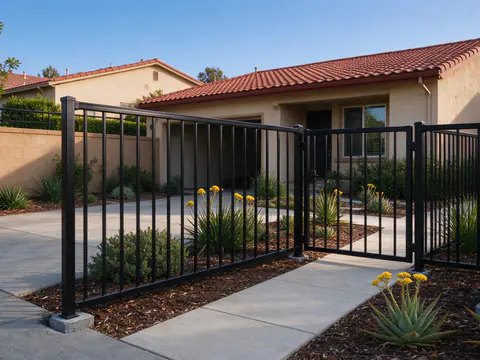
Where the public can see the fence, Ontario’s rules point to steel. Tubular steel and ornamental fencing gives a storefront, office or business entry a finished look while still marking the line and controlling access. Security versions use heavier pickets, tighter spacing and rails set to the inside face; ornamental versions favor finish and design. Powder-coated finishes resist rust, though sprinkler overspray at landscaped frontages is the usual source of early corrosion. The wrought iron vs tubular steel vs aluminum guide compares the materials.
Gates, automation and access
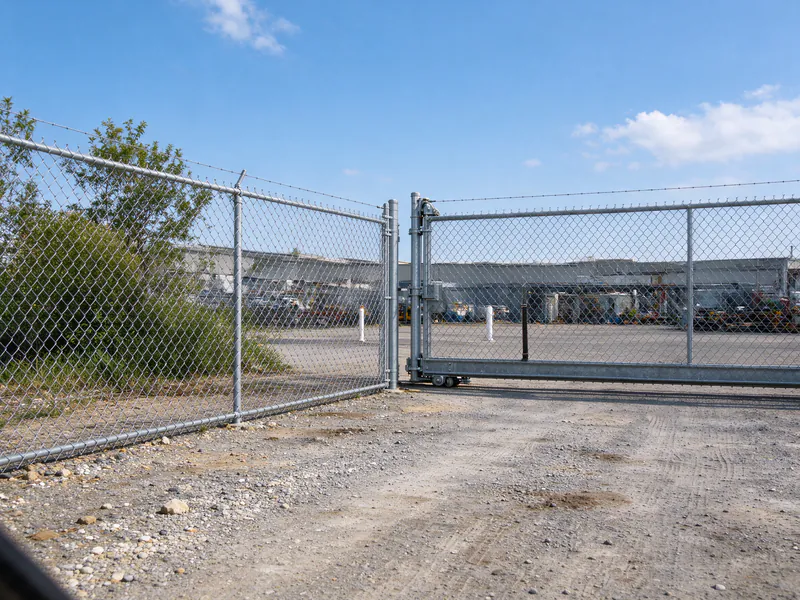
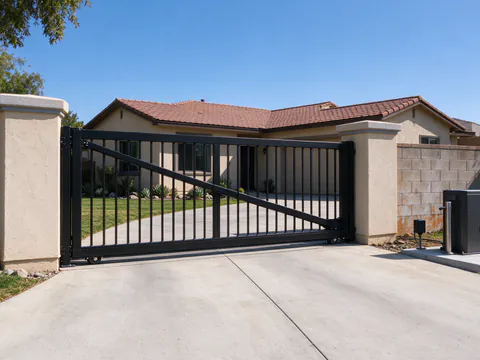
Commercial gates take more abuse than any other part of the fence. A cantilever slide gate rolls back along the fence line on carriages mounted to its posts, with no track across the driveway, which suits busy entrances, trucks and pavement that collects debris; it needs clear run-back space beside the opening. A swing gate is simpler and costs less but needs room to open and is harder on its hinges in wind. Pedestrian gates beside a vehicle gate keep foot traffic out of the drive lane.
Automated gates add an operator, safety sensors and access control such as keypads, card readers or remote transmitters. Operator safety follows the UL 325 standard for gate operators, which shapes the sensors and entrapment protection a moving gate needs. The automatic gate installation page covers that work, and wide manual gates for yards are covered on the RV and driveway gates page.
What drives the price of commercial fencing
Commercial fencing is priced from its specification rather than a typical per-foot band. Fabric gauge or picket size, fence height, post size and footing depth, top and bottom rails or tension wire, and barbed arms where the code allows them set the base. Gates and automation are often the largest single items. Access, working around site operations, removal of old fencing, engineering where plan check requires it and public-works rules such as prevailing wage on public projects add to it. Labor in the region costs a little more than nationally: the Bureau of Labor Statistics puts the mean wage for fence erectors in the Riverside-San Bernardino-Ontario metro at $26.95 an hour, about 11 percent above the $24.29 national mean. A wage is not a billing rate, since a contractor’s price also carries insurance, licensing, vehicles, equipment and overhead. Damage to an existing fence from a storm or vehicle is a separate question, covered in the wind-damaged fence insurance guide and on the fence repair page, and the fence cost guide explains Ontario’s valuation-based permit fees.