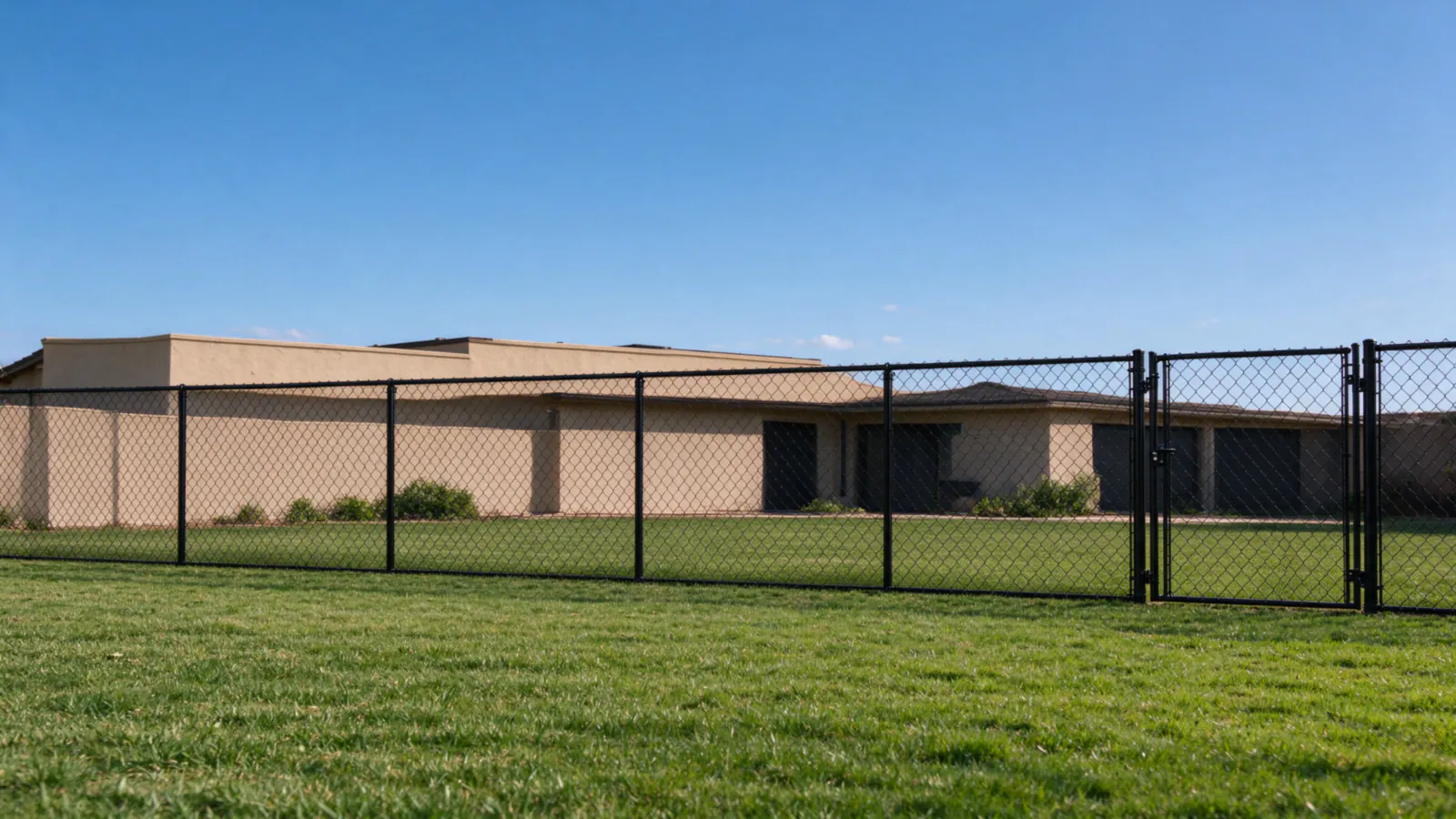
Chain link fence installation in Ontario, CA buys the most fence for the money: a 4 to 6 foot line that keeps dogs and children in, marks a property edge and lets air, light and view through. Grove Ontario Fence Builders installs galvanized and black vinyl-coated chain link across Ontario and the west Inland Empire, for back yards, side-yard dog runs, large lots and commercial properties. Installation is carried out by licensed and insured fence contractors. This page explains how a chain link fence is built and tensioned, how privacy slats change it, where local rules limit it, and when wood or vinyl is the better fit.
Chain link has a reputation as the plain choice, and it earns that. What it lacks in looks it makes up in cost, in how little wind it catches and in how easily it is repaired one section at a time.
What happens on the first visit
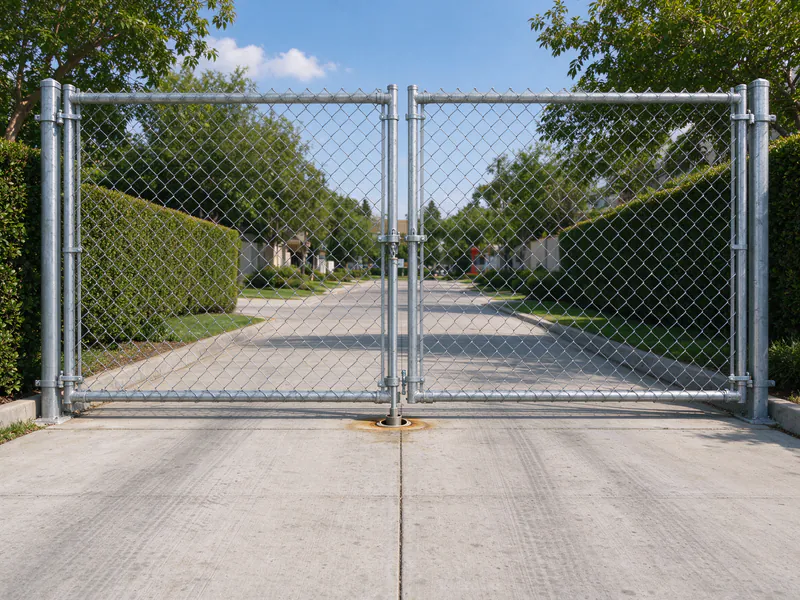
The first visit measures the run and marks every end, corner and gate, because those points decide the most important parts of a chain link fence: its terminal posts. Grade changes are noted, since chain link follows a slope well but the fabric has to be cut and stretched to suit it. Gate widths are set at the same time, for a walk gate, a mower or a vehicle.
Before any price is final, the property line and any shared-fence question come up. An old fence does not prove where the line is, and the property line and survey guide explains when a surveyor is needed. Ontario requires a building permit for chain link fences over 3 feet, so nearly every chain link job in the city is permitted; the Ontario fence permit guide has the details. A DigAlert ticket goes in at least two working days before post holes are dug, under California Government Code 4216.2.
How a chain link fence is built
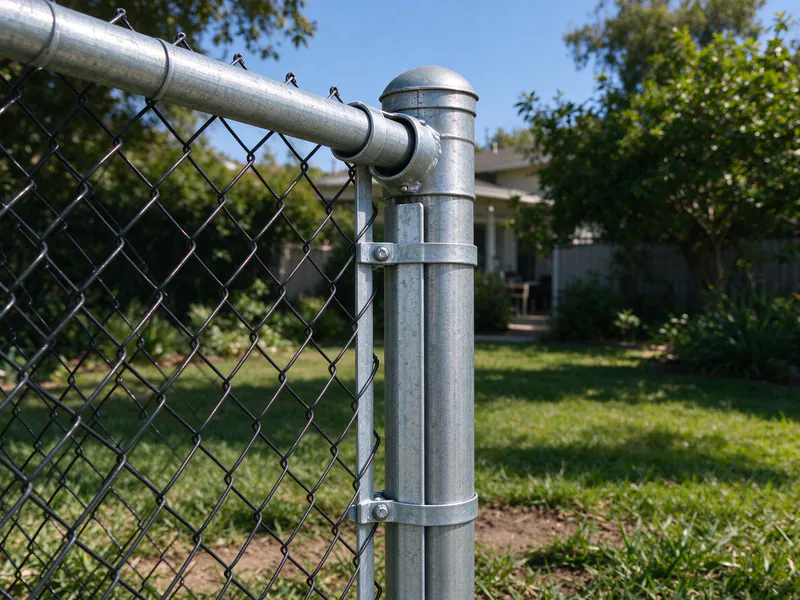
A chain link fence is a frame with fabric stretched across it. The frame’s strength sits at the terminal posts: the end posts, corner posts and gate posts. They are larger in diameter than the line posts, set in bigger concrete footings, and on taller fences braced back to the first line post with a horizontal brace rail and a diagonal truss rod. The fabric is pulled toward them under tension, so a terminal post that leans lets the whole run go slack.
The fabric attaches to each terminal post through a flat tension bar threaded down its end, clamped to the post with tension bands. Between terminals, line posts carry the fabric and a top rail, a pipe that runs through loop caps on the line posts and holds their tops in line. Some fences use a tensioned top wire instead of a rail, which is lighter and cheaper but lets the fabric flex more. A bottom tension wire, run along the base and tied to the fabric, keeps a dog from pushing under or the fabric from curling out over time.
The fabric goes on last. It is unrolled, attached at one terminal, pulled tight with a stretcher bar and a come-along, then fastened at the next terminal and tied to the line posts and top rail. Proper tension is what makes chain link look straight and feel solid. Loose fabric is almost always a tension failure, not a fabric failure, and re-tying it without fixing the terminal post does not hold.
Line post spacing and footing size follow the fence height, the fabric, any slats and the soil. Much of Ontario sits on loose Tujunga loamy sand and Delhi fine sand, which hold a post less firmly than heavier ground, so terminal and gate post footings get particular attention.
Fabric gauge, mesh and coating
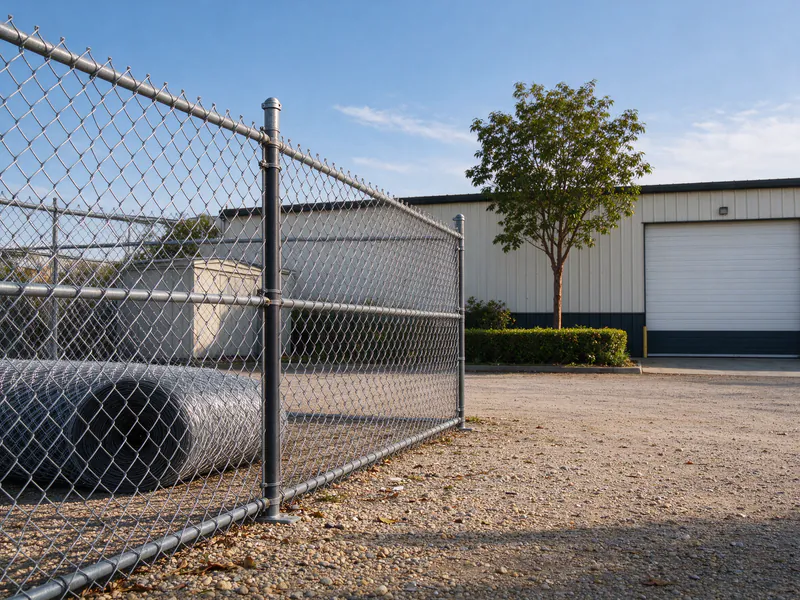
Three choices set how a chain link fence looks and lasts. Gauge is wire thickness, and a lower number means thicker wire, so 9 gauge fabric is heavier than 11 gauge. Residential fences commonly use the lighter gauges; heavier gauges resist cutting and impact and are standard on commercial fencing. Mesh size is the width of each diamond. The common residential mesh is about 2 inches, and smaller mesh is harder to climb and harder for small dogs to squeeze through.
The coating comes next. Galvanized fabric is zinc-coated steel, bright when new and dull gray within a few years, and on the dry valley floor it resists rust well. Black vinyl-coated fabric has a bonded PVC layer over the steel and pairs with black powder-coated posts and rails. It costs more but disappears against plants and stucco, which is why many homeowners choose black chain link for side and back yards they see every day.
Set the terminal posts before the fabric
Send the length, the height and every corner and gate. The post plan comes first.
Privacy slats and the wind they add
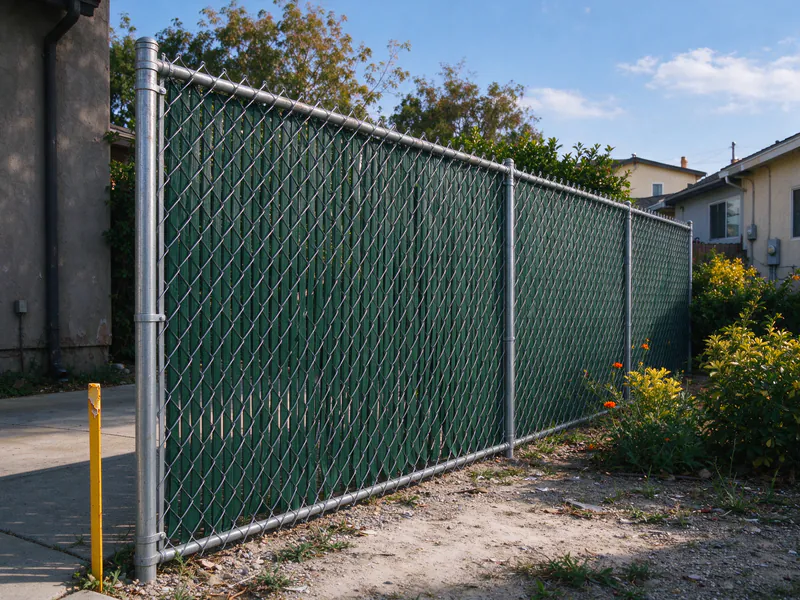
Privacy slats are strips woven vertically through the mesh to turn an open fence into a screen. Standard tubular slats leave small gaps; winged slats have fins that close most of them; hedge-style slats imitate a green hedge. Each gives a different level of privacy, and none makes chain link fully solid.
Slats change the structure, not just the look. Open chain link passes most of the wind. A slatted fence catches much of it, closer to a solid board fence, and the National Weather Service issued 44 High Wind Warnings for the Inland Empire valley zone around Ontario from January 2016 through October 2026. A light residential fence with standard line posts, built for open mesh, can lean or bend its top rail once slats go in. When slats are planned from the start, the posts, spacing and footings are sized for them. When they are added later, the existing posts and top rail are checked first. The Santa Ana winds guide explains how wind load builds on a fence face.
Slats are plastic, so they also give up one of chain link’s advantages in the foothill fire zones of Chino Hills and north Rancho Cucamonga, where a bare metal fence near the house is noncombustible.
Where chain link is allowed
Ontario’s Development Code allows chain link at single-family homes, with one limit: in front yards and street-side yards it is permitted only where chain link is the predominant material in the neighborhood, as the Planning Director determines. In back and interior side yards it is an ordinary choice. On nonresidential property the code bars chain link in areas visible to the public. Chain link is also one of the few metal fences the city allows at all, along with ornamental iron or tube steel and heavy wire mesh of at least 4 by 4 inches in 12.5 gauge, which rules out lighter welded wire panels.
Rancho Cucamonga goes further. Its residential fence rules do not allow chain link, including chain link with slats, plastic sheeting or fabric, to serve as a screening fence in any zone. A slatted chain link privacy fence that would pass in an Ontario back yard is not an option there, as the Rancho Cucamonga page explains. On Ontario’s large AR-2 and RE-2 lots, the code says chain link should be avoided along equestrian trail easements, where wood rail fencing is preferred.
Chain link or wood
Chain link and wood are the two ends of the fence decision. Chain link costs less per foot, lets wind through, needs almost no upkeep on the valley floor and is repaired by replacing a post, a rail or a stretch of fabric. A wood privacy fence screens completely, looks warmer and costs more, and it carries the full force of every gust on its posts. Many Ontario homeowners start with old chain link at the back of the lot and replace it with wood or vinyl when privacy becomes the goal; the fence replacement page covers that tear-out. Others keep chain link where privacy does not matter, such as a dog run, an alley line or a utility side yard, and spend the difference on the line they see.
Where a lot has an existing block wall and the owner wants more height, a fence set behind the wall or a topper mounted on it is a different job, covered on the block wall extension page.
What a chain link fence costs
A typical Southern California range for residential galvanized chain link, 4 to 6 feet tall, installed, is about $18 to $38 per linear foot. A 4-foot galvanized fence on a level line sits near the bottom; a 6-foot black vinyl-coated fence sits near the top. Privacy slats are priced on top of the fence by slat type, fence height and mesh size, and taller or heavier-gauge commercial chain link is priced by its own specification. Gates are priced separately by width, frame and hardware through gate installation, and a gate that drags or sags usually traces back to its post. Removing an old fence typically adds $3 to $8 per linear foot. These are budgeting figures, not quotes; the fence cost guide and the fence cost estimator break them down further.