
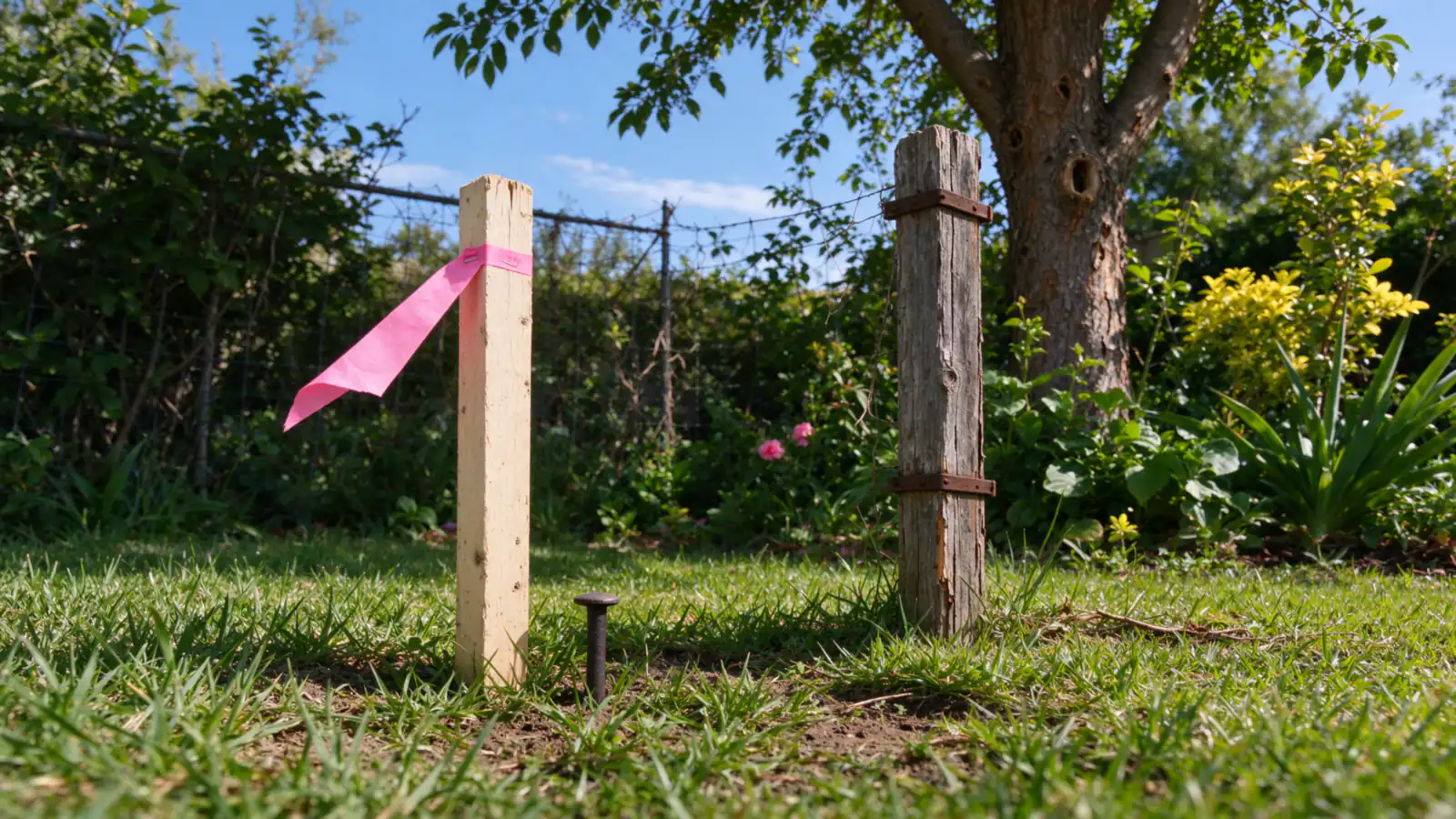
Yes, in most cases. In the City of Ontario, the Development Code allows fences on common interior side and rear property lines, and on the street-side line of corner lots with a landscaped strip to the curb. What the code cannot tell you is where that line actually runs on the ground, and that is the question to answer before a single post hole is dug.
Grove Ontario Fence Builders installs and replaces fences on shared lines across Ontario and the west Inland Empire, with the work carried out by licensed and insured fence contractors. A fence contractor lays out a run from corners and monuments, but does not certify a boundary. This guide covers what the rules allow, how the real line is found, when a surveyor is worth hiring, and the easements and buried lines that can move a post.
Where Ontario lets a fence sit
Section 6.02.020.D of the Ontario Development Code sets the locations. Fences may go on common interior side and rear lines. A corner or reverse-corner lot may fence along its street-side line as long as the area between the fence and the sidewalk or curb is fully landscaped and kept up by the owner. A front-yard wall up to 3 feet may also sit on the front or street-side line. Through-lots are the exception: the rear wall must sit at least 5 feet behind the rear property line.
Location is separate from height and permits. A fence on the line still has to meet the height limits and, in Ontario, a building permit is required for fences over 3 feet, both covered in the Ontario fence permit guide. On the street side, the property line and the back of the sidewalk are often not the same place, and the city requires an encroachment permit from the City Engineer before anything is built in the right-of-way.
Why the old fence is not proof of the line
Fences move. A fence built when a tract was new may have been replaced more than once since, and each crew started from the old posts rather than the corners. A few inches of drift per replacement adds up. Some fences were set inside the line on purpose to avoid a neighbor’s footing, or around a tree that is gone now. A replacement built on the old footprint can carry an old error forward for decades.
The legal line comes from the recorded subdivision map and the survey monuments set from it: typically a pipe, rebar with a plastic cap, a tag in concrete or a lead-and-tack in a curb. When those monuments can be found and the neighbors agree on them, the fence can usually be laid out from them. When they are missing, buried under decades of landscaping or disputed, nobody’s tape measure from the old fence settles the question.
When to hire a licensed land surveyor
California licenses land surveyors through the Board for Professional Engineers, Land Surveyors, and Geologists, and a licensed land surveyor is the professional who locates and sets a boundary. A survey is worth the cost in a few common situations:
- The corner monuments cannot be found, or the ones you find disagree with each other.
- A neighbor disputes where the line is, or the old fence is visibly off.
- The new fence is a permanent, costly build, such as tube steel with welded panels or a wall footing.
- A gate, a pool barrier or a structure is being placed close to the line.
- The lot is irregular, a cul-de-sac pie shape or a large lot where small angle errors grow over distance.
There is no public fee figure for a boundary survey. What sets the price is the lot’s size and shape, how much record research is needed, whether existing monuments are found or have to be reset, and whether the surveyor must file a record of the work with the county. The fence cost guide lists the survey as a scope item to check rather than a per-foot cost for that reason.
How a neighboring city handles shared lines
Chino Hills shows one way a city can document a shared line. For property-line walls and fences that need a permit there, the city accepts a Common Property Line Wall/Fence Agreement in lieu of a formal survey. Every adjoining owner signs that the footing location matches the commonly recognized boundary. If any owner will not sign, the permit must describe the work as wholly on the applicant’s property, and a survey stamped by a registered surveyor goes to the inspector at the footing inspection.
Ontario’s permit FAQ does not describe an equivalent form. Whether a shared-line fence in the city needs a neighbor’s written sign-off is confirmed per address with the Building Department when the permit is applied for. The Chino Hills area page covers the rest of that city’s rules.
On the line or just inside it
Owners choose between two layouts, and each has consequences:
| Layout | What it means | Watch for |
|---|---|---|
| Centered on the line | A dividing fence that both owners use | Civil Code 841 presumes an equal share of reasonable costs; agree on height, material and which side faces out |
| Wholly inside your line | Your fence, built and maintained by you | A strip of your land sits on the far side; footings must stay on your side too |
The footing is part of the decision. A concrete footing wider than the post can cross the line even when the post sits just inside it, which is why layout is done from the line, not from the face of the boards. Where neighbors share the line, the good neighbor fence law guide explains the 30-day written notice that comes before cost sharing.
Easements that limit where a fence can go
An easement gives someone else a right to use part of your land, and it can matter more than the boundary itself. Utility easements along rear or side lot lines are common in subdivisions, and a fence built across one may have to come out, at the owner’s cost, when the utility needs access. Drainage easements can carry a swale that a solid fence would block, and a wide drive or RV gate across an access easement raises the same question. Recorded easements show on a preliminary title report and often on the tract map.
Ontario adds two city-specific cases. In the AR-2 and RE-2 zones, the Development Code requires an 8-foot equestrian trail easement along the front line, with fences at its edge held to 48 inches plus 1 inch for each 2 inches of setback. And the street right-of-way behind a sidewalk belongs to the public, so unpermitted work there must be removed within 7 days of notice. In Ontario Ranch, a theme wall maintained by a master association adds a third party, as the HOA approval guide explains.
Call DigAlert before the first post hole
California Government Code 4216.2 requires an excavator to mark out the dig area and notify the regional notification center at least two working days, and no more than 14 calendar days, before starting. The law counts augering as excavation. In Southern California the center is DigAlert, reached by calling 811, and a ticket is good for 28 days.
The member utilities mark their own lines, usually up to the meter. Private lines past that point, such as sprinkler mains, landscape lighting, a gas line to a pool heater or a feed to a detached garage, are the owner’s to locate, and they often run right along a fence line. The owner exemption in section 4216.8 covers only work that needs no permit, so it rarely helps in Ontario, where most fences need one. The fence installation process guide shows where the ticket sits in the schedule.
A short order of operations
Find the recorded corners. If they are missing, disputed or the fence is a costly permanent build, hire a surveyor. Check the title report for easements. Talk to the neighbor and, for a shared fence, send the Civil Code 841 notice. Then apply for the permit, call DigAlert and set posts from the line rather than the old fence. When you know where the line is and want it priced, call Grove Ontario Fence Builders at (909) 324-5352 or request an estimate; the fence replacement page covers taking out the old run, and the wood fence installation page covers the most common new one.
Know where the line is?
Send the address, the length of the run and a photo of the corner markers if you found them. Layout starts from there.