RV gate installation looks like an ordinary gate job made bigger, but a 12 to 16 foot opening changes almost every decision: how the gate moves, how much driveway it needs, what it hangs from and what a vehicle can actually fit through. Grove Ontario Fence Builders installs swing, rolling and cantilever gates for RVs, boats and trailers across Ontario and the west Inland Empire, with the work carried out by licensed and insured fence contractors. This page explains clear opening against nominal width, how driveway slope picks the gate type, how much runback a sliding gate needs and what goes into the price.
Most RV gates are added to an existing side yard, often by cutting a wide opening into a fence or wall that was never designed for one. That makes the posts and the space around the gate as important as the gate itself.
What happens on the first visit
The first visit measures the opening that matters: the distance between the faces of the posts or walls, the angle a vehicle approaches from the street, and the widest point of the vehicle including mirrors and any awning hardware. The driveway is checked with a level along the swing arcs or the slide path, since a few inches of rise across 7 feet of leaf decides whether a swing gate can open at all. The visit also notes what the gate will hang from, whether a block wall or pilaster is involved, where sprinkler lines, utilities and drainage cross the drive, and whether there is room along the fence for a sliding gate to park.
From there the choice narrows quickly. The standard RV gate width guide covers sizing in more depth, and the general gate installation page covers walk gates and side-yard gates under 12 feet.
Clear opening versus nominal gate width
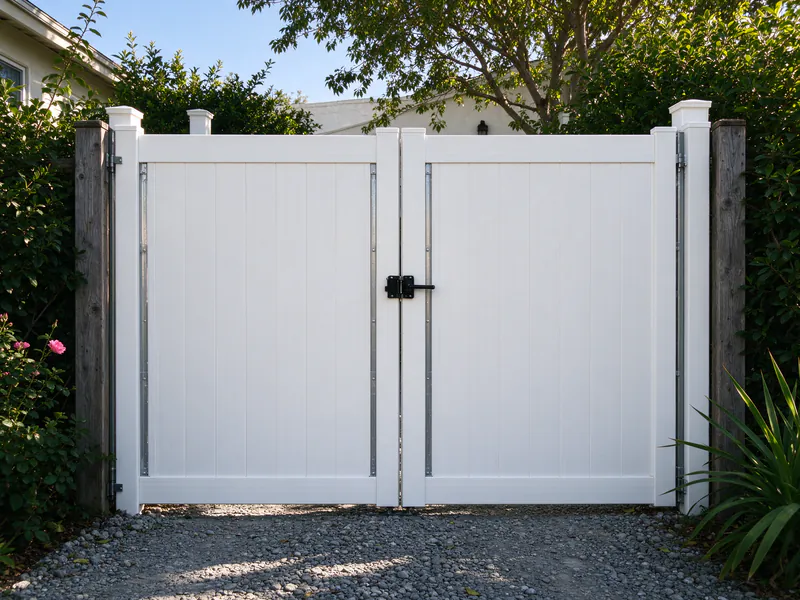
A gate sold as 12 feet is a 12-foot gate, not a 12-foot hole. Hinges hold the leaf away from the post, the latch side needs a gap so it does not bind, and on a double gate the two leaves meet with a stop or latch hardware between them. A swing leaf that only opens to 90 degrees also stands in the opening by its own thickness and hardware. On a sliding gate, the guide rollers and the receiver post take a few inches too. The usable width ends up somewhat less than the number on the order.
Then there is the vehicle. An RV or trailer rarely drives straight in; it turns off a residential street and has to swing wide or back in at an angle, which needs much more width than the body. Mirrors stand proud of the sides. If the lot is narrow and the street tight, the gate size is set by the turn, not by the vehicle’s width. Measuring the real path, with the vehicle if possible, prevents the most common regret: a new gate that is technically wide enough and miserable to use.
Driveway slope, swing clearance and runback
Swing gates
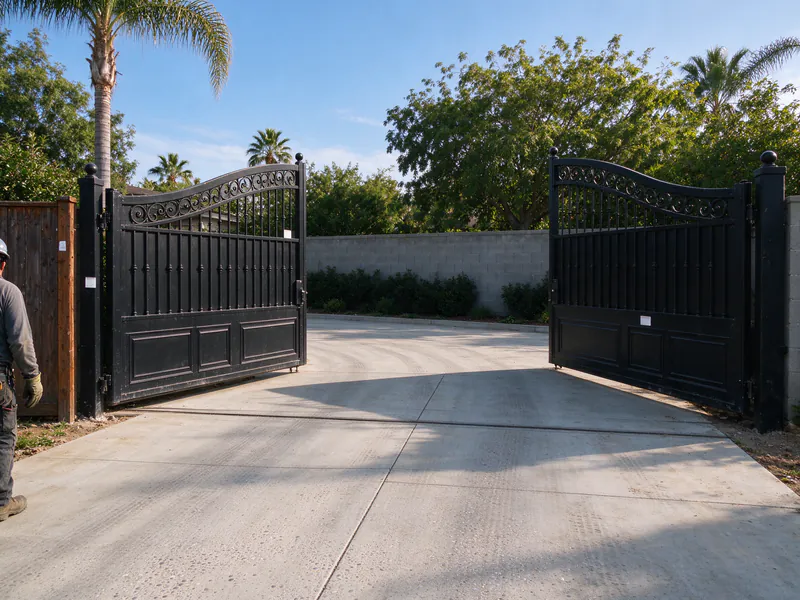
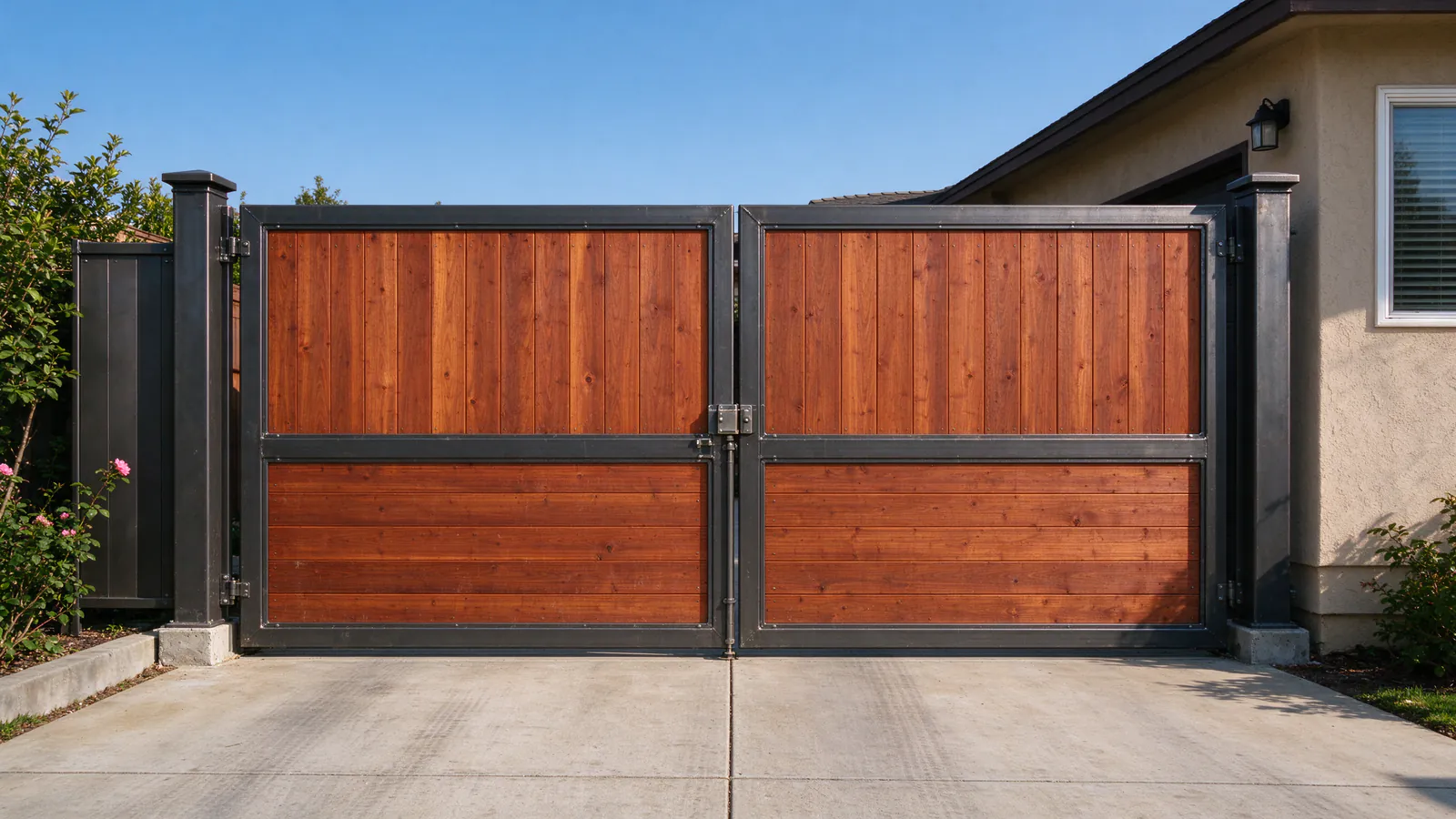
A swing leaf sweeps an arc as deep as the leaf is wide. A 14-foot double gate needs two 7-foot arcs inside the yard; a single 14-foot leaf needs one 14-foot arc and puts its whole weight on one post. Inward swing is the norm, because Ontario’s Development Code (6.02.015) keeps fences and construction out of the street right-of-way without an encroachment permit, and a gate swung out over a sidewalk sits in it. Where the drive rises into the yard, an inward-swinging leaf hits the slope before it opens fully. Rising hinges, a bottom edge cut to the grade, swinging the leaves the other way where the property allows it, or choosing a slide gate are the usual answers.
Rolling gates
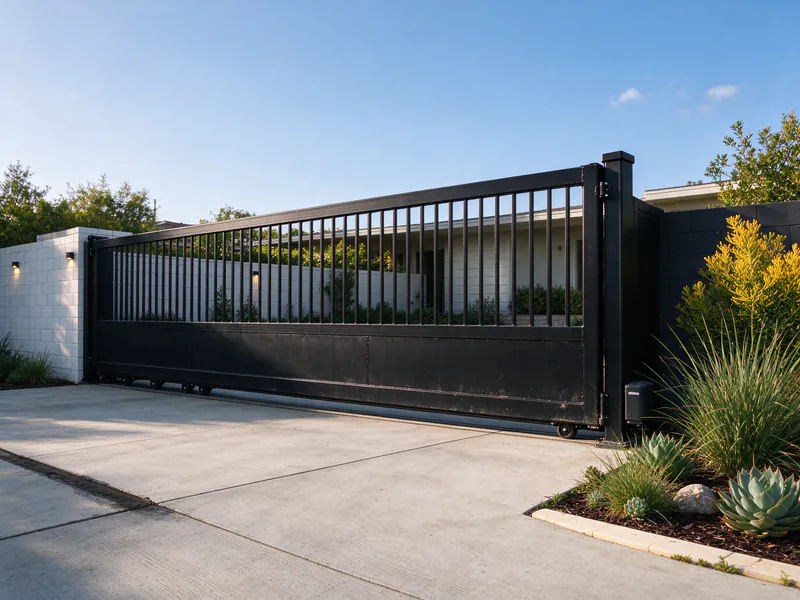
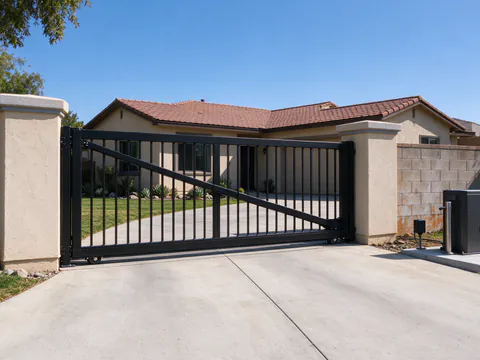
A rolling slide gate rides on wheels in a V-groove track laid across the opening and along the fence. It needs a level, continuous path for its full length and room beside the opening for the whole gate to park. Sand, leaves and gravel collect in the track, and a track across a sloped or cracked drive gives a rough ride, so rolling gates suit flat concrete drives best.
Cantilever gates
A cantilever gate has no track. It hangs from roller trucks bolted to two posts beside the opening and slides above the ground, carried by a counterbalance tail that extends past the opening. On many systems that tail adds about half the opening again, so a cantilever gate for a 14-foot opening is a much longer frame overall, and all of it needs a clear, roughly level run along the fence. The two roller posts and their footings take concentrated loads. In return, the gate does not care about a sloped or uneven drive, and it is the easiest type to automate later.
Check the space before choosing the gate
Send a photo along the fence line from the opening and a rough slope of the drive. That decides between swing and slide.
Posts, frames and hardware for a long leaf
A 7 or 8 foot steel leaf carries a lot of weight on a short lever arm, and a 14-foot single leaf much more. That load goes into the hinge post as a constant twist, and in central Ontario’s Tujunga loamy sand, about 80 percent sand, or Ontario Ranch’s Delhi fine sand at roughly 96 percent sand, a post needs a larger footing to resist it than it would in firmer ground. Square steel posts in footings sized for the leaf, the soil and the face of the gate are the usual base; a solid face catches Santa Ana wind, and Inland Empire wind warnings commonly forecast gusts of 55 to 75 mph. Post and footing size come from the leaf, not from a single standard depth.
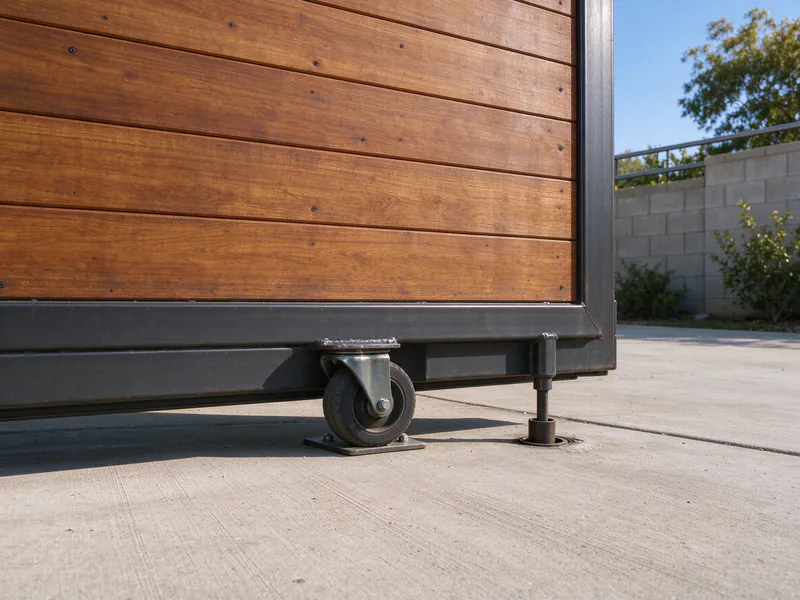
Frames for RV gates are almost always welded tubular steel, faced with pickets, wood boards or metal panels to match the fence. Double gates need a center stop and a drop rod on the passive leaf, set into a sleeve in the concrete so the rod has a clean hole to drop into. A wheel under a long leaf is a crutch that works only on smooth, level concrete. The steel vs wood posts guide covers post types, and the sagging gate guide explains why a leaf drops.
Where the gate can go: Ontario’s rules
Ontario’s Development Code 6.02.020 limits fences in the front yard to 3 feet and allows 6 feet on side and rear lines, so a full-height RV gate normally sits in the side yard rather than out in the front setback. Where a driveway meets a street or alley, section 6.02.030 lets the Planning Director or City Engineer require a corner cutoff, drawn as a 45-degree line through a point 20 feet from the intersection, and nothing in that cutoff can stand over 3 feet. Rancho Cucamonga sets a clear visibility triangle with two 10-foot sides at driveway corners. The city’s Building Permit FAQ requires a permit for wrought iron fences and gates over 3 feet, and Planning reviews the design and location of every gate. Whether a vehicle can be parked or stored in the side yard is a separate zoning question, confirmed per address. Ontario Ranch HOAs add their own approvals, covered in the HOA fence approval guide and the Ontario fence permit guide.
What goes into an RV gate price
RV and wide driveway gates have no single price; each is built for its opening, and the quote is clearest when it is split into its parts.
| Part of the price | What sets it |
|---|---|
| The gate leaf or leaves | Opening width, single or double, swing or slide, frame tubing and face material |
| Posts and footings | Leaf length and weight, soil, wind on the face, and whether a wall or pilaster is involved |
| Hardware | Hinges, drop rods and sleeves, center stop, latch, track or cantilever roller trucks |
| Site work | Cutting into an existing fence or wall, removal and haul-away, and any concrete for a track or footings |
| Permit and approvals | City permit for a gate over 3 feet, HOA review where the tract has one |
| Automation, if chosen | Operator, power, safety sensors and controls, scoped on the automatic gate page |
What is outside the gate matters as much. Widening a curb cut or driveway apron in the street involves the city and is a separate job, and new paving or electrical work is usually separate too. The Ontario fence cost guide shows how gates sit beside fence footage on a quote, the fence cost estimator adds a gate to a fence range, and an iron RV gate often matches a wrought iron fence along the front of the lot.