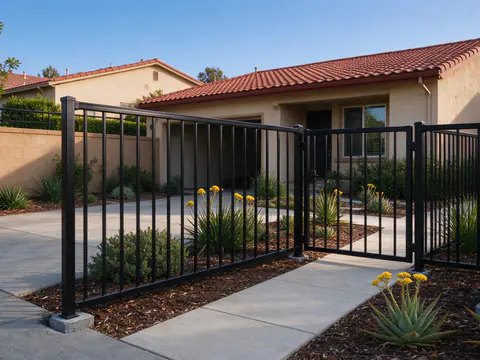
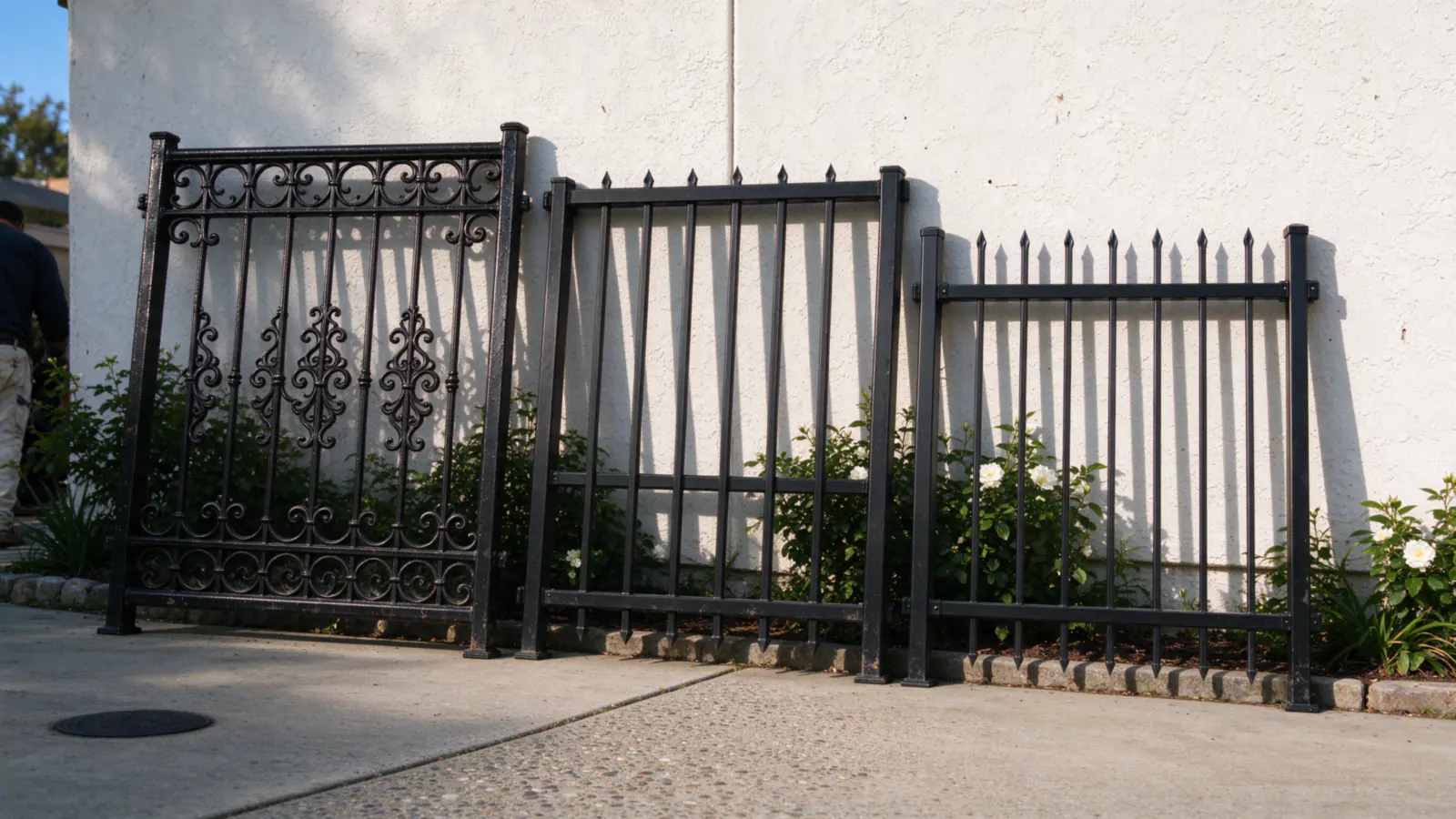
What most Inland Empire homeowners call wrought iron is tubular steel: hollow square steel tube, welded into panels and gates and finished with paint or powder coat. Aluminum is the lighter, rust-proof alternative, usually sold in prefabricated panels. True wrought iron is rarely made today. All three share the same typical installed range in Southern California, about $35 to $100 per linear foot.
Grove Ontario Fence Builders installs ornamental steel and aluminum fences, gates and block wall toppers across Ontario and the west Inland Empire, with the work carried out by licensed and insured fence contractors. This guide separates the three metals, explains how each resists or suffers corrosion, and covers the local rules, pool requirements and wind behavior that steer the choice.
What each term actually means
Wrought iron is an old material: nearly pure iron with threads of slag through it, worked by heating and hammering. It resists corrosion well, which is why historic gates survive, but it is seldom produced now. In everyday use, “wrought iron fence” has become a style name for any black metal fence with pickets, scrolls or spear tops.
Tubular steel, often called tube steel or ornamental steel, is what nearly every new “wrought iron” fence is made of. Fabricators cut square steel tube for posts, rails and pickets, weld it into panels and gates, and finish it with paint or powder coat, sometimes over galvanizing. Solid steel bar and cast or forged finials and scrolls are added for decoration. Steel is magnetic, heavy and stiff.
Aluminum fencing is extruded into tube and assembled into panels, usually with rails punched to receive the pickets and brackets that attach panels to posts. It is about a third the weight of steel, does not rust and almost always comes powder coated from the factory. Many systems are sold in residential and heavier commercial grades, and some panels are made specifically to meet pool barrier spacing.
Side-by-side comparison
| Factor | Tubular steel | Aluminum |
|---|---|---|
| Strength and stiffness | Highest; resists impact and leaning | Lower; heavier grades narrow the gap |
| Rust | Rusts where coating is broken | Does not rust |
| Weight | Heavy; posts and footings sized for it | Light; easier on posts and gate hinges |
| Fabrication | Custom, welded, can be altered on site | Mostly prefabricated panels and brackets |
| Slopes | Panels can be welded to follow grade | Panels rack within limits or step |
| Gates | Best for wide drive, RV and automated gates | Fine for walk gates; wide gates need care |
| Ontario code | Named as an allowed metal | Not named; confirmed with Planning |
| Typical installed range | $35 to $100 per linear foot | $35 to $100 per linear foot |
The shared band hides real differences. Height, picket spacing, post size, decorative tops, the finish and whether panels are welded on site all move a job within it. The fence cost guide lists the drivers.
Rust, corrosion and the local climate
Steel rusts when bare metal meets water and oxygen. Ontario’s climate is kind to it: under 12 inches of rain a year on NOAA’s normals for Ontario International Airport, low humidity, and none of the airborne salt that eats metal near the coast. Rust on an inland steel fence usually starts at a predictable place: a scratch or chip in the coating, a weld that was not fully sealed, the base of a post where sprinklers wet it daily, or a bottom rail sitting in soil or mulch. Hollow tube can also rust from the inside if water gets in through an open top or a drilled hole and cannot drain.
Aluminum sidesteps red rust entirely. Its exposure is mainly to the coating: strong sun can chalk or fade powder coat over time, and impact can dent the thinner tube. Where a steel fence meets aluminum, or steel hardware is used on aluminum, the two metals should be isolated to avoid galvanic corrosion at the contact point.
Coatings: what protects steel
The finish is what decides how long a steel fence looks good. From least to most protection:
- Paint over bare steel. The simplest finish, easy to touch up, but it needs repainting more often and fails first at chips.
- Powder coat over bare steel. A baked-on finish that is tougher and more even than paint. Once it is breached, rust can creep underneath it.
- Galvanized steel with powder coat. A zinc layer under the powder coat, so a scratch exposes zinc rather than bare steel. This is the most durable finish for steel.
Whatever the finish, caps on post tops, sealed welds and keeping sprinklers off the bottom rail keep a steel fence looking good longer. Rust caught at the surface is a scrape, prime and paint job; tubing rusted through at the base is a welded repair, covered on the fence repair page.
Ontario’s rules for metal fences
The Ontario Development Code limits metal fences to ornamental iron or tube steel, chain link, or wire mesh of at least 4 by 4 inches in 12.5 gauge, and lists ornamental steel or iron among standard residential fence materials. Aluminum is not named, so an aluminum fence in the city is confirmed with the Planning Department before ordering. Some specific plans name it directly: the Edenglen plan in Ontario Ranch lists decorative iron, tubular steel or aluminum, or glass for view fencing. Razor wire is banned citywide and barbed wire in residential districts, so security on a home comes from height, picket design and steel itself. The Ontario fence permit guide covers heights and permits, which apply to iron fences over 3 feet.
Pools, wind and gates
For a pool barrier, both metals work when picket spacing and rail placement meet the rules. State law calls for no opening that passes a 4-inch sphere and no footholds, and Ontario requires a 5-foot nonclimbable enclosure. Aluminum’s corrosion resistance suits pool decks splashed with chlorinated water; steel there needs an intact coating. The pool fence requirements guide has the full list, and the pool fence installation page covers the build.
Open metal fences carry far less wind load than solid privacy panels because wind passes between the pickets. That makes them the calm choice on exposed lines, as the Santa Ana winds guide explains. Gates change the picture. A wide steel drive or RV gate is heavy, so its posts and footings carry most of the engineering, and adding an operator brings its own requirements. The RV gate page and the automatic gate page cover those.
On top of a block wall
Many Ontario lots already have block walls on the side and rear lines, and a steel topper is a common way to add height or a view fence. The wall has to be checked before anything is anchored to it, because it was not designed for the extra wind load or the prying force of posts bolted to its cap. The block wall extension page explains that check, and the block wall vs fence guide compares the two when a whole line is being replaced.
Which one to choose
Choose tubular steel when you want maximum strength, custom design, a fence that follows a slope precisely, or wide and automated gates. Choose aluminum when rust resistance and low upkeep matter most, around pools, or where Planning or a specific plan accepts it. True wrought iron belongs to restoration work. To price a metal fence for your yard, call Grove Ontario Fence Builders at (909) 324-5352 or request an estimate; the wrought iron fence installation page covers how these fences are built and set.
Pricing a metal fence?
Send the length, the height, the picket style you like and any gates. Steel and aluminum can be priced on the same layout.