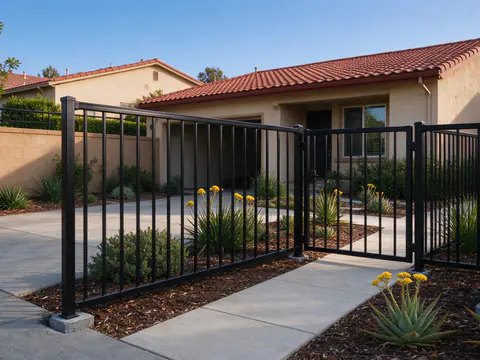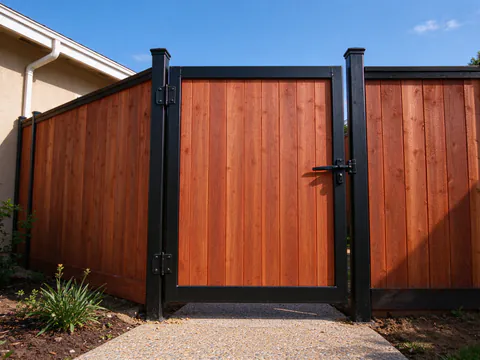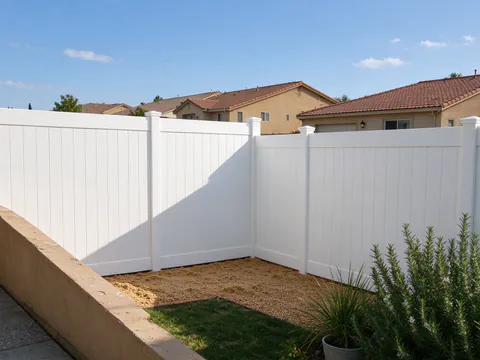
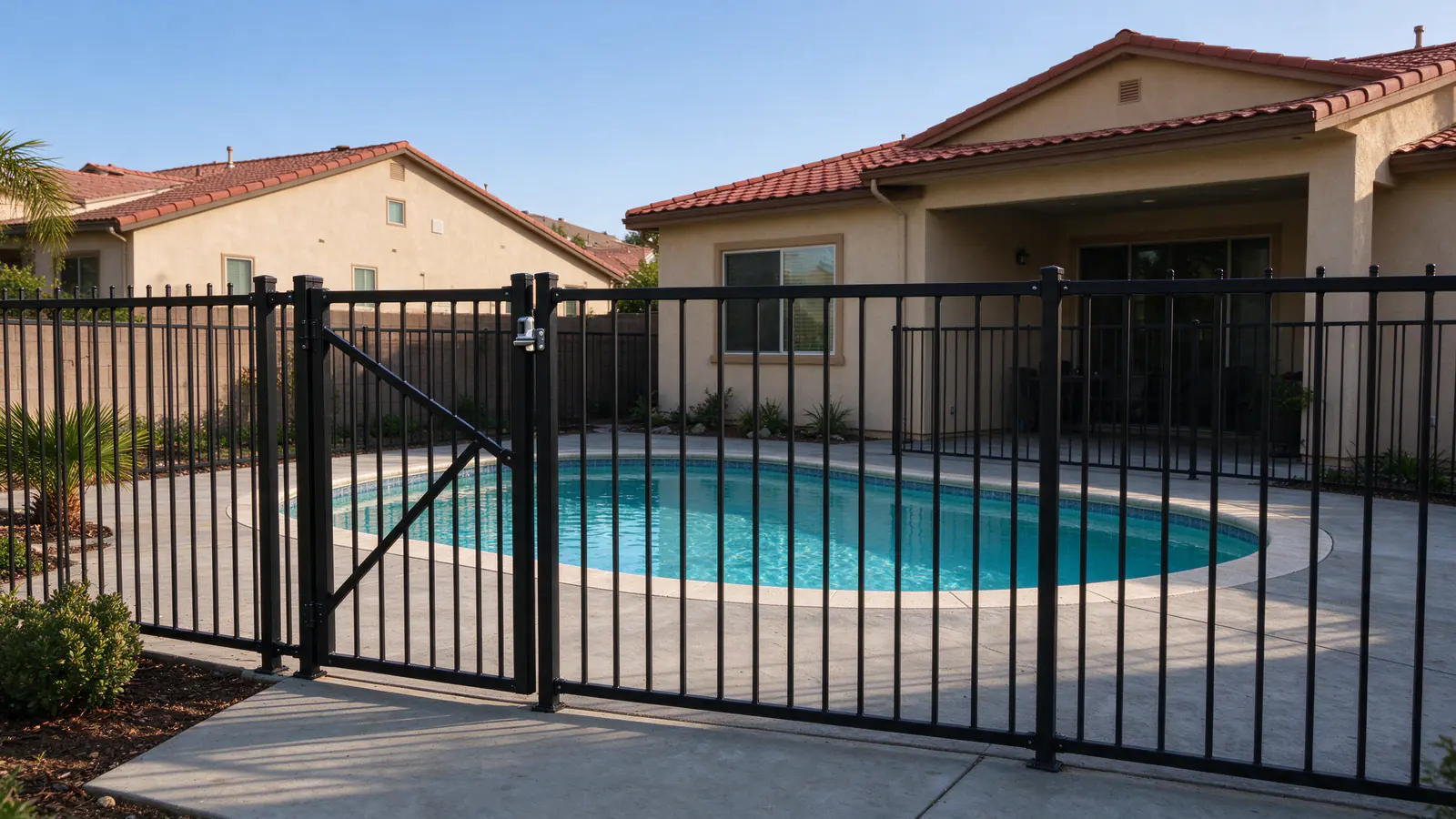
Pool fence installation in Ontario, CA starts with a rule that is stricter than most people expect: the city requires every pool, hot tub, spa, pond or decorative pool deeper than 18 inches to be fully enclosed by a decorative nonclimbable fence or wall at least 5 feet tall. Grove Ontario Fence Builders plans and installs pool enclosures and pool gates across Ontario and the west Inland Empire, in steel, aluminum, vinyl and wood. Installation is carried out by licensed and insured fence contractors. This page explains the two sets of rules a pool barrier answers to, the dimensions that matter, why gates fail most often, and how a fence fits a pool build’s schedule.
No fence product makes a pool compliant on its own. A barrier passes because of how it is laid out, how the gates are hung and adjusted, and what stands near it. Inspection approval belongs to the city, and nothing is called compliant until the inspector has signed it off.
What happens on the first visit
A pool barrier visit looks at the whole yard, not just the line where the fence will go. It records the pool or spa and its depth, the house doors and windows that open toward the water, the existing block walls and how tall they are on the outside, and every gate that leads into the area, including side-yard gates in the return walls. It notes the grade along the planned line, because the gap to the ground is limited, and anything near the fence that a child could climb: planters, retaining walls, equipment pads and air-conditioning units.
For a new pool, the visit also sets timing. Ontario’s Information Bulletin 114 requires the enclosure and drowning-prevention measures to be installed by the pre-plaster inspection, so the fence is part of the pool builder’s schedule, not something added after the water is in. The fence installation process guide shows where permits, HOA review and the DigAlert ticket fall, and the HOA fence approval guide covers tracts where the association must approve the material.
Two rules: Ontario’s enclosure and the state’s seven features
Two separate rules apply in Ontario, and a pool barrier is planned to satisfy both.
The first is local. Ontario Development Code section 6.02.020.A.3 requires any swimming pool, hot tub, spa, pond or decorative body of water more than 1.5 feet deep, above or below ground, to be fully enclosed by a decorative nonclimbable fence or wall at least 5 feet tall, with decorative gates, built to the building code. It applies to backyard ponds and above-ground spas as well as in-ground pools.
The second is state law. California Health and Safety Code 115922, as amended effective January 1, 2025, requires a new or remodeled pool or spa at a single-family home to have at least two of seven drowning-prevention features when a building permit is issued. The list is an enclosure that meets section 115923, a removable mesh fence meeting ASTM F2286 with a self-closing, self-latching, lockable gate, a safety cover meeting ASTM F1346, exit alarms on doors and windows with direct access to the pool, self-closing and self-latching devices on those doors with the release at least 54 inches up, a pool alarm meeting ASTM F2208, or an equivalent verified by a testing lab. Some pairs do not count together, such as an exit alarm and a self-closing device on the same door, or a cover and a pool alarm. Ontario’s Information Bulletin 114 applies the same list.
State law defines an enclosure as a fence, wall or other barrier that isolates the pool from the home. On many Ontario tract lots, the existing 6-foot block walls and their gates enclose the back yard from the street and neighbors, while the house side is open to the pool. That is where a fence between the house and the water, or door alarms and self-closing door hardware, comes in. Which combination works at a given address is a design question settled before anything is built; the pool fence requirements guide covers the rules in more depth.
The dimensions an enclosure must meet
Section 115923 sets the numbers for an enclosure, and Ontario’s bulletin repeats them:
- Height: at least 60 inches.
- Gap to the ground: no more than 2 inches at the bottom.
- Openings: nothing in the barrier that a 4-inch sphere can pass through.
- Climbability: no handholds or footholds on the outside face.
- Gates: open away from the pool, close by themselves and latch by themselves, with the latch at least 60 inches above the ground.
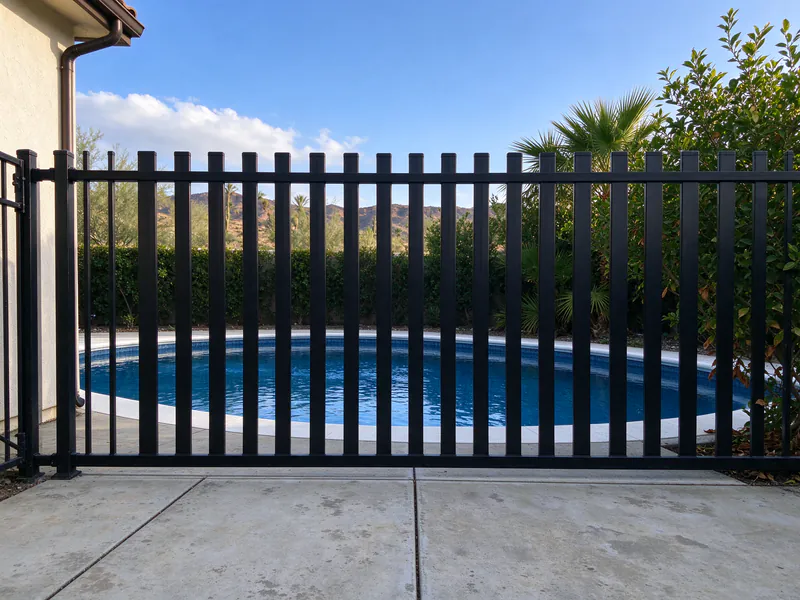
Each one shapes the fence. The 4-inch rule decides picket spacing on a steel or aluminum fence. The foothold rule means horizontal rails close together on the outside face can act as a ladder, so rails go on the pool side or the design keeps climbable parts off the outside, and the inspector judges the result. The 2-inch rule is tested along the whole line, so on a slope the panels are racked or stepped with the bottom kept close to grade. Soil that washes out under the fence over a few seasons can open that gap later, which is worth checking each spring.
What stands near the fence counts too. A planter, a bench, a retaining wall or an equipment pad against the outside of the barrier gives a child the step the fence was built to deny, so the layout keeps them clear of the line.
Map the barrier before the pool is plastered
Send a sketch with the pool, the house doors, the walls and every gate. The barrier plan comes from that.
Why gates fail and how they are hung
Most pool barriers that fail do so at a gate. A self-closing, self-latching gate only works if it swings freely, closes from any open position and lands its latch every time. A gate that has dropped a quarter inch on its hinges catches the latch, stops short and stays open. That is why the gate post matters more on a pool fence than anywhere else: it has to stay plumb under the gate’s weight and the constant pull of the closing hinges. In the loose Tujunga and Delhi sands mapped across much of Ontario, the gate post gets a footing sized for that job, and the sagging gate guide explains what happens when it does not.
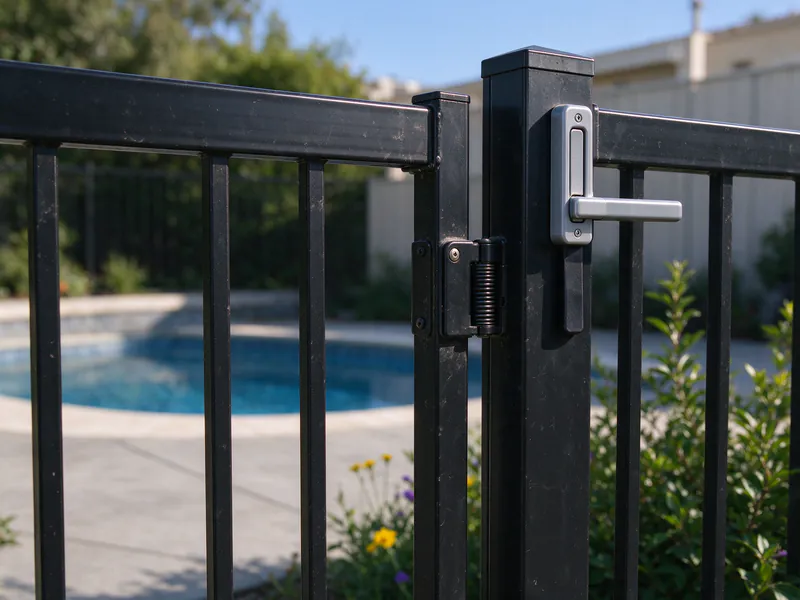
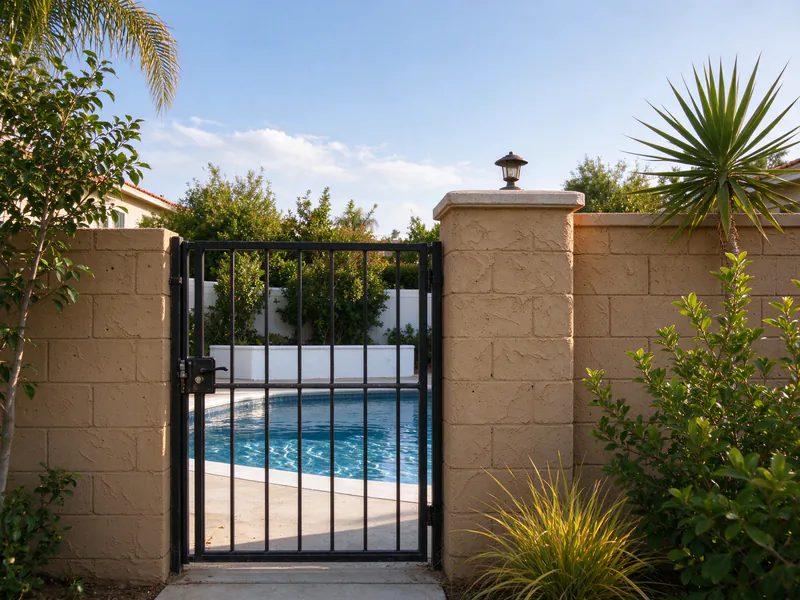
Pool gate hardware is a system: spring or hydraulic self-closing hinges, a latch mounted high on the gate with its release at least 60 inches up, and a stop so the gate cannot swing past the latch. Magnetic latches with a pull-up release are common because they catch reliably without slamming. Every gate is tested from several open positions before the job is done. On Ontario tract lots, side-yard gates in the block return walls often become part of the enclosure, and they need the same self-closing, self-latching hardware as the gates in the new fence. The gate installation page covers gate frames and hardware in general.
Choosing a material for the barrier
Steel and aluminum picket fencing is the common pool barrier because it keeps the water in view, meets the 4-inch spacing rule in standard pool-rated panels and lets wind through. Aluminum does not rust where pool water splashes it; steel needs its finish kept intact. The wrought iron vs tubular steel vs aluminum guide compares them.
Vinyl or wood privacy fencing works when the owner wants screening as well. A solid face has no openings, so the work is in keeping rails and framing on the pool side, where they cannot be climbed from outside. Standard chain link is rarely a good pool barrier, because its diamonds give small feet a toehold.
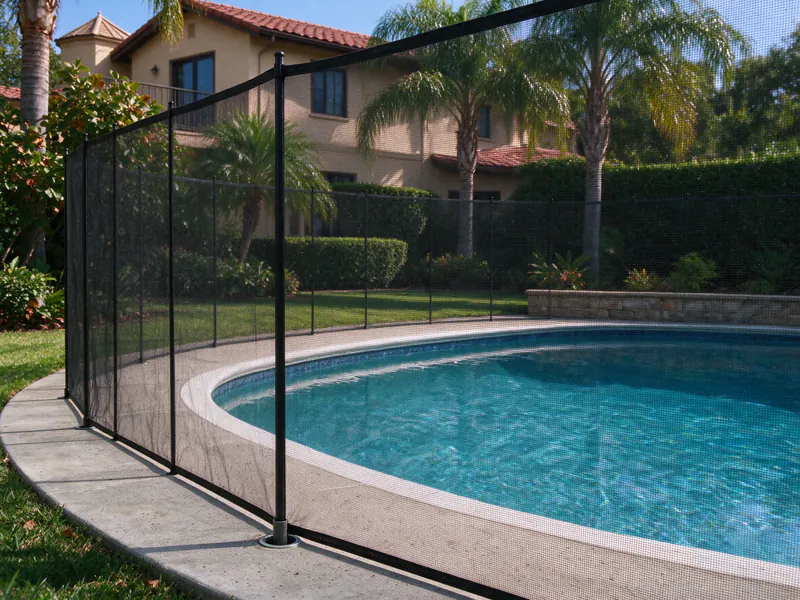
Removable mesh fencing, set in sleeves drilled into the deck, counts as one of the state’s seven features when it meets ASTM F2286 and has a compliant gate. Ontario’s code separately asks for a 5-foot decorative nonclimbable enclosure, so whether mesh meets the city rule at a particular address is confirmed with the city first.
Pool fences in the cities around Ontario
The state’s two-of-seven rule applies everywhere in California when a permit is issued for a new or remodeled pool at a single-family home. Local enclosure rules vary. Ontario’s requirement for any water deeper than 18 inches is broader than many cities’, and how Rancho Cucamonga, Chino Hills and the other nearby cities apply their own pool barrier rules is confirmed per address with each building department. Height limits still apply to the fence itself: a pool fence on an Ontario side or rear line stays within 6 feet, as the Ontario fence permit guide explains.
What drives the price of a pool fence
Pool fencing is priced by its parts rather than a single per-foot figure. Linear footage and material set the base, and a pool-rated steel or aluminum fence is priced like other ornamental metal fencing of the same height. The barrier rules then add required parts: self-closing hinges and self-latching hardware on every gate, heavier gate posts, tight picket spacing and, on a slope, racked panels or extra steps to keep the gap to grade under 2 inches. Retrofitting hardware to existing side-yard gates is a separate line. Ontario’s building permit fee is set by project valuation, explained in the fence cost guide, and the fence cost estimator gives a range for the fence itself before the gate hardware is added.