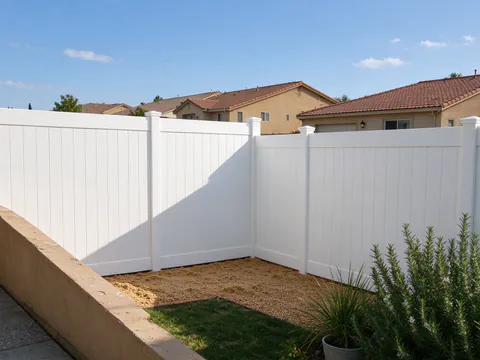
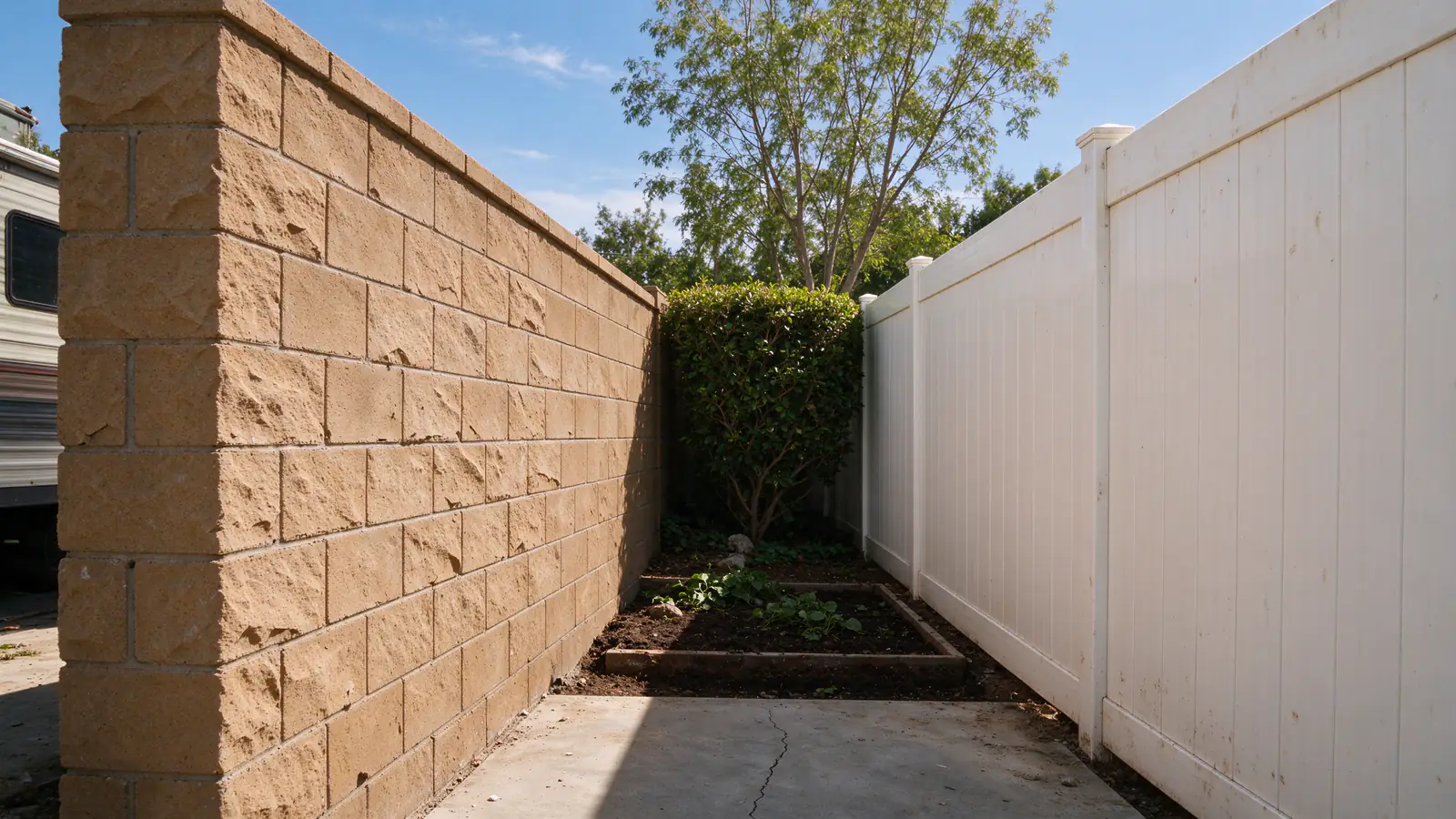
A vinyl fence costs far less up front. A 6-foot vinyl privacy fence typically runs $35 to $75 and up per linear foot installed in Southern California, while a block wall is a reinforced masonry project that typically costs much more per foot. Block wins on mass, sound and fire resistance; vinyl wins on cost, speed and easy repair.
Grove Ontario Fence Builders installs vinyl fences, wood and iron fences, and adds height to existing walls through block wall fence extensions, across Ontario and the west Inland Empire. Installation is carried out by licensed and insured fence contractors. A new block wall is a separate masonry project, so this guide compares the two choices honestly instead of pricing the wall.
What each price is made of
A fence and a wall are built in completely different ways, and their prices reflect that. A vinyl fence is a row of posts, each in its own concrete footing, with rails and panels slotted between them. A block wall stands on a continuous concrete footing along its whole length, with steel reinforcing bars running up through the hollow cells of the block and grout filling the cells that carry them. Ontario’s structural design criteria, Information Bulletin 103, place residential work in Seismic Design Category D2 and wind Exposure C, and a masonry wall is designed for both.
| Part of the job | Vinyl privacy fence | Block wall |
|---|---|---|
| Foundation | Individual post footings | Continuous reinforced concrete footing |
| Structure | Posts with aluminum or steel inserts where needed | Block with vertical and horizontal steel and grouted cells |
| Finish | Factory color; nothing to paint | Decorative block or a stucco or stone finish, with a cap |
| Typical installed price | $35 to $75 and up per linear foot | Priced by scope; no dependable per-foot range |
| Removal of an old fence | $3 to $8 per foot, either way | $3 to $8 per foot, either way |
| Permit | Valuation-based in Ontario | Valuation-based in Ontario, on a larger valuation |
The block wall’s price moves with its height, footing size, block type, the amount of steel and grout the design calls for, pilasters, any stucco or stone veneer, engineering where the city asks for it, and access for block pallets and concrete. The City of Ontario sets permit fees by project valuation, so a wall’s larger valuation also means a larger fee; in unincorporated San Bernardino County, block walls are charged by wall area rather than the flat fence fee.
If you are weighing iron against vinyl as well, wrought iron, tubular steel and aluminum fences typically run $35 to $100 per linear foot installed in Southern California, overlapping vinyl at the low end and passing it with heavier sections and custom work. The wrought iron vs tubular steel vs aluminum guide compares the metals, and the fence cost guide explains what moves each range.
Side by side
| Vinyl privacy fence | Block wall | |
|---|---|---|
| Privacy | Full, with solid panels | Full |
| Wind | A solid panel catches wind like a sail; posts and inserts must be sized for it | Heavy and engineered; not immune if the footing or steel is inadequate |
| Noise | Some reduction | More, thanks to mass and no gaps |
| Fire | Combustible; softens, melts and burns | Noncombustible |
| Termites | Nothing to eat | Nothing to eat |
| Heat | Expands in summer sun; systems leave room for movement | Stores heat; no movement issue |
| Upkeep | Washing; impact can crack panels | Paint or stucco touch-ups; efflorescence and cracks to watch |
| Repairs | A damaged panel or post can be replaced if the system is still available | Crack repair is local; a leaning wall often means footing trouble and a much bigger job |
| Build sequence | Posts set and cured, then panels | Footing, steel, block, grout and cap, with the inspections the permit lists |
Neither is maintenance-free. Vinyl avoids rot and paint but can crack from impact and turn brittle with long sun exposure, and with about 93 days a year at or above 90°F at Ontario’s airport, panels and rails move with heat. Block does not move, but a wall that starts to lean, often because of roots, drainage or an undersized footing, is rarely a simple fix. The Santa Ana winds guide explains what wind does to each, and the vinyl vs wood guide covers vinyl’s trade-offs against wood.
Ontario rules that shape the choice
Ontario’s Development Code, Division 6.02, sets the materials. Walls visible to the public must be decorative masonry, such as brick, split-face or slump block, with a decorative cap; plain grout caps are not permitted. Fences may be ornamental steel or iron, wood, or PVC consistent with industry standards. The City of Ontario’s Building Permit FAQ requires a permit for block walls over 3 feet and for wood, chain link and iron fences over 3 feet, and vinyl over 3 feet is best treated the same way. Heights are 3 feet in front yards and 6 feet along side, street-side and rear lines for both. The permit and height rules guide covers the details.
The code also explains why so many Ontario lots already have block. New single-family subdivisions must build 6-foot decorative masonry walls on the perimeter and street-side lines, masonry walls on interior side and rear lines, and return walls between the side walls and the house. On those lots, the question is usually what to put on the one line without block, or how to add height to a wall that is there, rather than wall versus fence for the whole yard.
Nearby cities differ. Rancho Cucamonga requires residential perimeter walls to be decorative block, such as split-face, fluted, or block with a stucco or stacked-stone finish, and allows solid vinyl for privacy screening. In Chino Hills, a masonry wall is exempt from a permit only when it is 4 feet or less and more than 5 feet from every property line, so a block wall on a lot line almost always needs one; the city accepts a signed common property line agreement in place of a survey. The Rancho Cucamonga and Chino Hills pages cover those rules.
Where the ground changes level
A wall that holds back soil is a retaining wall, not a fence, and it is designed and permitted as one; Ontario requires a permit for retaining walls over 2 feet, measured from the bottom of the footing. A vinyl fence cannot retain soil at all. If your yard sits higher or lower than the neighbor’s, the soil needs its own retaining structure, and the fence or wall goes on top of it or behind it. Ontario also measures fence height from the lowest adjacent grade, so a fence on the high side of a grade change loses usable height.
The middle paths
Several choices sit between a full vinyl fence and a new block wall:
- A topper on an existing wall. Wrought iron, vinyl or wood can add height to a sound block wall, if its footing, steel and grout can carry the extra wind load and the total stays within the height limit. That is what a block wall fence extension checks before anything is attached.
- An open metal fence. A wrought iron or tubular steel fence is noncombustible and lets wind through, at the cost of privacy.
- A wood fence on steel posts. A wood fence on galvanized posts costs within the $30 to $70 per foot range for 6-foot redwood or cedar and resists wind and termites better than wood on wood.
Which fits which yard
A vinyl fence fits a privacy line on a budget, a yard with no fire-zone exposure, a line that may need panels replaced someday, and a job you want finished soon. A block wall fits a busy street where noise matters, a foothill lot where fire exposure is real, a line where it should match the tract’s existing masonry, and owners willing to pay for mass and permanence. For fire-zone lots, the wildfire zone fence guide covers what state rules expect near the house.
To price a vinyl, wood or iron fence for the line you have, or a topper for the wall that is already there, call Grove Ontario Fence Builders at (909) 324-5352 or request an estimate.
Weighing a fence against a wall?
Send the line length, the height and what is on the other side, and the fence options can be priced against the wall you are considering.