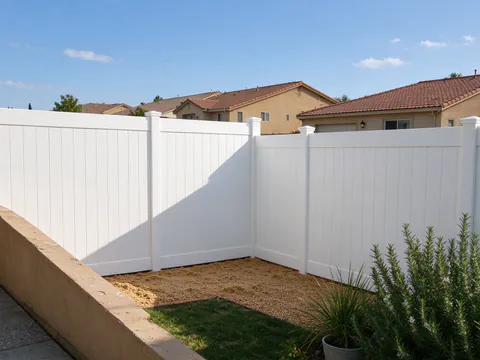
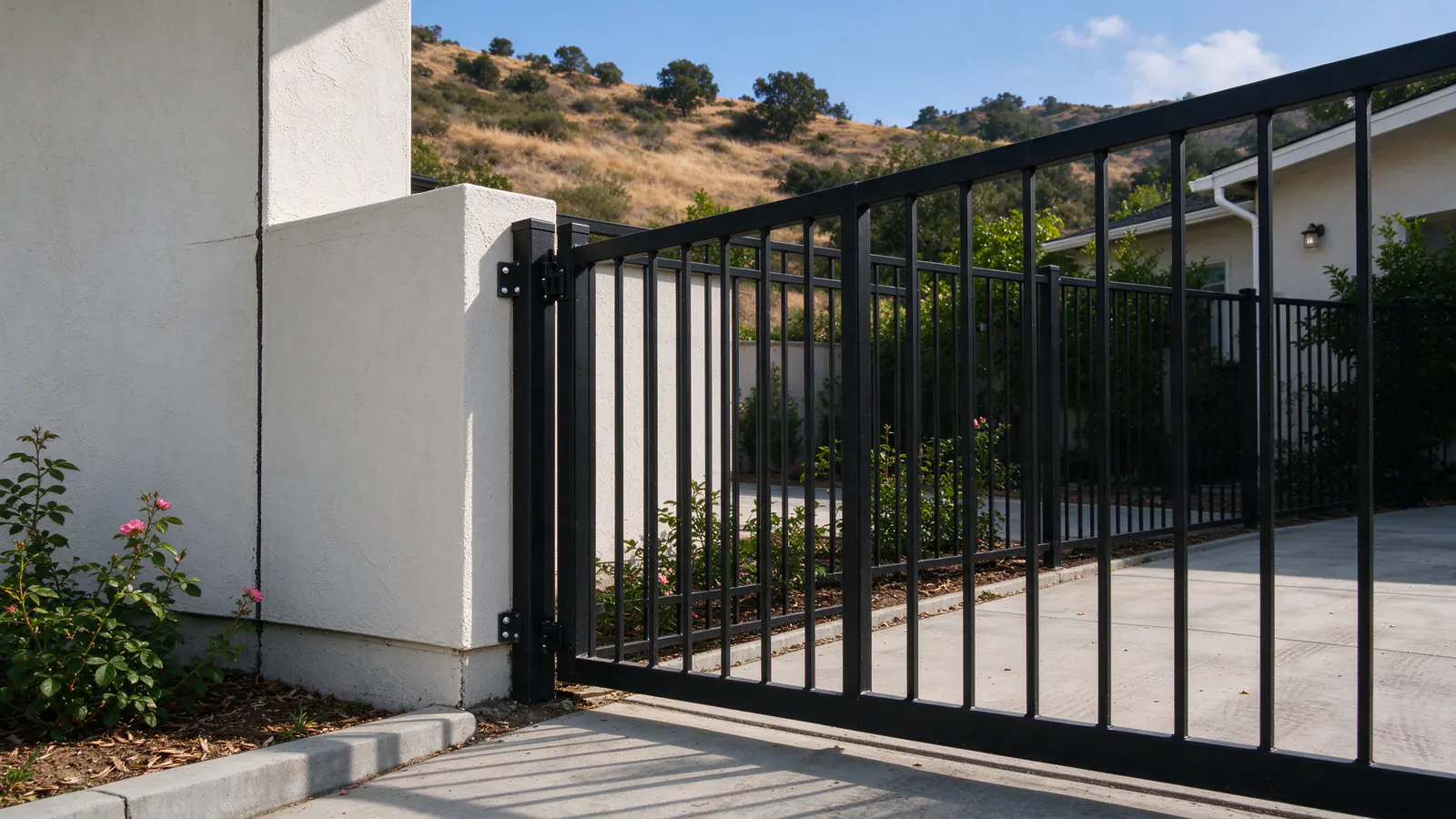
Yes. Vinyl (PVC) fencing softens and sags at temperatures far below those of a fire, and it melts and burns once flame reaches it, so it is not a noncombustible material. Wood burns too. Steel, iron, aluminum, chain link and masonry are noncombustible, which matters most where a fence meets a house in a fire hazard zone.
Grove Ontario Fence Builders installs vinyl, wood, wrought iron and tubular steel and chain link fences across Ontario and the west Inland Empire, with the work carried out by licensed and insured fence contractors. Ontario itself has no mapped fire hazard severity zones, but several cities in the same service area have large ones, so this guide explains how each material behaves, where the zones are, what state law already asks for near a house, and what the proposed Zone 0 rules would change.
How fence materials behave in a fire
| Material | Combustible? | What happens near flame and embers |
|---|---|---|
| Vinyl (PVC) | Yes | Softens and sags in radiant heat, then melts and burns; a melted section leaves a gap, which defeats a pool barrier |
| Wood | Yes | Embers lodge in joints, at board bottoms and in debris along the base; a burning fence can carry flame along its length |
| Wood boards on steel posts | Yes, the boards | The posts stay standing; the infill still burns |
| Wrought iron, tubular steel | No | Does not burn; paint or powder coat can scorch |
| Aluminum | No | Does not burn; loses strength and can deform in an intense fire |
| Chain link | No, without slats | Steel fabric and posts do not burn; plastic slats do |
| Block wall | No | Does not burn and blocks radiant heat |
The risk is not the fence by itself. A combustible fence that runs up to a house acts like a fuse: fire burning in vegetation or debris at the far end can travel along the fence to the wall of the house. That is why the attention in state rules falls on the few feet of fence closest to the structure. Vinyl can also deform from ordinary heat sources, such as a grill set close to the fence, well short of a fire.
Where the fire zones are around Ontario
CAL FIRE’s fire hazard severity zone maps for local responsibility areas show no Moderate, High or Very High zones inside Ontario or Montclair city limits. Fire-zone rules do not shape fences in those cities. The picture changes toward the San Gabriel foothills and the Chino Hills.
| City | Very High | High | Moderate |
|---|---|---|---|
| Chino Hills | About 73% | About 10% | About 2% |
| Claremont | About 37% | About 11% | About 4% |
| Rancho Cucamonga | About 30% | About 4% | About 3% |
| Jurupa Valley | About 22% | About 3% | About 12% |
| Fontana | About 14% | About 5% | About 2% |
| Upland | About 5% | About 6% | About 3% |
| Chino | About 5% | About 1% | About 2% |
| Ontario, Montclair | None | None | None |
These are shares of each city’s land on CAL FIRE’s local responsibility area maps, concentrated on the north side of Rancho Cucamonga, Claremont, Upland and Fontana, across most of Chino Hills, and on the hill edges of Jurupa Valley and Chino. A city-wide percentage does not tell you about your lot. Check your own address on the state’s fire hazard severity zone map, and see CAL FIRE’s Ready for Wildfire site for defensible-space guidance. The Rancho Cucamonga and Chino Hills pages cover fence work in those cities.
What state law already asks for near a house
California Government Code 51182, for locally designated Very High Fire Hazard Severity Zones, and Public Resources Code 4291, for the State Responsibility Area, both as amended effective October 13, 2025, require owners of occupied structures to maintain 100 feet of defensible space. Within that, fuel reduction is more intense from 5 to 30 feet of the structure, and the closest 5 feet is to be an ember-resistant zone under regulations from the State Board of Forestry and Fire Protection. The statutes direct the Board to consider eliminating materials in that zone that embers are likely to ignite.
A wood or vinyl fence that attaches to the house sits squarely in that 5-foot zone. Even before any fence-specific rule takes effect, it is the part of the fence most worth rethinking on a foothill lot.
The proposed Zone 0 rules for fences
The Board of Forestry has been drafting the Zone 0 regulations that define the ember-resistant zone. A July 2026 staff memo to the Board describes a draft that would:
- Prohibit construction of new combustible fences within 5 feet of a structure.
- Let existing combustible fences remain and be repaired with the same materials.
- Require a noncombustible section, such as a noncombustible gate, where a fence or gate attaches to an occupied structure, within five years of the rules taking effect.
- Leave fences more than 5 feet from a structure unaffected.
- Define “noncombustible” consistently with California’s wildland-urban interface building standards.
Those are draft provisions. Whether and when they are adopted, and the date they would take effect, should be checked on the Board’s Zone 0 page before a foothill fence is designed. A fence built to the draft standard today, with noncombustible materials where it meets the house, would not need to change if the rules are adopted as drafted.
Fence designs that work on a foothill lot
Most of what the draft asks for can be built without giving up privacy:
- A metal section at the house. A wood or vinyl privacy fence can end in a steel or iron gate or a short metal panel for its last 5 feet, so nothing combustible touches the wall.
- An all-metal fence. Tubular steel, iron, aluminum and plain chain link are noncombustible from end to end; the wrought iron vs tubular steel vs aluminum guide compares them.
- Masonry. A block wall is noncombustible and blocks radiant heat; the block wall vs fence guide compares cost and trade-offs.
- Wood on steel posts. The posts survive, which makes rebuilding faster, though the boards still burn.
- Clean ground along the fence. Leaves, dry grass and stored items piled against the base are what embers ignite first.
Rancho Cucamonga adds its own constraint. Its residential fence handout requires privacy screening to be solid wood on steel frames, solid vinyl, or tubular steel or wrought iron backed with metal sheeting painted to match, and chain link with slats is not accepted as screening anywhere in the city. On a north Rancho Cucamonga lot, steel or iron backed with metal sheeting is the way to get a privacy screen that is also noncombustible.
Wind and fire arrive together
The Santa Ana season and fire weather overlap. The National Weather Service office in San Diego issued 44 High Wind Warnings for the Inland Empire valley zone between January 2016 and October 2026, most from October through February, and the same dry, gusty winds carry embers far ahead of a fire. A fence near the house has to stand up to the wind and not feed the fire, which points to metal posts and noncombustible sections in both cases. The Santa Ana winds guide covers the wind side.
If you live in Ontario
On an Ontario lot, fire-zone rules do not apply, and the choice between vinyl, wood, metal and block comes down to cost, privacy, wind and upkeep. The vinyl vs wood guide and the vinyl fence installation page cover those trade-offs. Keeping grills and fire pits away from a vinyl fence still matters, because radiant heat can warp panels long before anything burns.
For a fence that meets a house on a foothill lot, call Grove Ontario Fence Builders at (909) 324-5352 or request an estimate and mention the city, so the layout can plan for the 5 feet closest to the house.
Building near the foothills?
Send the address and the fence line, and the last 5 feet beside the house can be planned in noncombustible material.