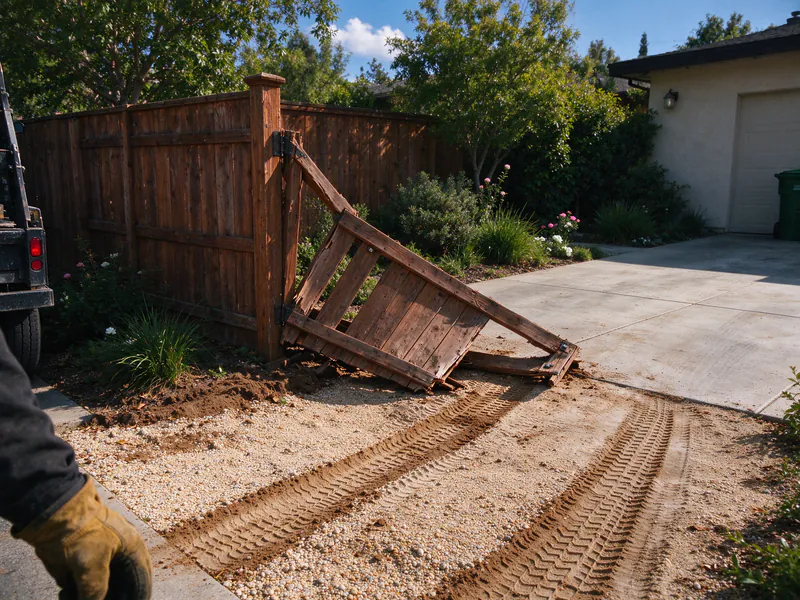
Emergency fence repair means two jobs in sequence: securing a fence that has been knocked down by wind, a vehicle or a falling tree, and then rebuilding it properly. Grove Ontario Fence Builders handles both across Ontario and the west Inland Empire, with the work carried out by licensed and insured fence contractors. Outside the posted business hours, the phone line is for emergency calls only. That line is a way to reach someone about a downed fence; it is not a promise of a particular arrival time, which always depends on conditions after a storm and safe access to the site.
This page explains what to do in the first hour, what temporary securing involves, how a fence knocked down by wind gets rebuilt so it does not fail the same way, and how to document the damage for an insurance claim. For a fence that is leaning or rotting slowly rather than lying on the lawn, the fence repair page is the better starting point.
What to do before anyone arrives
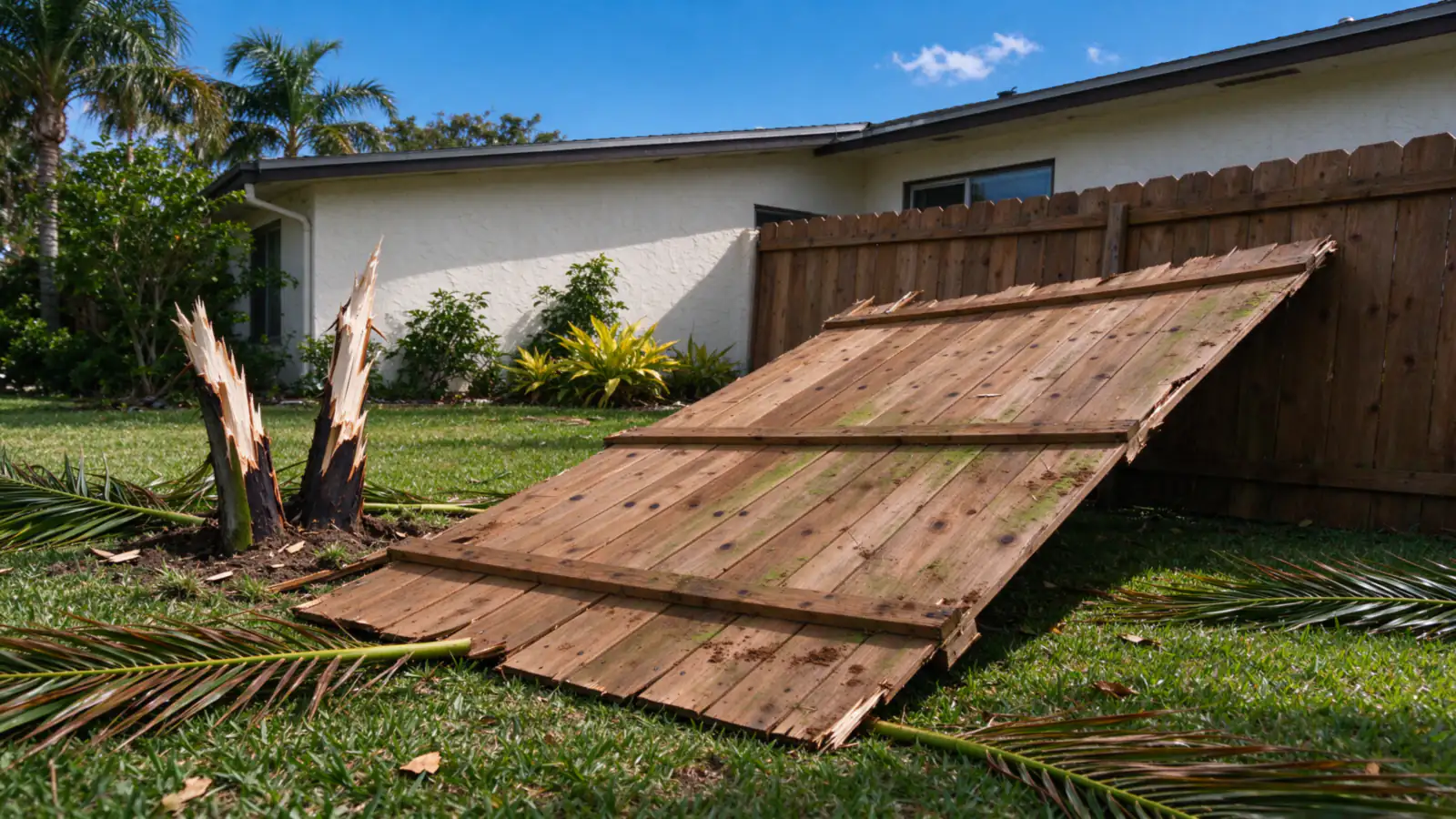
Safety comes first, and the fence comes second. While the wind is still blowing, stay away from leaning sections and loose panels; a privacy panel that has already broken free is a large, light sail. If a power line is down or touching the fence, keep everyone well back and call 911 or the electric utility. If the fence enclosed a pool, treat the pool as unprotected until a barrier is back up: keep children inside and supervised, and lock any doors from the house to the pool area. Pets that rely on the fence need to be inside or on a leash.
Once it is safe, take photographs before anything is moved. Wide shots of the whole run show the extent; close-ups of broken posts at the ground line, snapped rails, torn fasteners and whatever hit the fence show the cause. A note of the date and the wind event helps later. Do not try to stand a broken section back up by hand during a gust. If a neighbor shares the fence, let them know; the fallen section affects both yards.
Why fences come down here: Santa Ana wind
Wind is the Inland Empire weather that breaks fences. The National Weather Service office in San Diego issued 44 High Wind Warnings, 38 High Wind Watches and 141 Wind Advisories for the Inland Empire valley zone that includes Ontario between January 2016 and October 2026. The warnings cluster in the Santa Ana season: 15 in January, 7 each in October and November, and none from May through August. NWS warning texts repeatedly place the strongest winds below the Cajon Pass and in the corridor toward the Santa Ana Mountains, with typical warning gusts of 55 to 75 mph and isolated gusts to 100 mph forecast near the pass in March 2024.
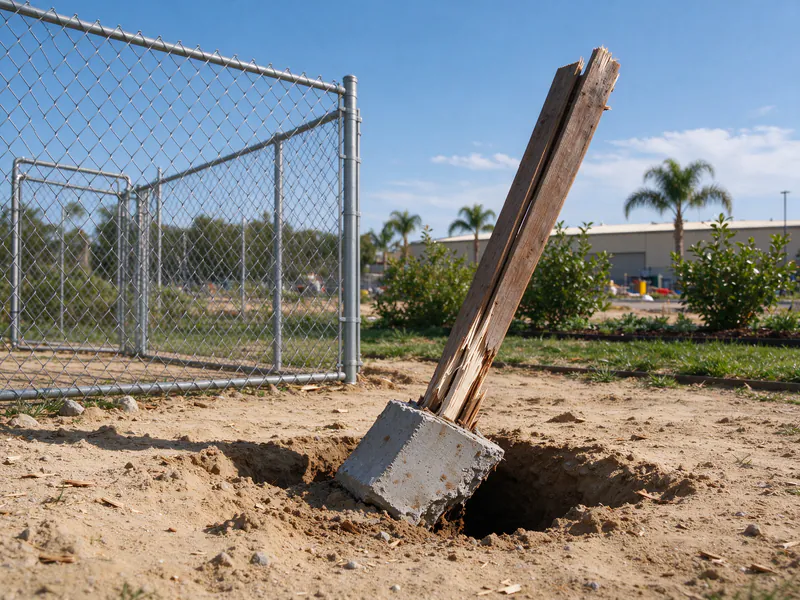
A solid 6-foot privacy fence takes the full force of those gusts on its face, and the load goes into the posts. A fence usually fails at its weakest points: a post rotted at the ground line, a footing too small for the soil, a rail fastener that rusted through. In Ontario’s sandy ground, much of it Tujunga loamy sand and, in Ontario Ranch, Delhi fine sand, an undersized footing can rotate in the soil until the run lies down. Fallen trees and flying debris add impact damage on top. The Santa Ana wind guide explains the forces in more detail.
Temporary securing: making the line safe
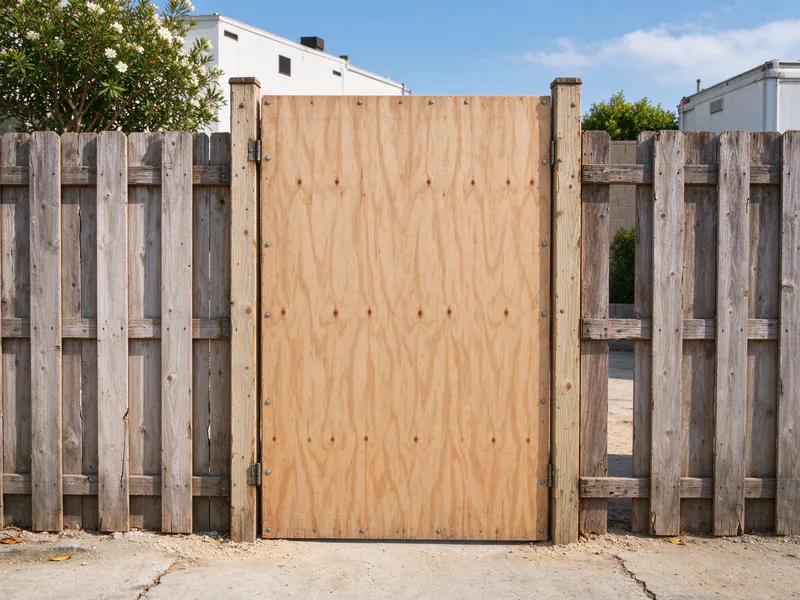
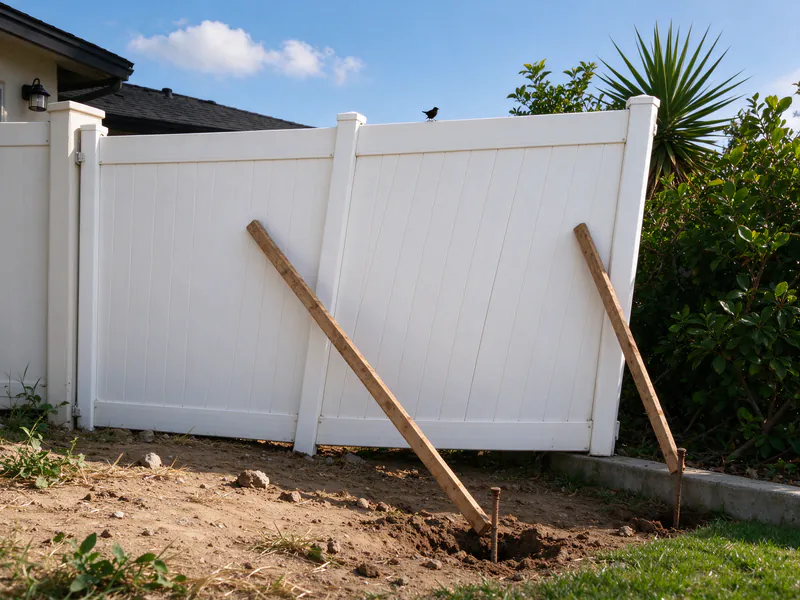
Temporary work has one goal: make the site safe and the yard closed until the fence can be rebuilt. Depending on what fell, that means bracing a leaning section so it cannot drop further, taking down sections that are cracked at the posts and cannot stand safely, clearing broken boards and nails off the lawn, and closing the gap with temporary panels, braces or construction fencing.
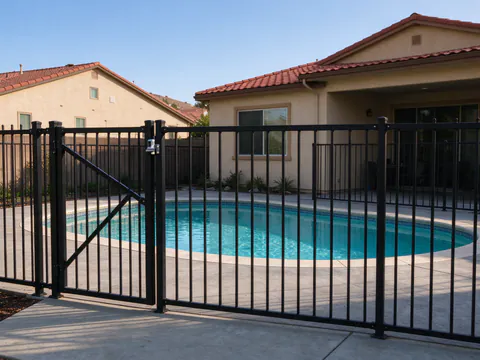
Temporary securing usually avoids digging. Government Code 4216.2 requires a DigAlert ticket at least two working days before excavation, and its exception for emergencies is meant for situations of imminent danger, which a fallen fence rarely is. So braces and temporary fencing are set on the surface and weighted, and the permanent post holes wait for the ticket. Where a pool enclosure has been breached, restoring a temporary barrier comes ahead of everything else, because Ontario’s Development Code requires pools and spas over 1.5 feet deep to be fully enclosed by a nonclimbable fence or wall at least 5 feet tall, and Health and Safety Code 115923 sets the gate and gap rules for that enclosure.
A fence down in the wind?
Call and describe what fell and what it protected. Pools, pets and blocked access are sorted out first.
The permanent repair: rebuilding so it stands next time
The permanent repair is where the real decisions are made, and they should not be rushed by the emergency. The first question is why the fence failed. If posts snapped at the concrete, they were probably rotted or termite-damaged at the ground line, and their neighbors along the run may be close behind. If whole footings rotated out of the ground, the footings were too small for the fence and the soil. If a tree or a car took out one section, the rest of the fence may be sound.
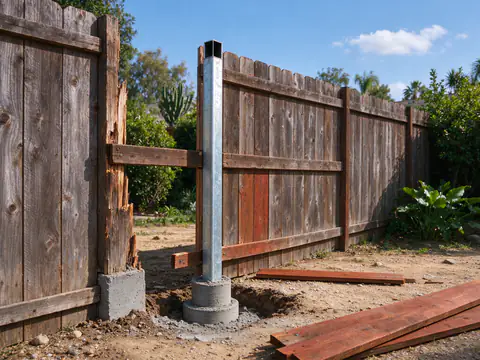
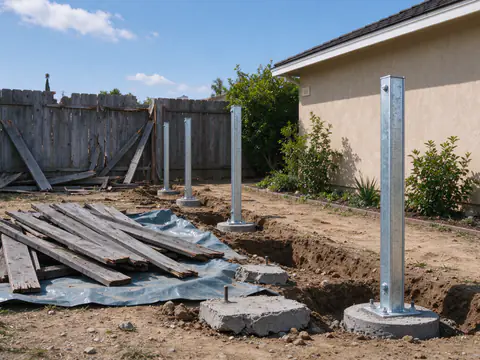
That diagnosis decides the scope. An isolated impact is a straightforward fence repair: new posts, rails and boards or panels in the damaged section. A wind failure that exposed weak posts all along the line points toward replacing the run, covered on the fence replacement page, and a rebuild is a natural time to consider galvanized steel posts, which cannot rot and flex less in a gust; the steel vs wood posts guide compares them. Footings are sized for the fence height, the post spacing and the soil, rather than matched to whatever failed. A gate that was wrenched off its hinges usually needs its hinge post checked and reset, as described on the gate installation page.
A permanent rebuild of a long run over 3 feet is checked against Ontario’s Building Permit FAQ, which requires a permit for wood, chain link and iron fences over that height. A pool barrier is rebuilt to the enclosure rules, covered on the pool fence page.
Insurance and documentation
Wind and impact damage often lead to a claim, so documentation is worth doing well from the start. Whether a homeowners policy covers a fence, and for how much after the deductible, depends on the policy wording and the cause of the damage. An estimate and a written description of the damage support a claim, but they are not a coverage decision; only the insurer decides what it pays.
Useful records include the photos taken before cleanup, the date and the wind event (National Weather Service warnings for the zone are public records), a description of what failed and why, and the repair estimate. For vehicle damage, the driver’s details, their insurance information and any police report matter most, since the driver’s auto policy is often the first place a claim goes. The wind damage insurance guide goes further into the claim process.
Shared fences after a storm
When a dividing fence falls, both neighbors are affected, and California Civil Code 841 presumes that adjoining owners share the reasonable cost of maintaining or replacing a dividing fence. The statute’s 30-day written notice is designed for planned work, so on an urgent rebuild the practical step is to talk early, agree in writing who pays what, and get legal advice if that agreement does not come. The good neighbor fence law guide explains what the notice contains.
What sets the cost of emergency work
Emergency work has no single price. Temporary securing depends on how much fell, how much has to be taken down or braced, how much debris has to go and how hard the site is to reach. The permanent repair is priced like any other repair or replacement: the number of posts and footings, old concrete to break out, the length of run rebuilt, the material and any gate work. The Ontario fence cost guide shows typical per-foot ranges for a rebuilt run, and the fence cost estimator turns a length and material into a budgeting range.