
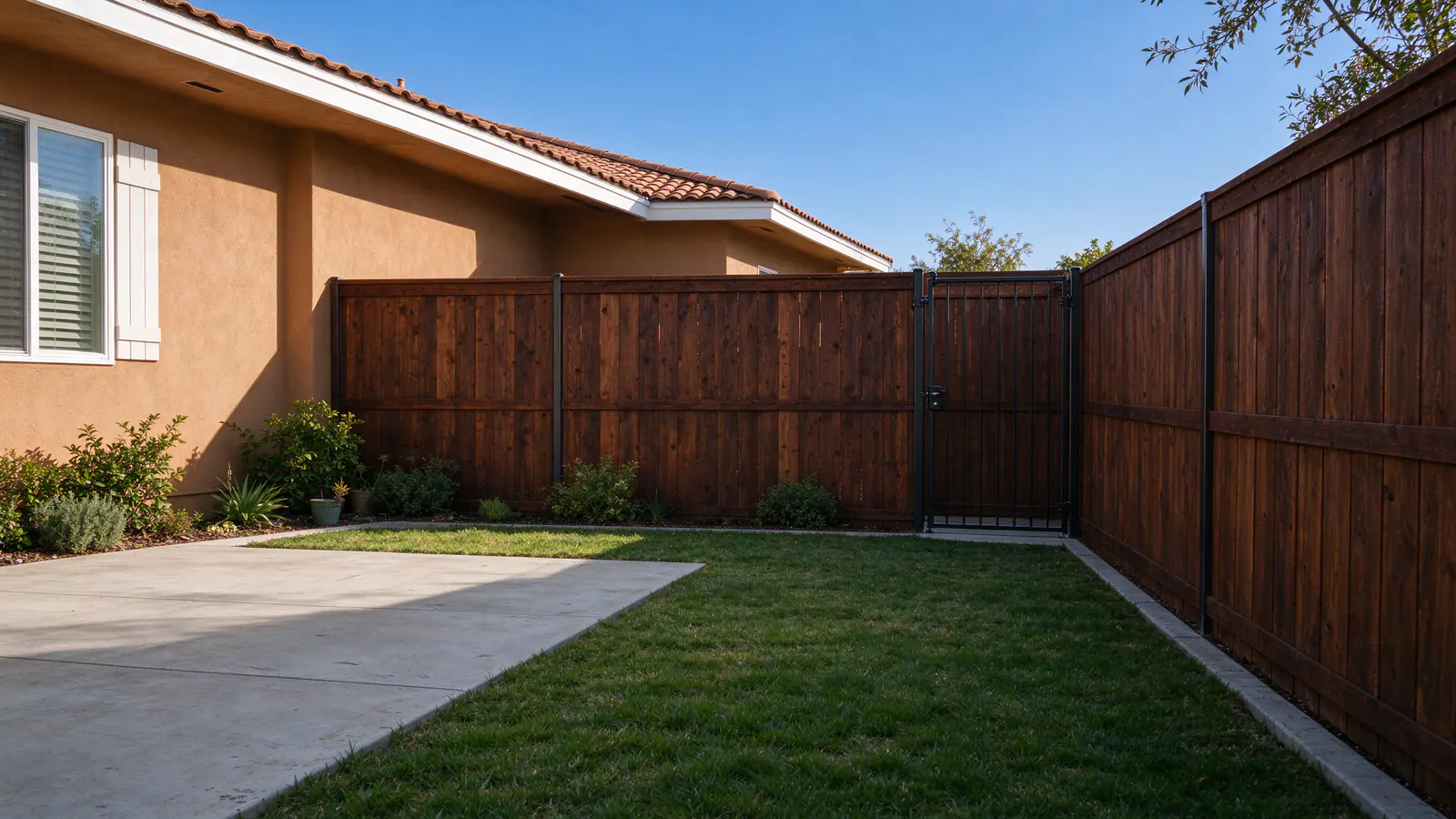
The best fence colors for a stucco house come from the house’s smaller details, not its walls. Stucco covers so much surface that a fence matched to it tends to look slightly off, since a vinyl panel or a stain almost never lands on exactly the same shade. Taking the fence color from the trim, the roof tile or the window frames, or going a shade or two darker than the stucco, reads as intentional.
Grove Ontario Fence Builders installs vinyl, wood and iron fences and gates for stucco homes across Ontario and the west Inland Empire, with the work carried out by licensed and insured fence contractors. Here is how color choices play out by material, and what inland sun does to them.
Read the house first
A typical stucco tract house pairs a body color, often a warm neutral such as tan, sand, beige or cream or a cooler white or gray, with trim in a contrasting shade and a concrete or clay tile roof. Before choosing, note four things: the stucco color and whether it leans warm (yellow, pink, red undertones) or cool (gray, blue); the trim and fascia color; the roof tile; and the window frames, which are often white, tan or bronze.
A warm house with a terracotta roof and bronze windows suits warm browns, tans and bronze. A cool gray or white house with a charcoal roof suits grays, black and crisp white. Mixing the two families is where combinations go wrong, such as a bright white fence against a cream house, where the two whites make each other look dingy.
Vinyl: limited colors, so choose carefully
Vinyl fences come in a short list of factory colors, commonly white, tan or almond, gray and a few wood-grain looks. The color runs through the material, so it does not peel, but it does not change either.
White is the most common vinyl color and the riskiest against stucco, because most stucco is not white. Against a tan or beige wall, a tan or almond fence usually blends better. Gray vinyl suits cooler houses. Wood-grain vinyl suits homes where an HOA asks for a wood look without real wood, as some Ontario Ranch specific plans do on perimeter fencing.
Darker vinyl colors absorb more heat. NOAA’s climate normals for Ontario International Airport show about 93 days a year at or above 90°F and 19 at or above 100°F, so a dark panel in full sun runs hot. Vinyl makers commonly caution against painting vinyl darker than its factory color for that reason. The vinyl vs wood fence guide covers the other tradeoffs.
Wood: stain, and the color it fades to
A wood privacy fence in redwood or cedar starts warm reddish or honey-toned and, left unfinished, weathers to silver-gray in the sun. That gray actually suits many cool stucco palettes, but it reads as unfinished against a warm tan house.
A semi-transparent stain keeps a warm tone and lets the grain show; a solid stain gives a uniform color closer to paint and hides variation between boards. Darker stains fade faster in strong ultraviolet light, so a rich brown may need refreshing sooner than a lighter cedar tone. The cedar vs redwood guide compares how the two species take stain, and the fence lifespan guide covers how finish upkeep affects life. A horizontal slat fence shows stain color across long boards, so it is worth testing a sample on the actual wood.
Iron and tubular steel: black is safe, bronze often better
Wrought iron and tubular steel fences and gates are usually black. Black works with almost any stucco because it reads as a line, not a surface. Against warm stucco with bronze window frames, though, dark bronze or dark brown often looks more considered. A powder-coated finish holds color better than field paint in strong sun.
Matching a side-yard gate to the window frames or the garage door is one of the simplest ways to tie a fence into a stucco house.
Block walls and toppers
Ontario’s Development Code requires new subdivisions to build decorative block walls, so many lots already have one. Where a fence or topper sits on a block wall, it has to work with the block’s color too. The block wall extension page covers the structure; for color, a topper that matches the wall cap or the house trim usually looks better than one that introduces a third shade.
HOA palettes come first
In a community with an association, the color decision may already be made. An association may publish an approved palette for fences and walls, and some specific plans name materials, such as wood-look or tubular steel perimeter fencing. Read the guidelines before choosing, and include a color sample or product sheet with the submittal; the HOA fence approval guide covers what to send. In Ontario Ranch, the specific plan for the tract is part of that review.
Remember the neighbor’s side
A shared fence shows its back to the house next door. A color that suits your stucco may not suit theirs, so it is worth a conversation, and a two-sided style removes the question of who gets the finished face. The post on talking to your neighbor about a new fence covers how to raise it.